Quantum walks on complex networks with connection instabilities and community structure
A continuous-time quantum walk is investigated on complex networks with the characteristic property of community structure, which is shared by most real-world networks. Motivated by the prospect of viable quantum networks, I focus on the effects of network instabilities in the form of broken links, and examine the response of the quantum walk to such failures. It is shown that the reconfiguration of the quantum walk is determined by the community structure of the network. In this context, quantum walks based on the adjacency and Laplacian matrices of the network are compared, and their responses to link failures is analyzed.
💡 Research Summary
The paper investigates continuous‑time quantum walks (CTQWs) on complex networks that exhibit community structure, focusing on how the walk responds to link failures—a form of network instability relevant for future quantum communication infrastructures. The author models an undirected, unweighted graph G(V,E) by its adjacency matrix A and Laplacian L, and defines the quantum walker’s state in an N‑dimensional Hilbert space spanned by basis vectors |j⟩ associated with each node. The primary evolution considered is the adjacency‑matrix‑driven walk, |Ψ(t)⟩ = e^{-iAt}|Ψ(0)⟩, with the initial state taken as the uniform superposition |Ψ(0)⟩ = (1/√N)∑_j |j⟩. The probability of finding the walker on node j at time t is P_j(t)=|⟨j|Ψ(t)⟩|², and its long‑time average ¯P_j = (1/T)∫_0^T P_j(t)dt is interpreted as the node’s “population”.
Numerical simulations on Zachary’s karate‑club (KC) network (N=34), the bottlenose‑dolphin network, and synthetic benchmark graphs reveal that ¯P_j correlates strongly with the degree centrality C_j of each node: highly connected hubs attract a larger share of the quantum walk’s probability mass. This baseline establishes that the CTQW naturally reflects structural importance.
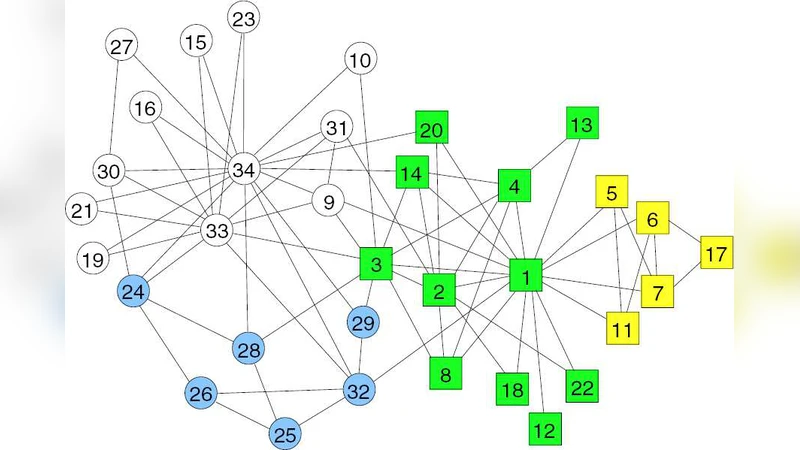
The core investigation introduces a single link removal (edge failure) and recomputes the long‑time populations. Two distinct regimes emerge. If the removed edge lies entirely within a community, the population of that community’s nodes decreases, while neighboring communities experience a rise in population. This is interpreted as the loss of internal pathways reducing the walker’s dwell time inside the community, prompting probability to leak outward. Conversely, when the removed edge bridges two distinct communities, the populations of the hub nodes in both communities increase. The bridge’s removal isolates the communities, causing the walker to remain longer within each subgraph. Representative cases on the KC network illustrate these patterns (edges (1,3), (19,33) inside communities, and edge (3,9) bridging communities).
To quantify the similarity of node responses, the author defines a node‑affinity measure α_{ij} = (1/K)∑{k=1}^K θ_i(k)θ_j(k), where θ_j(k)=+1 if node j gains population after removal of edge k, and –1 if it loses population. α{ij} ranges from –1 to +1; positive values indicate that nodes i and j react in the same direction to link failures, effectively capturing community membership. The affinity matrix computed for the KC network reproduces the known community partition with high fidelity, and similar behavior is observed in larger, more heterogeneous networks, albeit with reduced sharpness.
The paper then contrasts the adjacency‑based CTQW with a Laplacian‑based CTQW, |Ψ_L(t)⟩ = e^{iLt}|Ψ(0)⟩. Because the Laplacian’s smallest eigenvalue is zero and its corresponding eigenvector is the uniform state, the uniform initial condition is stationary under the Laplacian evolution; thus no dynamics are observed unless a localized initial state |j⟩ is used. With a localized start, the long‑time populations depend heavily on the chosen node and do not reflect degree centrality, demonstrating that the Laplacian walk is far less sensitive to the underlying community structure than the adjacency walk.
In summary, the study shows that CTQWs governed by the adjacency matrix encode the topological features of complex networks: node centrality determines baseline occupation, and community structure dictates how probability redistributes after link failures. The node‑affinity function provides a compact metric for predicting correlated node behavior under structural perturbations. These findings have practical implications for designing robust quantum communication networks, fault‑tolerant routing, and network‑wide monitoring schemes, where quantum walks could serve both as diagnostic tools and as functional components of quantum information protocols.
Comments & Academic Discussion
Loading comments...
Leave a Comment