Positive scalar curvature, K-area and essentialness
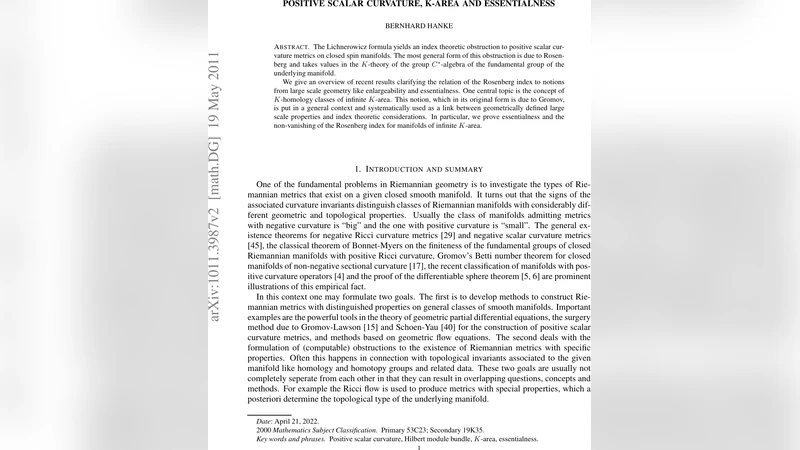
The Lichnerowicz formula yields an index theoretic obstruction to positive scalar curvature metrics on closed spin manifolds. The most general form of this obstruction is due to Rosenberg and takes values in the $K$-theory of the group $C^*$-algebra of the fundamental group of the underlying manifold. We give an overview of recent results clarifying the relation of the Rosenberg index to notions from large scale geometry like enlargeability and essentialness. One central topic is the concept of $K$-homology classes of infinite $K$-area. This notion, which in its original form is due to Gromov, is put in a general context and systematically used as a link between geometrically defined large scale properties and index theoretic considerations. In particular, we prove essentialness and the non-vanishing of the Rosenberg index for manifolds of infinite $K$-area.
💡 Research Summary
The paper surveys recent progress on the relationship between the Rosenberg index—an obstruction to positive scalar curvature (PSC) on closed spin manifolds—and large‑scale geometric notions such as enlargeability and essentialness. The Rosenberg index lives in the K‑theory of the group C*‑algebra C*π₁(M) of the fundamental group and generalises the classical Lichnerowicz‑Atiyah‑Singer obstruction. The authors place Gromov’s original concept of infinite K‑area into a modern K‑homology framework, defining “K‑homology classes of infinite K‑area”. A class of infinite K‑area is one that can be represented by vector bundles of arbitrarily large rank whose connections are arbitrarily close to flat (ε‑flat) for any ε>0.
The central result is that any closed spin manifold M carrying a K‑homology class of infinite K‑area is automatically essential (its fundamental class maps non‑trivially to the classifying space Bπ₁(M)) and, consequently, its Rosenberg index α(M)∈Kₙ(Cπ₁(M)) does not vanish. The proof proceeds by constructing, for each ε, an ε‑flat bundle of large rank whose K‑theoretic push‑forward yields a non‑trivial element in Kₙ(Cπ₁(M)). This element coincides with the Rosenberg index, showing α(M)≠0.
The paper also revisits enlargeability, a large‑scale geometric condition introduced by Gromov‑Lawson, and shows that enlargeable manifolds automatically admit infinite K‑area classes. Hence enlargeability implies essentialness and non‑vanishing of the Rosenberg index, providing a unified perspective on several previously known PSC obstructions.
Several concrete families of manifolds are examined. For manifolds whose fundamental groups are amenable, hyperbolic, or contain free subgroups, the authors demonstrate how to build the required ε‑flat bundles, thereby establishing infinite K‑area and the associated index obstruction without computing the Rosenberg index directly. This method recovers known results (e.g., the non‑existence of PSC on tori, enlargeable spin manifolds) and yields new examples where the Rosenberg index is forced to be non‑zero by geometric arguments alone.
In summary, the authors establish a clear triangle of implications:
Infinite K‑area ⇒ Essentialness ⇒ Non‑vanishing Rosenberg index.
This bridges large‑scale geometry, non‑commutative C*‑algebra K‑theory, and index theory, offering a powerful tool for detecting the impossibility of positive scalar curvature on a broad class of spin manifolds. The work suggests further avenues, such as extending the framework to manifolds with boundary, exploring connections with higher rho‑invariants, and applying the infinite K‑area viewpoint to other curvature‑related problems.
Comments & Academic Discussion
Loading comments...
Leave a Comment