Untangling planar graphs from a specified vertex position - Hard cases
Given a planar graph $G$, we consider drawings of $G$ in the plane where edges are represented by straight line segments (which possibly intersect). Such a drawing is specified by an injective embedding $\pi$ of the vertex set of $G$ into the plane. …
Authors: Mihyun Kang, Oleg Pikhurko, Alex
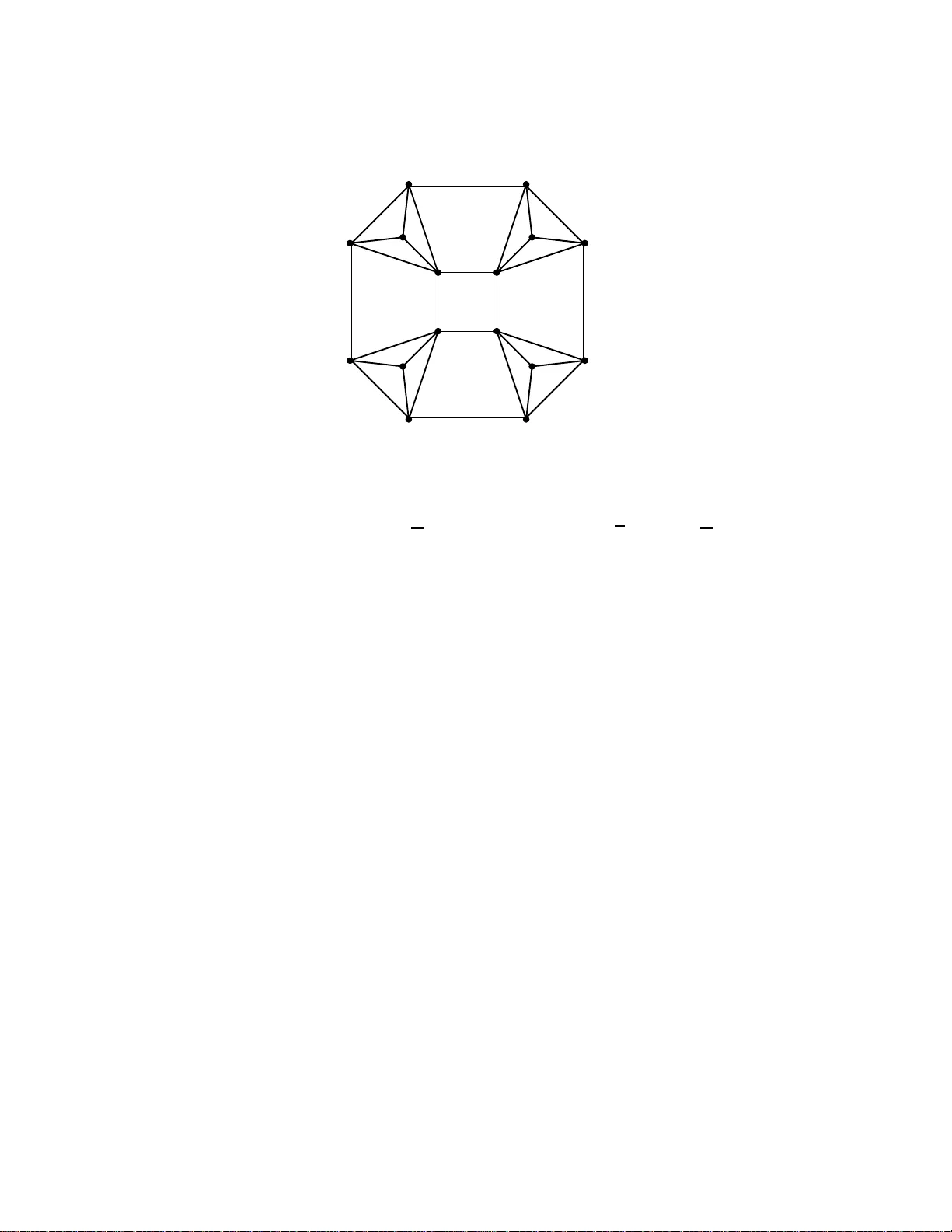
UNT ANGLING PLANAR GRAPH S FR OM A SPECIFIE D VER TE X POSITION — HARD CASES M. KANG, O. PIKHURKO ∗ , A. RA VSKY, M. SCHACH T, AND O. VERBITSKY † Abstract. Giv en a planar g raph G , we consider drawings of G in the pla ne where edges are repres ent ed by straight line segments (which p oss ibly intersect). Such a drawing is sp ecified by an injectiv e embedding π of the vertex set o f G int o the plane. Let fix ( G, π ) be the maxim um integer k suc h that there exists a c rossing- free redrawing π ′ of G which keeps k vertices fixed, i.e., there exist k vertices v 1 , . . . , v k of G such that π ( v i ) = π ′ ( v i ) for i = 1 , . . . , k . Given a set of po int s X , let fix X ( G ) denote the v alue of fix ( G , π ) minimized over π lo cating the vertices of G on X . The absolute minimum o f fix ( G, π ) is denoted by fix ( G ). F or the wheel g raph W n , we prov e that fix X ( W n ) ≤ (2 + o (1)) √ n for every X . With a somewhat worse constant factor this is a s well true for the fan graph F n . W e insp e ct also other g raphs for whic h it is known tha t fi x ( G ) = O ( √ n ). W e also show that the minimum v alue fi x ( G ) of the para meter fix X ( G ) is alwa ys attainable by a collinear X . 1. Intr oduction 1.1. The problem of untangli ng a planar graph. In a plane gr aph , each v ertex v is a p o in t in R 2 and eac h edge uv is represen ted a s a con tin uous plane curv e with endpoints u and v . All s uc h curv es are supposed to b e non-self-crossing and an y t w o of them eithe r ha v e no common point or share a common endv ertex. An underlying abstract gra ph of a plane graph is called plan a r . A planar graph can b e dra wn as a plane graph in man y w a ys, and the W agner-F´ ary-Stein theorem (see, e.g., [11]) states that there alwa ys exists a str aight line dr aw i n g in whic h ev ery edge is represen ted b y a straight line segmen t. Let V ( G ) denote the vertex set of a planar g raph G . In this pap er, by a d r awing of G w e mean an arbitrary injectiv e map π : V ( G ) → R 2 . W e supp o se that eac h edge u v of G is drawn a s t he straigh t line segmen t with e ndp oints π ( u ) and π ( v ). Due to p ossible edge crossings and eve n ov erlaps, π ma y not b e a plane dra wing of G . Hence it is na t ural to ask: Ho w many vertice s hav e to b e mov ed to obtain from π a plane (i.e., crossing-free) straigh t line drawing of G ? Alternativ ely , w e could allow in π curv ed edges without their exact sp ecification; suc h a draw ing could b e a lwa ys assumed to b e a plane graph. Then our task w ould b e to str aighten π rather than eliminate edge crossings. Date : 22 Nov ember 2010. ∗ Partially s upp or ted by the National Science F oundation throug h Gr a nt DMS-0758 057 and an Alexander von Hum b oldt fellowship. † Suppo rted by an Alexander von Hum b oldt retur n fellowship. 1 2 M. KANG , O. PIKHURKO, A . RA VSKY, M . SCHACHT, AND O. VERBITSKY More formally , for a planar graph G and a drawin g π , let fix ( G, π ) = max π ′ | { v ∈ V ( G ) : π ′ ( v ) = π ( v ) } | where the maxim um is tak en o v er all plane straight line drawings π ′ of G . F urther- more, let fix ( G ) = min π fix ( G, π ) . (1) In other words, fix ( G ) is the maxim um n um b er o f v ertices whic h can b e fixed in an y dra wing of G while untangling it. No efficien t algorithm determining the parameter fix ( G ) is kno wn. Moreo v er, computing fix ( G , π ) is known to b e NP-har d [8 , 18]. Impro ving a result of G oao c et al. [8], Bose et al. [5] sho w ed that fix ( G ) ≥ ( n/ 3 ) 1 / 4 for ev ery planar graph G , where here and in the rest of this pap er n denotes the n um b er of v ertices in the graph under conside ration. Be tter bounds on fix ( G ) are kno wn for cycles [12], t r ees [8, 5] and, more g enerally , outerplanar graphs [8, 14]. In all these cases it w as shown that fix ( G ) = Ω( n 1 / 2 ). F or cycles Cibulk a [6] pro ves a b etter low er b ound of Ω( n 2 / 3 ). Here we are in terested in upp er b ounds on fix ( G ), that is, in examples of graphs with small fi x ( G ). Moreov er, let X b e an arbitra ry set of n p oints in the plane and define fix X ( G ) = min π { fix ( G, π ) : π ( V ( G )) = X } . Note that fix ( G ) = min X fix X ( G ). This notation allows us to formalize another natural question. Can un tangling o f a graph b ecome easier if the set X of v ertex p ositions has some sp ecial prop erties (say , if it is kno wn that X is c o l line ar , i.e., lies on a line, or is in c onvex p osition , i.e., no x ∈ X lies in the con v ex h ull of X \ { x } )? This question admits sev eral v a riations: • F or whic h X can one a ttain equalit y fix X ( G ) = fix ( G )? • Are there gr a phs with fix X ( G ) small for a l l X ? • Are there graphs suc h that fix X ( G ) is f o r some X considerably la rger than fix ( G )? 1.2. Prior results. The cycle ( r esp. p ath ; empty gr aph ) on n v ertices will be de- noted b y C n (resp. P n ; E n ). Recall that the join of v ertex-disjoin t gr a phs G and H is the g raph G ∗ H consisting of the union of G and H and all edges b et w een V ( G ) and V ( H ). The gr aphs W n = C n − 1 ∗ E 1 (resp. F n = P n − 1 ∗ E 1 ; S n = E n − 1 ∗ E 1 ) ar e kno wn as whe els (resp. fans ; stars ). By k G w e denote the disjoin t union of k copies of a graph G . P ac h and T ardos [12] w ere first who established a principal fact: Some gra phs can be dra wn so that, in order to un tangle them, one has to shift almost all their v ertices. In fact, this is already true for cycles. More precisely , Pac h a nd T ardos [12] pro v ed that fix X ( C n ) = O (( n log n ) 2 / 3 ) for a n y X in con v ex p osition . (2) UNT ANGLING PLANAR GRAPHS — HARD CASES 3 The b est kno wn upp er b ounds are of the form fix ( G ) = O ( √ n ). Goa o c et al. [9] 1 sho w ed it for certain triangula tions. More sp ecifically , they pro v ed t hat fix X ( P n − 2 ∗ P 2 ) < √ n + 2 for any collinear X . (3) Shortly a fter [9] and independen tly of it , there app eared our man uscript [10 ], whic h w as actually a starting p oin t of the curren t pap er. F or infinitely many n , w e constructed a f amily H n of 3- connected planar graphs on n v ertices with max H ∈H n fix ( H ) = o ( n ). Though no e xplicit b ound w a s sp ecified in [10], a simple analysis of o ur construction rev eals that fix X ( H n ) ≤ 2 √ n + 1 for a n y X in con v ex p osition , (4) where H n denotes an arbitrary member of H n . While the graphs in H n are not as simple as P n − 2 ∗ P 2 and t he subseque n t examples in the literat ure, the construction of H n has the adv an tage that this class contains gr a phs with certain sp ecial prop erties, suc h as b ounded v ertex degrees. By a la t er result of Cibulk a [6], w e hav e fi x ( G ) = O ( √ n (log n ) 3 / 2 ) for ev ery G with maxim um degree and diameter b ounded b y a logarithmic function. Note in this respect tha t H n con tains graphs with b ounded maxim um degree that ha v e diameter Ω( √ n ). In subsequen t pap ers [16, 5] examples of graphs with small fix ( G ) w ere found in sp ecial classes o f planar graphs, suc h as outerplanar and ev en acyclic graphs. Spillner and W olff [16] show ed for the fa n graph that fix X ( F n ) < 2 √ n + 1 for a n y collinear X (5) and Bose et al. [5] established for the star forest with n = k 2 v ertices that fix X ( k S k ) ≤ 3 √ n − 3 fo r an y collinear X . (6) Finally , Cibulk a [6] prov ed that fix X ( G ) = O (( n log n ) 2 / 3 ) for any X in con v ex p osition for all 3-connected planar graphs. 1.3. Our present contribution. In Section 2 w e notice that the c hoice of a collinear v ertex p osition in (3), (5) , and (6) is actually optimal fo r pro ving upp er b ounds o n fix ( G ) . Sp ecifically , w e sho w that for any G the equalit y fix X ( G ) = fix ( G ) is attained by some collinear X (see Theorem 2.1). In Section 3 w e extend the bo und fix ( G ) = O ( √ n ) in the strongest wa y with resp ect to sp ecification of vertex p ositions. W e prov e tha t fix X ( W n ) ≤ (2 + o (1)) √ n for ev ery X , (7) fix X ( F n ) ≤ (2 √ 2 + o (1)) √ n for ev ery X (8) (see Theorem 3.5). Let us define FIX ( G ) = max X fix X ( G ) 1 The conference presentations [9] and [16] were subsequen tly combined in to the journal pap er [8]. 4 M. KANG , O. PIKHURKO, A . RA VSKY, M . SCHACHT, AND O. VERBITSKY Figure 1. Ex ample of a g r a ph in H 16 . (while fix ( G ) = min X fix X ( G )). With this notation, (7 ) and (8) read FIX ( W n ) ≤ (2 + o (1)) √ n and FIX ( F n ) ≤ (2 √ 2 + o ( 1 )) √ n. In Section 4 w e discuss an appro a c h attempting to give an analog of (7) for the aforemen tioned family of graphs H n . A mem ber of this f a mily is define d as a plane graph of the follo wing kind. Let k ≥ 3 and n = k 2 . Draw k triangulations, eac h ha ving k v ertices, so that none of the m lies inside an inner face of an y other triangulation. Connect these t riangulations b y some more edges making the whole graph 3- connected. H n is the set o f all 3-connected planar graphs obtainable in this w a y . This set is not empty . Indee d, we can allo cate the k triangulations in a cyclic order and connect eac h neighboring pair b y tw o v ertex-disjoin t edges as sho wn in Fig. 1. Note that k new edges form a cycle C k and the other k new edges participate in a cycle C 2 k . If w e remov e an y t w o v ertices from the obtained graph, eac h tr iangulation a s w ell a s the whole “cycle” sta y connected (since the aforemen tioned cycles C k and C 2 k are v ertex-disjoin t, at most one of them can get disconnected). Note that, if w e start with triangulations with b ounded ve rtex degrees, the ab ov e construction giv es us a graph with b ounded maxim um degree. In this situation our argumen t for ( 7 ) do es not w ork. W e hence undertak e a differen t approac h. Giv en a set of colored p oin ts in the plane, w e call it cluster e d if its mono chromatic parts ha v e pairwise disjoin t con v ex h ulls. Giv en a set X of n = k 2 p oin ts, let C ( X ) denote the maxim um cardinality of a clustered subset existing in X under a ny balanced coloring of X in k colors (see D efinition 4.1). It is not hard to sh ow (see Lemma 4.2) that fix X ( H n ) ≤ C ( X ) + k , (9) where H n denotes an arbitrary graph in H n . W e prov e that C ( X ) = O ( n/ log n ) f or ev ery X , whic h implies that FIX ( H n ) = O ( n/ log n ) (Theorem 4.4). Better upp er b ounds f or C ( X ) would give us b etter upp er b ounds fo r FI X ( H n ). Note that C ( X ) has relev a nce also to the star forest k S k , namely fix X ( k S k ) ≥ C ( X ) − k (10) UNT ANGLING PLANAR GRAPHS — HARD CASES 5 (see part 2 of L emma 4.2). Th us, if there we re a set X with C ( X ) ≫ k , the parameter FI X ( k S k ) w ould b e far apa r t from fix ( k S k ). As we do not kno w ho w close or far aw ay the parameters fix ( G ) and F I X ( G ) are for G = H n and G = k S k , the t w o graph families deserv e further at t en tion. Section 5 is dev oted to estimation of fix X ( G ) f o r X in we akly c onvex p osition , which means that the p oints in X lie on the b oundary of a con vex b o dy (including the cases that X is in con v ex p o sition and that X is a colline ar set). Since C ( X ) < 2 k for an y X in w eakly con v ex p osition, by (9) w e obta in fix X ( H n ) < 3 √ n for such X (Theorem 5.2). This result for H n together with the stronger results obtained fo r W n and F n in Section 3 migh t suggest that fix X ( G ) = O ( fix ( G )) should hold for any G whenev er X is in w eakly con v ex p o sition. The simplest case where w e are not able t o confirm this conjecture is G = k S k . By (9) and (10) we ha v e fix X ( H n ) ≤ fix X ( k S k ) + 2 k for an y k and n = k 2 , and b ounding fix X ( k S k ) from ab o v e seems harder. Nev er- theless, ev en here w e hav e a rather tight b ound: If X is in weakly con v ex p osition, then fix X ( k S k ) = O ( √ n 2 α ( √ n ) ), where α ( · ) denotes the in v erse Ac k ermann function (Theorem 5.4). W e conclude with a list of op en questions in Section 6. 2. Hardness of unt angling fro m a collinear position Theorem 2.1. F or every planar gr aph G we have fix ( G ) = fi x X ( G ) for some c ol lin e ar X . Theorem 2.1 can b e deduced from [5, Lemma 1]. F or the reader’s con venie nce, w e giv e a self-con tained pro of. Pr o of. L et fix − ( G ) denote the minim um v alue of fix X ( G ) ov er collinear X . W e ha v e fix ( G ) ≤ fi x − ( G ) b y definition. The theorem actually states the conv erse inequalit y fix ( G ) ≥ fix − ( G ). That is, giv en a n arbitrary dr awing π : V ( G ) → R 2 , w e hav e to sho w that it can b e untangled while k eeping at least fi x − ( G ) v ertices fixed. Cho ose Cartesian co ordinates in the plane so that π ( V ( G )) is lo cated b et w een the lines y = 0 and y = 1 . Let p x , p y : R 2 → R denote the pro jections on to the x -axis and the y -axis, resp ectiv ely . W e also sup p ose that the axes are c hosen so that the map λ = p x π is injectiv e. Let us view λ as a drawing of G , a ligning all the v ertices on the line y = 0. By definition, there is a plane drawing λ ′ of G suc h that the set of fixed vertice s F = { v ∈ V ( G ) : λ ′ ( v ) = λ ( v ) } has cardinality at least fix − ( G ). Giv en a set A ⊂ R 2 and a r eal ε > 0, let N ε ( A ) denote the ε -neigh b orho o d o f A in the Euclidean metric. F or eac h pair of disjoin t edges e, e ′ in λ ′ , there is an ε suc h that N ε ( e ) ∩ N ε ( e ′ ) = ∅ . Since G is finite, we can assume that t he latter is true with the same ε fo r all disjoint pairs e, e ′ . W e now define a drawing π ′ : V ( G ) → R 2 b y setting π ′ ( v ) = ( ( p x π ( v ) , εp y π ( v )) if v ∈ F , λ ′ ( v ) otherwise . Note that π ′ ( v ) ∈ N ε ( λ ′ ( v )) for ev ery v ∈ V ( G ) . Since λ ′ is crossing-free, so is π ′ . 6 M. KANG , O. PIKHURKO, A . RA VSKY, M . SCHACHT, AND O. VERBITSKY Finally , define a linear transformatio n o f the plane b y a ( x, y ) = ( x, ε − 1 y ) and consider π ′′ = aπ ′ . Clearly , π ′′ is a plane draw ing of G and all v ertices in F sta y fixed under the transition from π to π ′′ . 3. Hardness of unt angling fro m ever y ver tex position In Section 3 .1 we state know n results on the longest monotone subsequen ces in a random p ermutation. These results are used in Section 3.2 for pro ving upp er b ounds on FIX ( W n ) and FI X ( F n ). 3.1. Monotone subsequences in a random p erm utation. By a p ermutation of [ N ] = { 1 , 2 , . . . , N } w e will mean a sequence S = s 1 s 2 . . . s N where eac h p ositive in teger i ≤ N o ccurs once (that is, S determines a one-to-one map S : [ N ] → [ N ] b y S ( i ) = s i ). A subsequence s i 1 s i 2 . . . s i k , where i 1 < i 2 < . . . < i k , is incr e asing if s i 1 < s i 2 < · · · < s i k . The length of a longest increasing subs equence of S will b e denoted b y ℓ ( S ). Lemma 3.1. L et S N b e a uniform l y r and om p ermutation of { 1 , 2 , . . . , N } . 1. (Pilp el [1 3] ) E [ ℓ ( S N )] ≤ P N i =1 1 / √ i ≤ 2 √ N − 1 . 2. (F ri eze [7] , Bol lob´ as-Brightwel l [4] ) F or any r e al ǫ > 0 ther e is a β = β ( ǫ ) > 0 such that for al l N ≥ N ( ǫ ) we have P ℓ ( S N ) ≥ E [ ℓ ( S N )] + N 1 / 4+ ǫ ≤ exp − N β . F urther concen tration results for ℓ ( S N ) are obtained in [17, 3]. Lemma 3.1 sho ws t hat ℓ ( S N ) ≤ 2 N 1 / 2 (1 + N − 1 / 4+ ǫ ) with probabilit y a t least 1 − exp − N β . W e will a lso need a bound for another parameter of S N , roughly sp eaking, for the maxim um total length of t w o non-in terw ea ving mo no tone sub- sequence s of S N . Let us define this pa rameter more precisely . A subseque nce of a p erm utation S will b e called mono tone if it can b e made increasing b y shifting and/or reve rsing (as, for example, 21543). This notion is rather na t ural if w e regard S as a cir cular p ermutation , i.e., S is considered up to shifts. Call tw o subsequences S ′ and S ′′ of S non-interwe aving if they ha v e no common elemen t and S ha s no sub- sequence s i 1 s i 2 s i 3 s i 4 with s i 1 , s i 3 o ccurring in S ′ and s i 2 , s i 4 in S ′′ . Define ℓ 2 ( S ) to b e the sum of the lengths of S ′ and S ′′ maximized o v er non-in terw ea ving monoto ne subseque nces of S . Lemma 3.2. L et S N b e a uniformly r andom p ermutation of { 1 , 2 , . . . , N } . F or an y r e al ǫ > 0 ther e i s a γ = γ ( ǫ ) > 0 such t hat for a l l N ≥ N ( ǫ ) w e have P h ℓ 2 ( S N ) ≥ 2 √ 2 N 1 / 2 + 2 N 1 / 4+ ǫ i ≤ exp ( − N γ ) . (11) Pr o of. G iv en a sequenc e S N = s 1 s 2 . . . s N and a pair of indices 1 ≤ i < j ≤ N , consider the splitting of the circular ve rsion of S N in to tw o parts P 1 = s i . . . s j − 1 and P 2 = s j . . . s N s 1 . . . s i − 1 . Let P ′ 1 = s j − 1 . . . s i and P ′ 2 = s i − 1 . . . s 1 s N . . . s j b e the rev erses of P 1 and P 2 . Denote λ ij = max { ℓ ( P 1 ) , ℓ ( P ′ 1 ) } + max { ℓ ( P 2 ) , ℓ ( P ′ 2 ) } . UNT ANGLING PLANAR GRAPHS — HARD CASES 7 Note that ℓ 2 ( S N ) = λ ij for some pa ir i, j . Since the re are only polynomially man y suc h pairs, it suffices to show for eac h i, j that the inequalit y λ ij ≥ 2 √ 2 N 1 / 2 + 2 N 1 / 4+ ǫ (12) holds with an exp onen tially small probabilit y . Denote the length of P k b y N k , so that N 1 + N 2 = N . F or eac h k = 1 , 2, no te that b ot h ℓ ( P k ) and ℓ ( P ′ k ) are distributed iden tically to ℓ ( S N k ). Supp ose first that N 1 or N 2 is relativ ely small, sa y , N 1 ≤ 2( √ 2 − 1) √ N . Then (12) implies t ha t ℓ ( P 2 ) ≥ 2 N 1 / 2 2 + 2 N 1 / 4+ ǫ 2 or this estimate is true for P ′ 2 . Pro vided N , and hence N 2 , is larg e enough, w e conclude by Lemma 3.1 that (12) happ ens with probability at most 2 exp( − N β 2 ) ≤ 2 exp( − 1 2 N β ). Supp ose now that N k > 2( √ 2 − 1) √ N for b o th k = 1 , 2 and that N is large enough. Since N 1 / 2 1 + N 1 / 2 2 ≤ 2 N 1 + N 2 2 1 / 2 = √ 2 N 1 / 2 , the inequalit y (12) entails that for k = 1 or k = 2 w e mus t ha v e ℓ ( P k ) > 2 N 1 / 2 k + N 1 / 4+ ǫ k or this estimate m ust b e true fo r P ′ k . By Lemma 3.1, the ev en t (12) happ ens with probabilit y no more than 4 exp − c β N β / 2 , where c = 2( √ 2 − 1). W e see that, whatev er N 1 and N 2 are, (11) holds for an y positiv e γ < β / 2 and large enough N . 3.2. Graphs with small FIX ( G ) . Recall that FIX ( G ) = max X fix X ( G ). If FIX ( G ) is small, t his means that no special prop erties o f the set of v ertex lo cat io ns can mak e the un tangling problem for G easy . Lemma 3.3. F or a n y 3-c onne c te d planar gr aph G on n vertic es w ith maximum vertex de gr e e N = n − o ( √ n ) we have FIX ( G ) ≤ (2 + o (1)) √ n. Pr o of. W e ha v e t o prov e that fix X ( G ) ≤ ( 2 + o (1) ) √ n for any set X of n p oin ts. Let X = { x 1 , . . . , x n } and denote X N = { x 1 , . . . , x N } . Giv en a p o in t p in the plane, w e define a p erm utation S p describing the order in whic h the p oin ts in X N are visible from the standp oint p . If p = x s with s ≤ N , w e tak e p as the first visible point, that is, let s b e the firs t index in the sequence S p . No w, we look around starting from the nort h in a clo c kwise direction and put i b efore j in S p if w e see x i earlier than x j . The “north” direction o n the plane can b e fixed arbitrarily . If x i and x j lie in t he same direction fr om p , w e see the nearer p oin t first, that is, i precede s i in S p whenev er x i ∈ [ p, x j ]. Define an equiv a lence relations ≡ so that S ≡ S ′ if S and S ′ are obtainable fro m one another b y a shift. Let us sho w that the quotien t set Q = { S p : p ∈ R 2 } / ≡ is finite and estimate its cardinality . Su pp ose first tha t not a ll p oints in X N are collinear. Let L b e the set of lines passing through at least tw o p oints in X N . After remo v al of all lines in L , the plane is split in to connected comp onents that will be called L -fa c es . Any inters ection p oin t of tw o lines will be called a n L -vertex . The 8 M. KANG , O. PIKHURKO, A . RA VSKY, M . SCHACHT, AND O. VERBITSKY L -v ertices lying on a line in L split this line into L -e dges . Exactly t wo L -edges for eac h line are un b ounded. It is easy to see that S p ≡ S p ′ whenev er p and p ′ b elong to the same L -fa ce or the same L -edge. It follows that | Q | do es not excee d the total amoun t of L - faces, L -edges, and L -v ertices. Let us express this b ound in terms of l = | L | ≤ N 2 . If w e erase all the unbounded L -edges, w e obtain a crossing-free straight line drawing of a planar graph with a t most l 2 v ertices. It ha s less t ha n 3 2 l 2 − 3 2 l edges and l 2 − l faces. Restoring the un b ounded L -edges, w e see that the t otal n umber of L -edges is less than 3 2 l 2 + 1 2 l and the num b er of L -faces is less tha n l 2 + l . Therefore, | Q | < ( l 2 + l ) + 3 2 l 2 + 1 2 l + 1 2 l 2 − 1 2 l < 3 4 N 4 . In the muc h simpler case o f a collinear X N , w e hav e | Q | ≤ N . Let c b e a ve rtex of G with maxim um vertex degree. By the Whitney theorem on em b eddabilit y of 3-connected g raphs, the neighbors of c a pp ear around c in t he same circular order v 1 , . . . , v N in any plane drawing of G . Pic k up a random p ermutation σ of { 1 , . . . , N } and consider a dra wing π : V ( G ) → X suc h that π ( v i ) = x σ ( i ) . Let π ′ b e an un tanglemen t of π . Let p = π ′ ( c ) and den ote the set of all s hifts a nd rev erses of the p erm utation S p b y S p . W e ha v e to estimate the n um b er of vertic es remaining fixed under the transition from π to π ′ , that is, the cardinalit y of the set F = { π ( v ) : v ∈ V ( G ) , π ( v ) = π ′ ( v ) } . Let F ∗ = { π ( v i ) ∈ F : i ≤ N } , whic h is the subset of F corresp onding to the fixed neigh b ors of c . Note that | F \ F ∗ | ≤ n − N and recall that n − N = o ( √ n ) by our assumption. It f o llo ws that | F | ≤ | F ∗ | + o ( √ n ), and w e ha v e to estimate | F ∗ | . The p oin ts in F ∗ go around p in the canonical Whitney or der. T his means that the indices of the corresp onding v ertices form an increasing subse quence in σ − 1 S fo r some S ∈ S p . F or eac h S , the comp osition σ − 1 S is a random p erm u- tation of { 1 , . . . , N } . Recall that , irresp ectiv ely of the c hoice of p = π ′ ( c ), there are at most 2 N | Q | < 3 2 N 5 p ossibilities for S . By Lemma 3.1, ev ery increasing subseque nce of σ − 1 S has length at most 2 N 1 / 2 + N 1 / 4+ ǫ with probabilit y at least 1 − O ( N 5 exp − N β ). Th us, if N is sufficien tly large, we ha v e | F ∗ | ≤ (2 + o (1)) √ n for all un tang lemen ts π ′ of some dra wing π ( in fact, t his is true f or almost all π ). This implies the required b o und | F | ≤ (2 + o (1 )) √ n . While Lemma 3.3 immediately giv es us a b ound on FIX ( W n ) f o r the wheel gra ph, this lemma do es not apply directly to the fan graph F n b ecause it is not 3- connected and has a num b er of essen tially differen t plane dra wings. Nev ertheless, all these dra wings are still ra ther structured, whic h mak es analysis of the fan graph only a bit more complicated. Indeed, denote the cen tra l verte x of F n b y c and let v 1 . . . v n − 1 b e the path of the other v ertices. Let α b e a plane drawing of F n . Lab el eac h edge α ( c ) α ( v i ) with n um b er i and denote the circular sequence in whic h the lab els fo llow eac h other around α ( c ) by R α . Split R α in to t w o pieces. Let R ′ α b e the sequence of lab els starting with 1, e nding with n − 1, and con taining all interme diate lab els if w e go around α ( c ) clo c kwise. Let R ′′ α b e the coun ter-clo ckw ise analog of R ′ α . Note that R ′ α and R ′′ α o v erlap in { 1 , n − 1 } . UNT ANGLING PLANAR GRAPHS — HARD CASES 9 Lemma 3.4. Both R ′ α and R ′′ α ar e monotone. Pr o of. W e pro ceed b y induction on n . The base case of n = 3 is obv ious. Suppo se that the c laim is tr ue for all plane drawin gs of F n and consider an arbitrary pla ne dra wing α of F n +1 . Let β b e obtained fro m α b y erasing α ( v n ) along with the inciden t edges. Obv iously , β is a plane dra wing of F n . In the drawing α of F n +1 , w e consider the triangle T with v ertices α ( c ), α ( v n − 1 ), and α ( v n ). Clearly , all p oints α ( v i ) for i ≤ n − 2 ar e inside T or a ll of them a re outside. In b o th cases, n − 1 and n a re neigh b ors in R α . Therefore, R α is obta inable from R β b y inserting n on the one or the o t her side next to n − 1. It follo ws t ha t R ′ α is obtained from R ′ β either b y app ending n after n − 1 or by replacing n − 1 with n (the same concerns R ′′ α and R ′′ β ). It remains to note that b o th op erations preserv e monotonicit y . W e are now prepared to o btain upp er b ounds o n FIX ( G ) for the wheel graph W n and the fan gra ph F n . Not e that, up to a small constant factor , these b ounds matc h the low er bound fi x ( F n ) ≥ fix ( W n ) ≥ √ n − 2 (whic h f o llo ws, e.g., from [14, Theorem 4.1]). Theorem 3.5. 1. FIX ( W n ) ≤ (2 + o (1) ) √ n . 2. FIX ( F n ) ≤ (2 √ 2 + o (1)) √ n . Pr o of. The b ound for W n follo ws directly from Lemma 3 .3 as observ ed b efore. As for F n , notice tha t the argumen t of Lemma 3.3 b ecomes applicable if, in place of the Whitney theorem, we use Lemma 3.4. Let π b e a random lo cation of V ( F n ) on X , as in the pro of of Lemma 3.3. More precisely , let v 1 . . . v n − 1 denote the path of non-cen tral vertice s in F n . W e pic k a ra ndo m p erm utation σ of { 1 , . . . , n − 1 } and set π ( v i ) = x σ ( i ) . As established in the pro of of Lemma 3 .3, the set X determines a set of p erm utations S X with | S X | = O ( n 4 ) suc h that, from any standp oin t p in the plane, the ve rtices v 1 , . . . , v n − 1 are visible in the circular order τ p = σ − 1 S for some S ∈ S X . Let α b e an y un tangling of π a nd R α b e the asso ciated o rder on the neigh b orho o d of the cen tral v ertex α ( c ). By Lemma 3.4, R α consists of tw o monotone parts R ′ α and R ′′ α . The s et F of fix ed ve rtices is correspo ndingly split in to F ′ and F ′′ . Since R ′ α and R ′′ α o v erlap in t w o elemen ts, F ′ and F ′′ can ha v e o ne or t w o common ve rtices. If this happens, w e remo v e those from F ′′ . Notice that the indices of the v ertices in F ′ and in F ′′ form non-in terw ea ving monotone subsequences of τ α ( c ) . Therefore, | F ′ | + | F ′′ | ≤ ℓ 2 ( τ α ( c ) ) and part 2 of the theorem follow s from Lemma 3.2. 4. Making convex hulls disjoint In Section 1.2 w e listed the few g r a phs for whic h an upp er b ound fix ( G ) = O ( √ n ) is kno wn, na mely P n − 2 ∗ P 2 , F n , H n ∈ H n , and k S k . By Theorem 3.5 in the fo rmer t w o cases w e hav e a stronger result F IX ( G ) = O ( √ n ) (note that P n − 2 ∗ P 2 con tains W n as a subgraph). W e no w consider a problem related to estimating the parameters FIX ( H n ) and FI X ( k S k ). 10 M. KANG , O. PIKHURKO, A . RA VSKY, M . SCHACHT, AND O. VERBITSKY Definition 4.1. Let n = k 2 and X b e an n -p oin t set in the plane. Giv en a partition X = X 1 ∪ . . . ∪ X k , w e rega r d X = { X 1 , . . . , X k } as a coloring of X in k colors. W e will consider only b alanc e d X with eac h | X i | = k . Call a set Y ⊆ X cluster e d if the mono chromatic classes Y i = Y ∩ X i ha v e pa irwise dis joint con v ex h ulls. Let C ( X , X ) denote the larg est size o f a clustered subset of X . Finally , define C ( X ) = min X C ( X , X ). Lemma 4.2. L et H n denote an arbitr ary gr a p h in H n . 1. fix X ( H n ) ≤ C ( X ) + k . 2. fix X ( k S k ) ≥ C ( X ) − k . Pr o of. 1 . Recall that H n is defined as a plane graph whose vertex set V ( H n ) = V 1 ∪ . . . ∪ V k is partitioned so t ha t eac h V i spans a triangulatio n a nd these k tr ia ngulations are in the outer faces of each other. T ake X suc h that C ( X , X ) = C ( X ) and π : V ( H n ) → X s uc h that π ( V i ) = X i . Consider an un tanglemen t π ′ of π and denote the set of fixed v ertex lo cations b y Y . By the Whitney theorem, π ′ is obtainable from the plane graph H n b y a homeomorphism of the pla ne, p ossibly af t er turning some inner face of H n in to the outer face. Since V i spans a t r iangulation in H n , the conv ex hull of π ′ ( V i ) is a triangle T i . Since the corresp onding triangulations are pairwise disjoin t in H n , the triangles T i ’s are pairwise disjoin t p ossibly with a single exception for some T s con taining a ll the ot her triangles. Let Y i = Y ∩ X i . It fo llo ws that t he con v ex h ulls of the Y i ’s do not in tersect, p erhaps with an exception fo r a single set Y s . The excep tion ma y o ccur if π ′ is homeomorphic t o a v ersion of H n with differen t outer f ace. Therefore, | Y | ≤ C ( X ) + k , where t he term k corresp onds to the exceptional Y s . 2. Giv en an arbitra ry dra wing π : V ( k S k ) → X o f the star fo rest, w e ha v e to un tangle it while k eeping at least C ( X ) − k ve rtices fixed. Let V ( k S k ) = V 1 ∪ . . . ∪ V k where eac h V i is the v ertex set of a star comp o nent. Define a coloring X of X b y X i = π ( V i ). Let Y b e a largest clustered subset of X . Cho ose pairwise disjoin t op en con v ex sets C 1 , . . . , C k so that C i con tains Y i = Y ∩ X i for all i . Redra w k S k so t ha t, for eac h i , the i -th star comp onen t is con tained in C i . It is clear that, doing so, w e can lea v e all no n-cen tral v ertices in Y fixed. Thu s, w e hav e at least | Y | − k ≥ C ( X ) − k fixed v ertices. Lemma 4.3. F or any set X of n = k 2 p oints in the plane , we have C ( X ) = O ( n/ log n ) . Pr o of. L et B( X ) denote the set of a ll balanced k -colorings of X , i.e., the set of partitions X = X 1 ∪ . . . ∪ X k with eac h | X i | = k . W e ha v e | B( X ) | = n ! / ( k !) k . Call a k -tuple of subsets Z 1 , . . . , Z k ⊂ X a cr ossing-fr e e c oloring of X if the Z i ’s ha v e pairwise disjoin t con v ex hulls . W e do not exclude that some Z i ’s are empty and the coloring is partial, i.e., S k i =1 Z i ( X . Denote the set of all crossing-free colorings of X b y F( X ). Let X ∈ B( X ). An estimate C ( X , X ) ≥ a means that k X i =1 | X i ∩ Z i | ≥ a (13) UNT ANGLING PLANAR GRAPHS — HARD CASES 11 for s ome Z ∈ F( X ). Regard X and Z as elemen ts of the space { 1 , . . . , k , k + 1 } X of ( k + 1)- colorings of X , whe re the new color k + 1 is assigned to the p oints that are uncolored in Z . Then (13 ) means that the Hamming distance b et w een X a nd Z do es not exceed n − a . Note that the ( n − a )-neigh b orho o d o f Z can contain no more than n n − a k n − a elemen ts of B( X ). Therefore, an estimate C ( X ) < a w ould follo w fro m inequality | F( X ) | n a k n − a < | B( X ) | . (14) Giv en a partition Z = P 1 ∪ . . . ∪ P m of a p oin t set Z , w e call it cr ossing -fr e e if the con v ex hulls of the P i ’s are nonempt y and pairwise disjoin t. According to Sharir and W elzl [15, Theorem 5.2], the ov erall n um ber of crossing-free par titions of any l -p oint set Z is at mo st O (12 . 24 l ). In order t o derive from here a b ound for the n um b er of crossing-free c olorings , with eac h coloring ( Z 1 , . . . , Z k ) we asso ciate a partition ( P 1 , . . . , P m ) of the union Z = S k i =1 Z i so that ( P 1 , . . . , P m ) is the result of remo ving all empty sets from the sequence ( Z 1 , . . . , Z k ). Since ( P 1 , . . . , P m ) is the crossing-free partition of a subset of X , the Sharir-W elzl b ound implies that the n um b er of all p ossible partitions ( P 1 , . . . , P m ) o bt a inable in this w a y do es not exceed O (24 . 4 8 n ). Since ( Z 1 , . . . , Z k ) can b e restored fr o m ( P 1 , . . . , P m ) in k m w a ys, w e obtain | F( X ) | < c 2 k 24 . 48 n for a constan t c . Thus , w e would hav e (14) provided c 2 k 24 . 48 n n a a ! k n − a ≤ n ! ( k !) k . T aking logarithm of b oth sides, w e see that the la t ter inequality ho lds for all suffi- cien tly large n if w e set a = 6 . 4 n/ ln n . P art 1 of Lemma 4.2 and Lemma 4.3 immediately giv e us the main result of this section. Theorem 4.4. FIX ( H n ) = O ( n/ log n ) fo r an arbitr ary H n ∈ H n . Note that the bound of Theorem 4.4 is the best upper b ound on FIX ( G ) that w e kno w for graphs with b o unded v ertex degrees. 5. Hardness of unt angling fro m weakl y convex position Despite the observ ations made in Section 4, we do not kno w whether or not fix X ( H n ) and fix X ( k S k ) are close to , resp ectiv ely , fix ( H n ) and fix ( k S k ) for ev ery lo cation X of the v ertex set. W e no w restrict o ur atten t io n to p o in t sets X in w eakly con v ex p osition, i.e., on the b oundary of a con v ex plane b o dy . W e will use Dav enp ort- Sc hinzel sequen ces defined a s follows (see, e.g., [1] f o r mor e details). An in teger seq uence S = s 1 . . . s n is called a ( k , p ) -Dave n p ort-Schinze l se quenc e if the following conditions a r e met: • 1 ≤ s i ≤ k for each i ≤ n ; • s i 6 = s i +1 for eac h i < n ; • S con tains no subsequence xy xy xy . . . of length p + 2 f or an y x 6 = y . 12 M. KANG , O. PIKHURKO, A . RA VSKY, M . SCHACHT, AND O. VERBITSKY By a subse quenc e of S w e mean any sequence s i 1 s i 2 . . . s i m with i 1 < i 2 < . . . < i m . The maxim um length of a ( k , p )-Da v enp ort-Schin zel sequence will b e denoted b y λ p ( k ). W e are interes ted in the particular case o f p = 4. W e inductiv ely define a family of functions o v er p o sitiv e in tegers: A 1 ( n ) = 2 n n ≥ 1 , A k (1) = 2 k ≥ 1 , A k ( n ) = A k − 1 ( A k ( n − 1)) n ≥ 2 , k ≥ 2 . A ckermann ’s function is defined b y A ( n ) = A n ( n ). This function grows fa ster than an y primitive recursiv e function. The inv erse of Ack ermann’s function is defined by α ( n ) = min { t ≥ 1 : A ( t ) ≥ n } . Agarw al, Sharir, a nd Shor [2] pro v ed that λ 4 ( k ) = O ( k 2 α ( k ) ). Note that α ( n ) gro ws v ery slo wly , e.g., α ( n ) ≤ 4 for all n up to A (4), whic h is the expo nen tial tow er of t w os of heigh t 655 3 6. Th us, the b ound for λ 4 ( k ) is nearly linear in k . Sometimes it will b e con v enien t to iden tify a sequence S = s 1 . . . s n with all its cyc lic shifts. This w ay s j s n s 1 s i , where i < j , is a subsequence of S . In suc h circumstances w e will c all a s equence cir cular . Subsequences of S will b e regarded also as circular sequences. Note that the set of all circular subseque nces is the same for S and any of its shifts. The length of S will b e denoted by | S | . Lemma 5.1. L et k , s ≥ 1 and S k ,s b e the c i r cular se quenc e c o n sisting of s suc c essive blo cks of the fo rm 12 . . . k . 1. Supp ose that S is a subse quenc e of S k ,s with no 4-subsubse q uen c e of the form xy xy , wher e x 6 = y . Then | S | < k + s . 2. Supp ose that S is a subse quenc e of S k ,s with no 6-subsubse q uen c e of the form xy xy xy , wher e x 6 = y . Then | S | < λ 4 ( k ) + s ≤ O ( k 2 α ( k ) ) + s . Pr o of. 1 . W e pro ceed b y double induction on k and s . The base case where k = 1 and s is arbitra r y is tr ivial. Let k ≥ 2 and consider a subsequence S with no forbidden subsubse quence. If eac h of the k elemen ts o ccurs in S at most once, then | S | ≤ k and the claimed b ound is true. Otherwise, without loss of generalit y w e supp ose that S con tains ℓ ≥ 2 o ccurrences of k . Let A 1 , . . . , A ℓ (resp. B 1 , . . . , B ℓ ) denote the parts of S (resp. S k ,s ) b etw een these ℓ elemen ts. Th us, | S | = ℓ + P ℓ i =1 | A i | . Denote the num b er of elemen ts with at least one o ccurrence in A i b y k i . Eac h elemen t x o ccurs in at most one of the A i ’s b ecause otherwise S w ould con ta in a subseque nce xk xk . It follows that P ℓ i =1 k i ≤ k − 1. Not e that, if w e app end B i with an elemen t k , it will consist of blo c ks 12 . . . k . Denote the num b er o f these blo c ks by s i and notice the equalit y P ℓ i =1 s i = s . Since A i has no forbidden subsequenc e, w e ha v e | A i | ≤ k i + s i − 1. If k i ≥ 1, t his follows fro m the induction assumption b ecause A i can b e regarded a subsequence of S k i ,s i . If k i = 0, this is a lso true b ecause then | A i | = 0. Summarizing, w e obtain | S | ≤ ℓ + P ℓ i =1 ( k i + s i − 1) ≤ ℓ + ( k − 1 ) + s − ℓ < k + s . 2. Let S ′ b e obtained fro m S b y shrinking eac h blo c k z . . . z of the same elemen ts to z . Since S ′ is a ( k , 4)-D av enp o rt-Sc hinzel sequence, w e hav e | S ′ | ≤ λ 4 ( k ). Note no w that a n y tw o elemen ts neigh b oring in a shrunk en blo ck are at distance a t least UNT ANGLING PLANAR GRAPHS — HARD CASES 13 k − 1 in S k ,s . It easily follow s that the total num b er of elemen ts deleted in S is less than s . Theorem 5.2. L et H n b e an arbitr ary gr aph in H n . F or any X in w e akly c on vex p osition we have fix X ( H n ) < 3 √ n. Pr o of. By part 1 of Lemma 4.2, it suffices to sho w that C ( X ) < 2 k for an y set X of n = k 2 p oin ts o n the boundary Γ of a con v ex bo dy . Let X b e the in terw eaving k -coloring of X where the colors app ear a long Γ in the circular sequence S k ,k as in Lemma 5.1. Supp ose that Y is a clustered subset of X . Note that there are no tw o pairs { y 1 , y 2 } ⊂ Y ∩ X i and { y ′ 1 , y ′ 2 } ⊂ Y ∩ X j , i 6 = j , with inters ecting segmen ts [ y 1 , y 2 ] and [ y ′ 1 , y ′ 2 ]. This means that the subsequence of S k ,k induced b y Y do es no t con tain an y pattern ij ij . By part 1 of Lemma 5.1, w e hav e | Y | < 2 k and, hence, C ( X , X ) < 2 k as required. Remark 5.3. With a little mor e care, w e can improv e the constan t factor in The- orem 5.2 by pro ving that fix X ( H n ) ≤ 2 √ n + 1 for an y X in we akly con v ex p osition. The rest of this section is dev oted to the star forest k S k . This sequence of gra phs is of esp ecial in terest b ecause this is the only example of graphs for whic h w e know that fi x ( G ) = O ( √ n ) but are cu rren tly able to prov e neither that FIX ( G ) = o ( n ) nor that fi x X ( G ) = O ( √ n ) for X in w eakly conv ex p osition. The first part of the forthcoming Theorem 5 .4 restates [5, Theorem 5] (see (6) in Section 1.2) with a w orse fa ctor in front of √ n ; w e include it for an exp ository pur- p ose. Somewhat surprisingly , the pro of of this part is based on part 1 of Lemma 5.1, whic h w e already used to prov e Theorem 5.2. The second part, whic h is of our pri- mary in terest, requires a more delicate analysis based on part 2 of Lemma 5.1 . Theorem 5.4. L et k S k denote the star for es t with n = k 2 vertic es. F or every inte ge r k ≥ 2 we have 1. fix X ( k S k ) < 7 √ n for any c ol line a r X ; 2. fix X ( k S k ) = O ( √ n 2 α ( √ n ) ) for any X in we akly c onvex p osition. Pr o of. D enote V = V ( k S k ). Let V = S k i =1 V i ∪ C , where eac h V i consists of all k − 1 lea v es in the same star comp o nen t and C consists of all k cen tral v ertices. 1. Supp ose that X consis ts of p o in ts x 1 , . . . , x n lying on a line ℓ in this order. Consider a drawing π : V → X suc h that π ( V i ) = { x i , x i + k , x i +2 k , . . . , x i +( k − 2) k } for eac h i ≤ k , π ( C ) = { x n − k +1 , x n − k +2 , . . . , x n } . (15) Let π ′ b e a crossing-free straigh t line redra wing of k S k . W e ha v e to estimate the n um b er of fixed vertice s, i.e., those v ertices participating in F = { π ( v ) : v ∈ V , π ( v ) = π ′ ( v ) } . F or this purp ose we split F in to fo ur parts: F = A ∪ B ∪ D ∪ E where A (resp. B ; D ) consists of the fixed leav es adj a cen t to cen tral v ertices lo cated in π ′ ab ov e ℓ (resp. b elo w ℓ ; on ℓ ) and E consists o f the fixed central v ertices. T rivially , | E | ≤ k and it is easy to see that | D | ≤ 2 k . Let us estimate | A | and | B | . Lab el eac h x m b y the index i fo r whic h x m ∈ π ( V i ) and view x 1 x 2 . . . x n − k as the 14 M. KANG , O. PIKHURKO, A . RA VSKY, M . SCHACHT, AND O. VERBITSKY Figure 2. Proof o f part 1 of Theorem 5.4: a n ij ij -subseque nce in A . sequence S k ,k − 1 defined in Lemma 5.1. Let S b e the subseque nce induced b y the p oin ts in A . Note that S do es not contain any subsequenc e ij ij b ecause o therwise w e w ould ha v e an edge crossing in π ′ (see Fig. 2). By pa r t 1 of Lemma 5.1, w e ha v e | A | = | S | < 2 k . The same a pplies to B . It follo ws t ha t | F | = | A | + | B | + | D | + | E | < 7 k , as claimed. 2. Let X b e a set of n = k 2 p oin ts on the b oundary Γ of a conv ex plane bo dy P . It is kno wn that the b oundary of a con v ex plane b o dy is a rectifiable curv e and, therefore, w e can s p eak of the length of Γ or its arcs. Clearly , the con vex b o dy P pla ys a nominal role and can b e v ar ied once X is fixed. Th us, to av oid unnecessary tec hnical complications in the forthcoming argument, without loss of generality w e can supp ose that the b oundary curv e Γ contains o nly a finite n um b er of (maximal) straigh t line segmen ts. In particular, w e can supp ose that Γ con t a ins no straigh t line segmen t at all if X is in “strictly” con v ex p osition. W e will use the f o llo wing terminology . A chor d is a straigh t line segmen t whose endp oin ts lie on Γ. An arr o w is a dir ected c hord with one endp oint called he ad and the other called t ail . Call an arrow a me dian if its endp oin ts split Γ into arcs of equal length. F ix the “clock wise” order of motion along Γ and color eac h non- median arrow in one of t w o colors, red if the shortest wa y along Γ from the tail to the head is clo c kwise and blue if it is coun ter-clo c kwise. Giv en a p oin t a outside P , w e define quiver Q a as follow s. F or eac h line going through a and in t ersecting Γ in exactly tw o p oin ts, h and t , the Q a con tains the arro w th directed so that the head is closer to a than the tail. Giv en a non-median arrow th , w e will denote the shorter comp onen t of Γ \ { t, h } b y Γ[ t, h ]. Our arg umen t will b e based on the follo wing elemen tary fact. Claim A. Let arrows th and t ′ h ′ b e in the same quiv er Q and ha v e the same color. Supp ose that Γ[ t ′ , h ′ ] is shorter than Γ[ t, h ]. Then b oth t ′ and h ′ lie in Γ[ t, h ]. Pro of of Claim A. Let t ∗ h ∗ b e the median in Q . Since th a nd t ′ h ′ are of the same color, the four p oin ts t, h, t ′ , h ′ are in the same comp onen t of Γ \ { t ∗ , h ∗ } . The claim easily follows fro m the fact t ha t the c hords th and t ′ h ′ do not cross ( see Fig. 3). ⊳ After these preliminaries, w e begin with the pro of. Let x 1 , . . . , x n b e a listing o f p oin ts in X along Γ. Fix π to b e an arbitrary map satisfying (15). Let π ′ b e a crossing-free redra wing of k S k . Lo ok at the edges in π ′ with one endp oin t π ′ ( v ) on Γ and the other endp oin t elsewhe re. P erturbing π ′ a little at the p ositions not lying on Γ (and using the regular it y assumption made ab out Γ), w e can ensure that (1) an y suc h edge in tersects Γ in at most tw o p oints, including π ′ ( v ) (this is automatically true if Γ contains no straigh t line segmen t); UNT ANGLING PLANAR GRAPHS — HARD CASES 15 t * t ’ * h ’ h t h Figure 3. Proof o f Claim A. (2) if an edge in tersects Γ in t w o p oints, it splits Γ in to comp onents ha ving differen t lengths. Assume that π ′ meets these conditio ns. Let v b e a leaf adjacent to a cen tral v ertex c . Supp ose that π ′ ( v ) ∈ Γ , π ′ ( c ) / ∈ P , a nd the segmen t π ′ ( v ) π ′ ( c ) crosses Γ at a p oint h 6 = π ′ ( v ). By Condition 2, the arrow π ′ ( v ) h is not a median and hence colored in r ed or blue. W e color each such π ′ ( v ) in red or blue corresp ondingly . No w w e split the set of fixed vertice s F in to fiv e parts. Let E consist of the fixed cen tra l v ertices, I (resp. O ) consist of thos e fixed lea v es suc h that the edges emanating from them are completely inside (resp. o utside) P , and R (resp. B ) consist of the red (resp. blue) fixed lea v es. By Condition 1, we hav e F = E ∪ I ∪ O ∪ R ∪ B . T rivially , | E | ≤ k . Similarly to the pro o f of the first part of the theorem, notice that the subseq uences of S k ,k − 1 corresp onding to I and O do not con tain ij ij - subsubse quences. By part 1 o f Lemma 5.1, w e ha v e | I | < 2 k and | O | < 2 k . Finally , consider the subsequence S of S k ,k − 1 corresp onding to R and sho w that it do es not con tain a n y ij ij ij -subsubsequenc e. Assume, to the con trary , that suc h a subsubse quence exists. This means that x 1 . . . x n − k con tains tw o in terc hanging sub- sequence s a 1 a 2 a 3 and b 1 b 2 b 3 whose elemen ts b elong to tw o differen t star comp onen ts of π ′ , with cen tral v ertices a and b , resp ectiv ely . Since a 1 , a 2 , a 3 are red, Claim A implies that, s ay , a 2 and a 3 lie on the s horter arc of Γ cut off b y the edge aa 1 (see Fig. 4). Without loss of generalit y , let b 1 b e b et w een a 1 and a 2 and b 2 b e b et w een a 2 and a 3 . Since b 1 and b 2 are red and π ′ is crossing-free, it m ust b e the case that bb 1 in tersects Γ[ a 1 , a 2 ] and bb 2 in tersects Γ[ a 2 , a 3 ] (in another p oint). This mak es a con tradiction with Claim A. Th us, S is ij ij ij - f ree a nd, b y part 2 of Lemma 5.1, we ha v e | R | = | S | ≤ O ( k 2 α ( k ) ). All the same applies to B . Summarizing, w e see that | F | = | E | + | I | + | O | + | R | + | B | ≤ O ( k 2 α ( k ) ), as claimed. 16 M. KANG , O. PIKHURKO, A . RA VSKY, M . SCHACHT, AND O. VERBITSKY a 2 b b a b a 3 2 1 1 a Figure 4. Pro of of part 2 of Theorem 5.4: imp ossibilit y of an ij ij ij - subseque nce in R . 6. Open pr oblems 1. Can the parameters fix ( G ) and FIX ( G ) b e far apart from eac h ot her for some planar graphs? Sa y , is it p o ssible that for infinitely man y graphs w e ha v e F I X ( G ) ≥ n ǫ fix ( G ) with a constan t ǫ > 0? 2. L emma 4.3 states an upp er b ound C ( X ) = O ( n/ log n ) for an y set X o f n = k 2 p oin ts in the plane. A trivial lo w er b ound is C ( X ) ≥ √ n . Ho w to mak e the gap closer? By Lemma 4.2, this w a y w e could sho w either that FIX ( H n ) is close to fix ( H n ) or that FIX ( k S k ) is f a r from fix ( k S k ). 3. Find upp er b ounds on F IX ( G ), at least FIX ( G ) = o ( n ), for the cycle C n , the star forest k S k , and the uniform binary t ree. Recall that upp er b ounds on fix ( G ) for the se graphs are obtained in [12, 5, 6], r esp ectiv ely (the uniform binary tree is just a particular instance of the class of graphs with loga rithmic v ertex degrees and diameter treated in [6]). 4. L et Fix ( G ) denote the maxim um of fix X ( G ) o v er X in w eakly conv ex p osition. Ob viously , fix ( G ) ≤ Fix ( G ) ≤ FIX ( G ). No t e that the first inequalit y can b e strict: for example, fix ( K 4 ) = 2 while Fix ( K 4 ) = 3 fo r the tetrahedral graph. Is it true that Fix ( G ) = O ( fix ( G ))? Currently w e cannot prov e this ev en for g raphs G = k S k , cf. Theorem 5.4. 5. By Theorem 2.1, for ev ery G w e ha v e fix ( G ) = fix X ( G ) for some collinear X . Do es this equalit y hold for every collinear X ? This question is related to t he discussion in [14, Section 5.1]. Ac kno wledgemen ts. W e thank anon ymous referees f or their v ery careful reading of the manus cript and suggesting sev eral corrections a nd amendmen ts. UNT ANGLING PLANAR GRAPHS — HARD CASES 17 Reference s [1] P .K . Agar w al, M. Sharir. Dav enp ort-Schinzel seq uences and their g eometric applica tio ns. In: Handb o ok of Computational Ge ometry , J.R. Sack and J. Urr utia (Eds.), North-Holland, page s 1–47 (200 0). [2] P .K . Agarwal, M. Sharir, P . Shor. Shar p upper a nd lo wer b ounds on the length of gen- eral Davenport-Schinzel seq uences. Journ al of Combinatorial The ory, Series A 52(2):228 –274 (1989). [3] J. Baik , P . Deift, K. J ohansson. O n the dis tribution of the le ng th of the long est incre asing subsequence of random p ermutations. J. Am. Math. So c. 12 (4):1119 – 1178 (1999). [4] B. Bollo b´ as, G. Br ight w ell. The height of a r andom partial order: Concen tration of mea sure. Annals of Applie d Pr ob ability 2:1009–1 018 (1992). [5] P . Bo se, V. Dujmovic, F. Hurtado , S. Lang erman, P . Morin, D.R. W o o d. A p oly no mial b ound for untangling geometric plana r graphs. Discr ete and Computational Ge ometry 42(4):57 0–585 (2009). [6] J. Cibulk a. Untangling p oly g ons and graphs. Discr ete and Computational Ge ometry 43(2):402 – 411 (20 10). [7] A. F rieze. On the length of the longest monotone subseq uence in a rando m permutation. Annals of Applie d Pr ob ability 1(2):301–30 5 (1991). [8] X. Goao c , J. Krato ch v ´ ıl, Y. Ok a mo to, C.S. Shin, A. Spillner, A. W olff. Untangling a planar graph. Discr ete and Computational Ge ometry 42 (4):542–5 69 (2009). [9] X. Goa o c, J. Krato ch v ´ ıl, Y. Ok amoto, C.S. Shin, A. W o lff. Moving vertices to make a drawing plane. In: Pr o c. of t he 15-th Intern ational Symp osium Gr aph Dra wing. Lecture Notes in Computer Science , v ol. 48 75, pages 101– 112. Springer-V erlag, 2007. [10] M. K ang, M. Sch ach t, O . V erbitsky . How muc h work do es it take to s traighten a plane graph out? E-print: http://arxiv.or g/abs/ 0707.3373 (2 007). [11] T. Nishizeki, Md.S. Rahman. Planar gr aph dr awing. W or ld Scientific (20 04). [12] J. Pac h, G. T ardos . Untangling a p olyg on. Discr ete and Computational Ge ometry 28(4):585 – 592 (20 02). [13] S. Pilpel. Descending subseque nce s o f random p er m utations. Journal of Combinatorial The ory, Series A 5 3(1):96–1 16 (1990 ). [14] A. Ravsky , O. V erbitsky . On collinear sets in straight line dr awings. E -print: ht tp://ar xiv.org /abs/08 06.0253 (200 8). [15] M. Sharir , E. W elzl. O n the num ber of cr ossing-fre e matchings, cycles, and partitio ns . SIAM J. Comput. 36(3):695 –720 (2006 ). [16] A. Spillner, A. W olff. Unt angling a planar gra ph. In: Pr o c. of t he 34-th International Confer- enc e on Curr ent T r ends The ory and Pr actic e of Computer Scienc e. Lecture Notes in Co mputer Science, vol. 4910 , pag es 473–48 4. Spring er-V erlag, 2 008. [17] M. T alagrand. Concentration of measure and iso per imetric inequalities in pr o duct spaces. Publ. Math. Inst . Haut es Etud. Sci. 81 :73–20 5 (1995 ). [18] O. V erbitsky . On the obfuscation complexity o f planar gr a phs. The or etic al Computer Scienc e 396(1– 3):294– 3 00 (200 8). 18 M. KANG , O. PIKHURKO, A . RA VSKY, M . SCHACHT, AND O. VERBITSKY Institut f ¨ ur I nf orma tik, H umboldt Universit ¨ at zu Berlin, D-10099 Berlin Dep ar tment of Ma thema tical Sciences, Carnegie Mello n University, Pittsburgh, P A 15213 Institute for Applied Problems of Mechanics and Ma thema tics, Nauk ov a St. 3 B , L viv 79060, Ukraine Institut f ¨ ur I nf orma tik, H umboldt Universit ¨ at zu Berlin, D-10099 Berlin Institute for Applied Problems of Mechanics and Ma thema tics, Nauk ov a St. 3 B , L viv 79060, Ukraine
Original Paper
Loading high-quality paper...
Comments & Academic Discussion
Loading comments...
Leave a Comment