Sublinear time algorithms in the theory of groups and semigroups
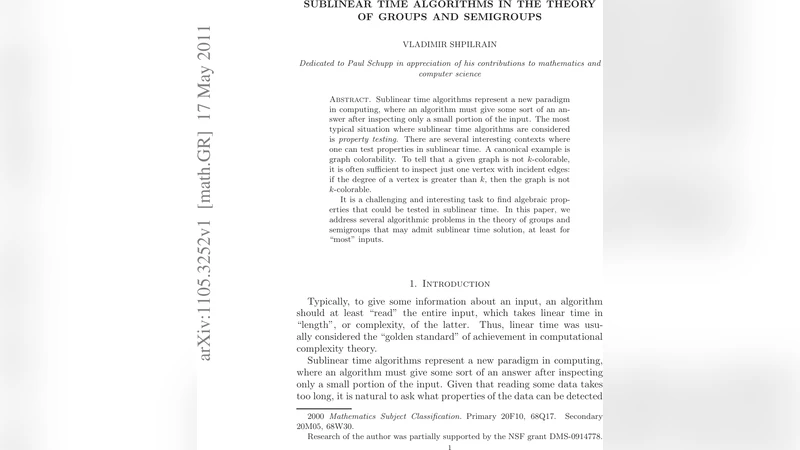
Sublinear time algorithms represent a new paradigm in computing, where an algorithm must give some sort of an answer after inspecting only a small portion of the input. The most typical situation where sublinear time algorithms are considered is property testing. There are several interesting contexts where one can test properties in sublinear time. A canonical example is graph colorability. To tell that a given graph is not k-colorable, it is often sufficient to inspect just one vertex with incident edges: if the degree of a vertex is greater than k, then the graph is not k-colorable. It is a challenging and interesting task to find algebraic properties that could be tested in sublinear time. In this paper, we address several algorithmic problems in the theory of groups and semigroups that may admit sublinear time solution, at least for “most” inputs.
💡 Research Summary
The paper investigates the applicability of sublinear‑time algorithms—algorithms that inspect only a tiny fraction of their input—to problems in group and semigroup theory. Sublinear algorithms, originally studied in property‑testing for combinatorial objects such as graphs, aim to decide whether a given object possesses a certain property by looking at a randomly chosen, bounded‑size part of it. The authors ask whether analogous “quick‑check” procedures exist for algebraic structures, focusing on two classical decision problems: (1) testing whether an element of a free group is primitive (i.e., belongs to some free basis) and (2) solving the word problem in groups and semigroups, especially in the context of positive monoids (monoids generated by group generators but without inverses).
1. Background and Notion of “Most” Inputs
The authors adopt the standard notion of a generic set based on asymptotic density: a subset S of all words over a finite alphabet is generic if the proportion of words of length ≤ n that lie in S tends to 1 as n → ∞. Algorithms are allowed a small failure probability ε(n) that also tends to 0. Under this framework, a sublinear‑time algorithm is one whose running time is o(|input|) for inputs drawn from a generic set.
2. Primitive‑Element Testing in a Free Group
Let F_r be a free group of rank r ≥ 2 with basis X = {x₁,…,x_r}. An element g is primitive if some automorphism of F_r sends g to x₁. Classical Whitehead theory tells us that the Whitehead graph W(g) of a cyclically reduced word g encodes adjacency of letters: each occurrence of a two‑letter subword x_i x_j (or x_i x_j⁻¹) creates an edge between the corresponding vertices. Whitehead proved that if g is primitive and |g| > 2, then W(g) must contain either an isolated edge or a cut‑vertex. Consequently, if W(g) is Hamiltonian (contains a cycle through all vertices), g cannot be primitive.
The authors propose a sublinear test: pick a random subword v of length |g|^δ for some fixed 0 < δ < 1, read v entirely (cost O(|g|^δ)), and examine the induced subgraph W(v). Results from prior work
Comments & Academic Discussion
Loading comments...
Leave a Comment