Twisted equivariant K-theory, groupoids and proper actions
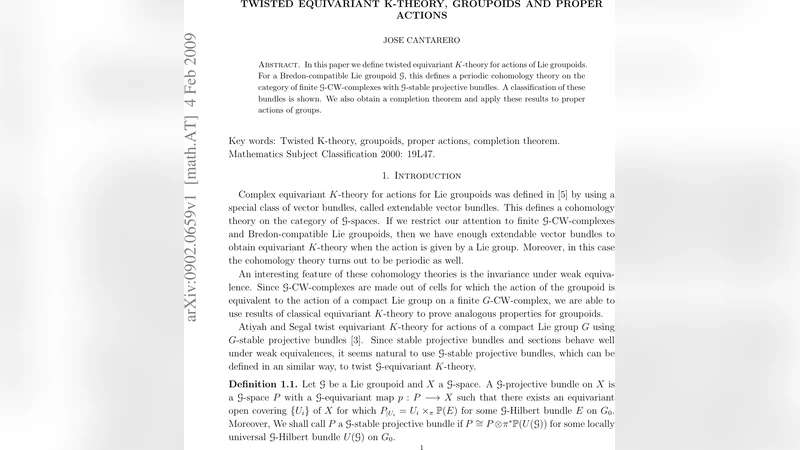
In this paper we define twisted equivariant K-theory for actions of Lie groupoids. For a Bredon-compatible Lie groupoid, this defines a periodic cohomology theory on the category of finite CW-complexes with equivariant stable projective bundles. A classification of these bundles is shown. We also obtain a completion theorem and apply these results to proper actions of groups.
💡 Research Summary
The paper develops a comprehensive framework for twisted equivariant K‑theory in the setting of Lie groupoids and applies it to proper actions of discrete groups. The authors begin by introducing a notion of “twist” for a Lie groupoid 𝔾, which is realized as a 𝔾‑equivariant U(1)‑central extension or, equivalently, as a degree‑two 𝔾‑cocycle α∈Z²(𝔾;U(1)). This twist governs the passage from ordinary 𝔾‑equivariant vector bundles to projective (or “stable projective”) bundles, mirroring the familiar passage from ordinary equivariant K‑theory to its twisted version for groups.
A central technical condition, called Bredon‑compatibility, is imposed on the groupoid. Roughly, it requires that each orbit type be represented by a compact isotropy group and that there are only finitely many orbit types, ensuring that Bredon cohomology is well behaved. Under this hypothesis the authors prove a classification theorem: isomorphism classes of 𝔾‑equivariant stable projective bundles over a 𝔾‑space X are in bijection with the cohomology group H²_𝔾(X;U(1)) represented by the twist α. In other words, the twist completely captures the obstruction to lifting a projective bundle to an honest vector bundle.
Having identified the twisting data, the authors define the α‑twisted equivariant K‑theory groups K⁎_𝔾(X,α). They construct a 𝔾‑equivariant spectrum whose homotopy groups give these groups, and they verify the usual Eilenberg–Steenrod axioms, including homotopy invariance, excision, and the existence of a long exact sequence for pairs. Bott periodicity is established by exhibiting a 𝔾‑equivariant Bott element coming from a 2‑dimensional complex representation of the groupoid; this yields a natural isomorphism Kⁿ_𝔾(X,α)≅Kⁿ⁺²_𝔾(X,α). Consequently, the theory is a 2‑periodic cohomology theory on the category of finite 𝔾‑CW complexes equipped with a twist.
The next major contribution is an Atiyah–Segal type completion theorem adapted to the groupoid context. Let R(𝔾) denote the representation ring of 𝔾 (the Grothendieck group of finite‑dimensional 𝔾‑equivariant vector bundles) and let I⊂R(𝔾) be its augmentation ideal. For a finite proper 𝔾‑CW complex X with twist α, the authors prove that the natural map
K⁎_𝔾(X,α) → ̂K⁎_𝔾(X,α)
from the equivariant K‑theory to its I‑adic completion is an isomorphism after tensoring with the appropriate coefficient ring. This result generalizes the classical Atiyah–Segal completion theorem for compact Lie groups to the broader setting of Lie groupoids, and it provides a powerful computational tool: the equivariant K‑theory of a proper action can be recovered from the K‑theory of the fixed‑point subspaces together with the representation‑theoretic data of the isotropy groups.
Finally, the authors specialize to the case where 𝔾 is the action groupoid G⋉X associated to a proper action of a (possibly non‑compact) discrete group G on a proper G‑space X. In this situation the Bredon‑compatibility condition is automatically satisfied, and the twist α coincides with the usual class in H³_G(X;ℤ) that classifies projective G‑bundles. The twisted equivariant K‑theory defined via the groupoid agrees with the traditional twisted equivariant K‑theory for groups, confirming that the new framework truly extends the known theory. Moreover, the completion theorem yields a G‑equivariant version of the Baum–Connes assembly map, suggesting new avenues for studying the K‑theoretic side of the conjecture in the presence of twists.
In summary, the paper accomplishes three major goals: (1) it introduces a robust definition of twisted equivariant K‑theory for Lie groupoids, complete with a classification of twists; (2) it proves a Bott periodicity theorem and establishes the theory as a 2‑periodic cohomology theory on finite equivariant CW complexes; (3) it extends the Atiyah–Segal completion theorem to the groupoid setting and demonstrates its utility for proper actions of groups, thereby linking the new theory to classical results and to the Baum–Connes program. The work thus provides a unifying language for equivariant K‑theory, twists, and groupoid actions, opening the door to new calculations and conceptual insights in non‑commutative geometry and topological analysis of group actions.
Comments & Academic Discussion
Loading comments...
Leave a Comment