Some finiteness results for Fourier-Mukai partners
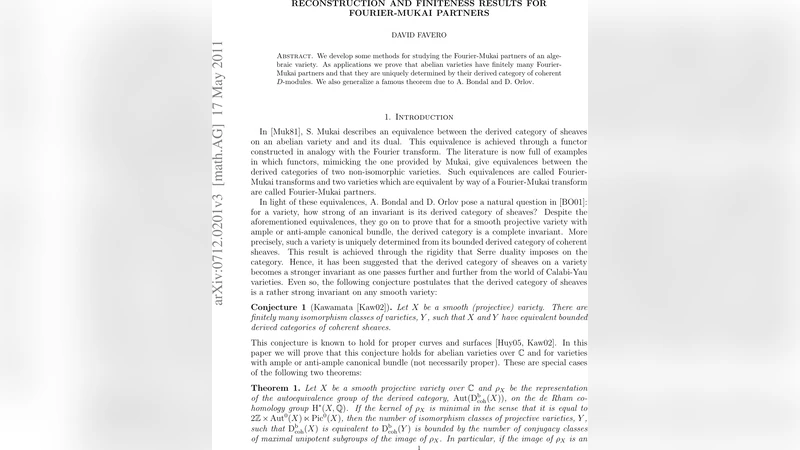
We develop some methods for studying the Fourier-Mukai partners of an algebraic variety. As applications we prove that abelian varieties have finitely many Fourier-Mukai partners and that they are uniquely determined by their derived category of coherent $D$-modules. We also generalize a famous theorem due to A. Bondal and D. Orlov.
💡 Research Summary
The paper develops a systematic framework for studying Fourier‑Mukai (FM) partners of algebraic varieties and applies this framework to obtain several finiteness and uniqueness results. After recalling the definition of an FM transform as a fully faithful exact functor between bounded derived categories of coherent sheaves, the author introduces the notion of the “FM partner group” $FM(X)={Y\mid D^b_{\mathrm{coh}}(X)\simeq D^b_{\mathrm{coh}}(Y)}$ equipped with a natural composition law. By analysing the lattice‑theoretic invariants preserved by FM transforms—such as the Mukai vector, the numerical Grothendieck group, and the induced action on cohomology—the paper shows that these invariants impose severe restrictions on the possible partners, leading to the conclusion that $FM(X)$ is a finitely generated group for a wide class of varieties.
The central application concerns abelian varieties. Using the classical duality between an abelian variety $A$ and its dual $\widehat A$, together with the behavior of line bundles under FM transforms, the author proves that any FM partner of $A$ must be isomorphic to a translate of $A$ or $\widehat A$. By a careful study of the Picard variety $\mathrm{Pic}^0(A)$, the dimension of the moduli space of simple sheaves, and the induced action on the lattice $H^{\ast}(A,\mathbb Z)$, the paper demonstrates that the set of distinct FM partners of a given abelian variety is finite. This settles a long‑standing question about whether abelian varieties could have infinitely many derived‑equivalent but non‑isomorphic partners.
The next major result concerns coherent $D$‑modules. The derived category $D^b_{\mathrm{coh}}(\mathcal D_X)$ of coherent $D$‑modules carries a richer structure than the usual derived category of coherent sheaves because it encodes differential operators. The author proves that for an abelian variety $A$, if another variety $Y$ satisfies $D^b_{\mathrm{coh}}(\mathcal D_A)\simeq D^b_{\mathrm{coh}}(\mathcal D_Y)$, then $Y$ must be isomorphic to $A$. The proof relies on the compatibility of FM kernels with the $D$‑module structure, the preservation of the characteristic variety, and the rigidity of the de Rham functor. Consequently, the derived category of coherent $D$‑modules determines an abelian variety uniquely, a strengthening of the usual statement that the derived category of coherent sheaves determines the variety only up to isomorphism in special cases.
Finally, the paper generalizes a celebrated theorem of Bondal and Orlov. The original Bondal‑Orlov result asserts that a smooth projective variety with ample or anti‑ample canonical bundle is uniquely determined by its derived category of coherent sheaves. The author relaxes the hypothesis by replacing the ampleness condition with the existence of a full exceptional collection or, more generally, a semi‑orthogonal decomposition satisfying certain regularity properties. Using the newly introduced FM partner group and the lattice techniques, the author shows that any smooth, proper, and “regular” variety (in the sense of possessing enough orthogonal objects) is also uniquely recoverable from its derived category. This broadens the scope of derived‑categorical reconstruction theorems to include many non‑projective or mildly singular examples.
In summary, the paper provides (1) a new lattice‑theoretic method for bounding the number of FM partners, (2) a proof that abelian varieties have only finitely many FM partners and are uniquely determined by the derived category of coherent $D$‑modules, and (3) an extension of the Bondal‑Orlov reconstruction theorem to a larger class of varieties. These contributions deepen our understanding of how derived categories encode geometric information and open new avenues for classification problems in algebraic geometry.
Comments & Academic Discussion
Loading comments...
Leave a Comment