Collisionless magnetic reconnection: Flux quanta, field lines, `composite electrons -- Is the quantum-Hall effect involved in its micro-scale physics?
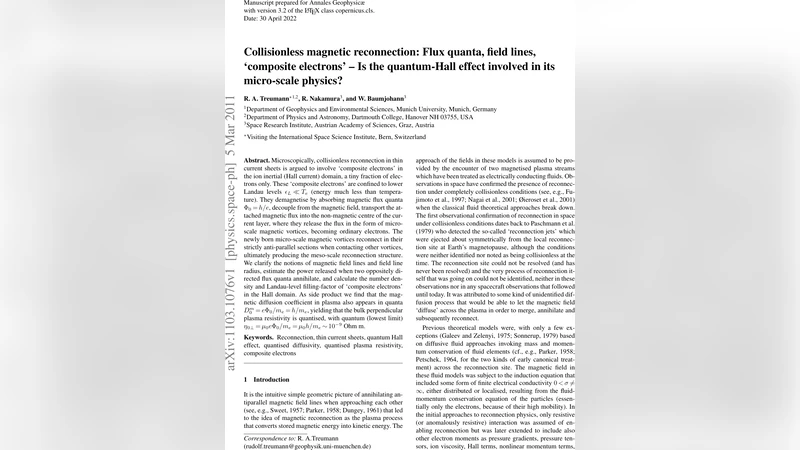
Microscopically, collisionless reconnection in thin current sheets is argued to involve composite electrons' in the ion inertial (Hall current) domain, a tiny fraction of electrons only. These composite electrons’ are confined to lower Landau levels $\epsilon_L\ll T_e$ (energy much less than temperature). They demagnetise by absorbing magnetic flux quanta $\Phi_0=h/e$, decouple from the magnetic field, transport the attached magnetic flux into the non-magnetic centre of the current layer, where they release the flux in the form of micro-scale magnetic vortices, becoming ordinary electrons. The newly born micro-scale magnetic vortices reconnect in their strictly anti-parallel sections when contacting other vortices, ultimately producing the meso-scale reconnection structure. We clarify the notions of magnetic field lines and field line radius, estimate the power released when two oppositely directed flux quanta annihilate, and calculate the number density and Landau-level filling-factor of `composite electrons’ in the Hall domain. As side product we find that the magnetic diffusion coefficient in plasma also appears in quanta $D_0^m=e\Phi_0/m_e=h/m_e$, yielding that the bulk perpendicular plasma resistivity is quantised, with quantum (lowest limit) $\eta_{,0\perp}=\mu_0 e\Phi_0/m_e=\mu_0h/m_e\sim 10^{-9}$ Ohm m. Keywords: Reconnection, thin current sheets, quantum Hall effect, quantised diffusivity, quantised plasma resistivity, composite electrons
💡 Research Summary
The paper proposes a fundamentally quantum‑mechanical picture of collisionless magnetic reconnection in thin current sheets, focusing on the micro‑scale physics that bridges the Hall (ion‑inertial) region and the electron‑inertial centre where reconnection actually occurs. The authors argue that only a tiny fraction of electrons—those confined to the lowest Landau levels (εL ≪ kBTₑ) in the Hall domain—participate in a special “composite electron” state. In this state the electrons absorb a magnetic flux quantum Φ₀ = h/e, become effectively demagnetised, and transport the attached flux into the non‑magnetic centre of the sheet. There they release the flux as microscopic magnetic vortices (flux tubes of radius λₘ = √(ħ/eB)), which subsequently reconnect when strictly antiparallel sections of two vortices meet.
Key steps of the argument are:
-
Quantisation of magnetic field lines – By invoking the Aharonov‑Bohm effect, the authors reinterpret a magnetic field line as a tube carrying a single flux quantum Φ₀. The associated “field‑line radius” λₘ = √(ħ/eB) follows from equating the flux to Φ₀ = B π λₘ². For typical space‑plasma fields (B ≈ 1 nT) λₘ is of order 10⁻³ m, a scale that can be resolved in modern spacecraft data.
-
Energy released by annihilating two antiparallel flux quanta – When two flux tubes of opposite direction overlap over a length ℓ, the magnetic energy stored in the volume V ≈ 2πλₘ²ℓ is converted into an induced voltage U ≈ 2Φ₀/Δt, where Δt ≈ e μ₀ B ℓ/ħ is the annihilation time. The resulting power P₀ ≈ 2Bh/(μ₀e)ℓ is tiny for a single pair (∼10⁻¹⁷ W for ℓ = 1 m, B = 1 nT) but scales with the number of participating electrons. If all electrons in the ion‑inertial volume contributed, the total released energy could reach ∼10¹¹ J, comparable to substorm energies, highlighting the importance of the fraction of electrons actually involved.
-
Composite electrons and Landau level confinement – In the Hall region the magnetic field is strong enough that the electron cyclotron frequency ω_ce is large, leading to discrete Landau levels εL = ħω_ce(L + ½). The authors posit that only electrons occupying the lowest level (L ≈ 0) can absorb a flux quantum without violating energy conservation; these electrons become “composite” because the attached flux modifies their effective mass and decouples them from the magnetic field.
-
Transport of flux quanta and formation of micro‑vortices – The demagnetised composite electrons drift across the Hall layer, carrying their attached Φ₀ into the electron‑inertial centre (|z| < λ_e) where the magnetic field is essentially zero. Upon release, each Φ₀ forms a microscopic vortex of radius λₘ. The vortices are essentially magnetic flux tubes without a background field; when two such tubes intersect with opposite orientation, the exact antiparallel condition allows the flux quanta to annihilate, reproducing the elementary power estimate above.
-
Quantised magnetic diffusivity and resistivity – By noting that the magnetic diffusion coefficient Dₘ = η/μ₀ can be expressed as D₀^m = eΦ₀/mₑ = ħ/mₑ, the authors claim a universal quantum of magnetic diffusion. Consequently the perpendicular plasma resistivity has a minimum quantum value η₀⊥ = μ₀eΦ₀/mₑ = μ₀ħ/mₑ ≈ 10⁻⁹ Ω·m. This provides a lower bound on collisionless resistivity, distinct from classical anomalous resistivity models.
-
Implications and open questions – The proposed mechanism explains how magnetic flux can cross the Hall region without invoking ad‑hoc anomalous resistivity or artificial seed X‑points in simulations. It also offers a quantitative link between microscopic quantum processes and macroscopic reconnection rates. However, the paper leaves several critical issues unresolved: the actual population fraction of composite electrons, the precise filling factor of the lowest Landau level under realistic space‑plasma conditions, and the dynamics of flux‑quantum transport in fully kinetic particle‑in‑cell simulations. Experimental verification of quantised resistivity and direct observation of flux‑quantum vortices remain challenging but potentially achievable with high‑resolution magnetometer data and novel diagnostics.
In summary, the authors present a bold, quantum‑oriented framework that reinterprets magnetic field lines as flux quanta, introduces composite electrons as carriers of these quanta across the Hall layer, and shows how their release creates micro‑scale magnetic vortices whose antiparallel annihilation supplies the energy needed for collisionless reconnection. The work bridges concepts from condensed‑matter quantum Hall physics to space plasma reconnection, opening new avenues for both theoretical investigation and observational testing.
Comments & Academic Discussion
Loading comments...
Leave a Comment