New Measure of the Dissipation Region in Collisionless Magnetic Reconnection
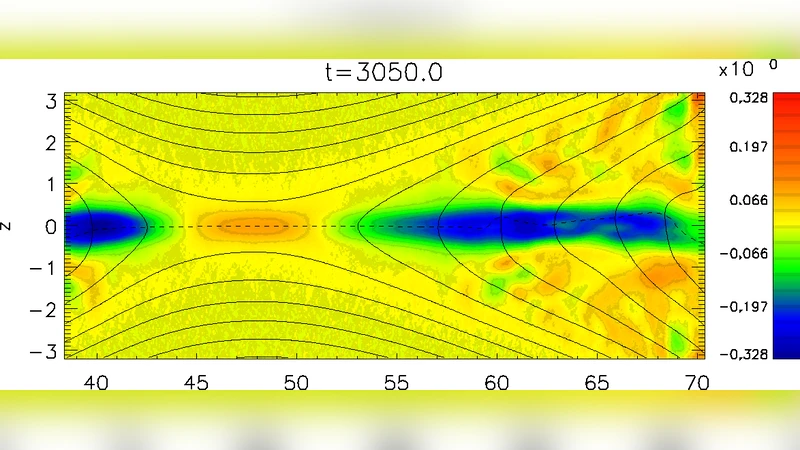
A new measure to identify a small-scale dissipation region in collisionless magnetic reconnection is proposed. The energy transfer from the electromagnetic field to plasmas in the electron’s rest frame is formulated as a Lorentz-invariant scalar quantity. The measure is tested by two-dimensional particle-in-cell simulations in typical configurations: symmetric and asymmetric reconnection, with and without the guide field. The innermost region surrounding the reconnection site is accurately located in all cases. We further discuss implications for nonideal MHD dissipation.
💡 Research Summary
The paper addresses a long‑standing problem in collisionless magnetic reconnection: how to unambiguously locate the small‑scale region where the ideal MHD condition ( \mathbf{E} + \mathbf{v}\times\mathbf{B}=0 ) breaks down and genuine energy conversion takes place. Traditional diagnostics such as the out‑of‑plane component of the electron non‑ideal electric field (E^{}_y) or electron velocity signatures have proven useful in symmetric, guide‑field‑free configurations, but they fail in asymmetric reconnection and when a guide field is present. Moreover, (E^{}_y) does not directly measure energy dissipation; it merely indicates a non‑ideal electric field, which can be zero even when substantial energy conversion occurs (e.g., in the outer electron diffusion region).
To overcome these limitations, the authors propose a new scalar quantity, (D_e), defined as the rate of electromagnetic energy transfer to the plasma measured in the electron bulk‑flow rest frame. Starting from the electromagnetic field tensor (F^{\mu\nu}) and the electron four‑velocity (u^\mu_e), they construct the rest‑frame electric field four‑vector (e^\mu = F^{\mu\nu}u_\nu). Contracting this with the four‑current (J^\mu) yields the Lorentz‑invariant scalar (D = J_\mu e^\mu). Specializing to the electron frame and taking the non‑relativistic limit gives
\
Comments & Academic Discussion
Loading comments...
Leave a Comment