Quasi-randomness of graph balanced cut properties
Quasi-random graphs can be informally described as graphs whose edge distribution closely resembles that of a truly random graph of the same edge density. Recently, Shapira and Yuster proved the follo
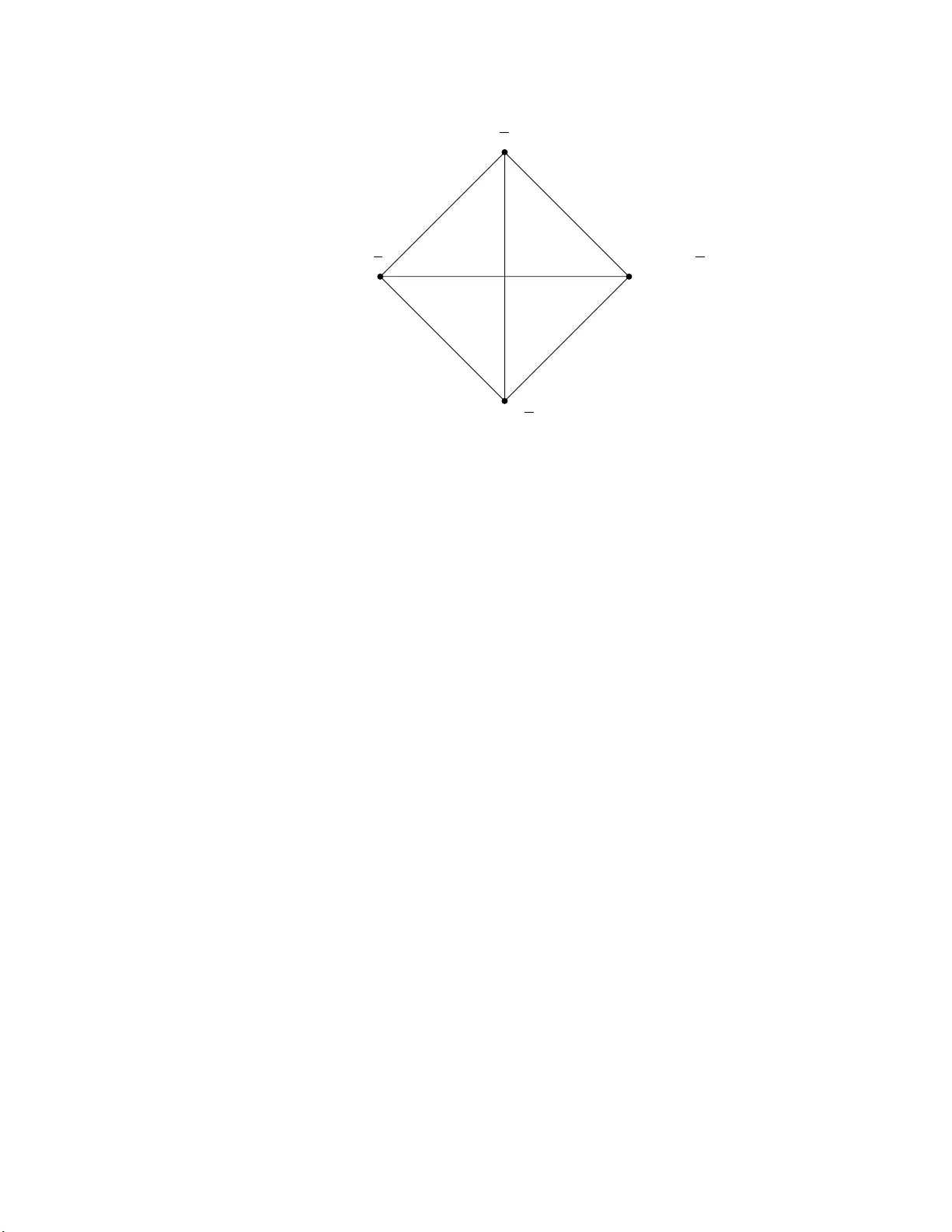
Quasi-random graphs can be informally described as graphs whose edge distribution closely resembles that of a truly random graph of the same edge density. Recently, Shapira and Yuster proved the following result on quasi-randomness of graphs. Let $k \ge 2$ be a fixed integer, $\alpha_1,…,\alpha_k$ be positive reals satisfying $\sum_{i} \alpha_i = 1$ and $(\alpha_1,…, \alpha_k) \neq (1/k,…,1/k)$, and $G$ be a graph on $n$ vertices. If for every partition of the vertices of $G$ into sets $V_1,…, V_k$ of size $\alpha_1 n,…, \alpha_k n$, the number of complete graphs on $k$ vertices which have exactly one vertex in each of these sets is similar to what we would expect in a random graph, then the graph is quasi-random. However, the method of quasi-random hypergraphs they used did not provide enough information to resolve the case $(1/k,…, 1/k)$ for graphs. In their work, Shapira and Yuster asked whether this case also forces the graph to be quasi-random. Janson also posed the same question in his study of quasi-randomness under the framework of graph limits. In this paper, we positively answer their question.
💡 Research Summary
The paper addresses a long‑standing open problem concerning the quasi‑randomness of graphs under the “balanced cut” condition for equal‑size partitions. In earlier work, Shapira and Yuster proved that if a graph G on n vertices satisfies the following property for every k‑partition of its vertex set into parts of prescribed sizes α₁n,…,α_kn (with Σα_i=1) that is not the uniform vector (1/k,…,1/k), then G must be quasi‑random. Their proof relied on hypergraph regularity and did not extend to the case where all α_i are equal, i.e., the perfectly balanced partition. Janson later raised the same question in the language of graph limits, asking whether the uniform balanced cut condition alone forces quasi‑randomness.
The authors give an affirmative answer. They show that if for every equipartition V₁,…,V_k of the vertex set (|V_i|=n/k) the number of copies of K_k that have exactly one vertex in each part deviates from the expected value p^{\binom{k}{2}}·(n/k)^k by o(n^k), then the graph G is p‑quasi‑random. Consequently, all subgraph densities in G converge to the corresponding powers of p, and the usual equivalent characterisations (eigenvalue gap, 4‑cycle density, edge distribution across cuts, etc.) hold.
The proof proceeds through several modern tools. First, the authors embed the sequence of graphs into the graph‑limit (graphon) framework, representing the limit object by a measurable function W:
📜 Original Paper Content
🚀 Synchronizing high-quality layout from 1TB storage...