We compiled X-ray and Optical observations of the accreting X-ray binary system A 0535+262 since its discovery in 1975, that will allow us to shed light on the unpredictable behavior of this binary system. We present the data in terms of the Be-disk interaction with the neutron star companion. In addition, we show recent results from the continuous monitoring of this source by the Gamma-ray Burst Monitor(GBM), on board the Fermi observatory, since its launch in 2008 June 11.
Deep Dive into A 0535+26: an X-ray/Optical Tour.
We compiled X-ray and Optical observations of the accreting X-ray binary system A 0535+262 since its discovery in 1975, that will allow us to shed light on the unpredictable behavior of this binary system. We present the data in terms of the Be-disk interaction with the neutron star companion. In addition, we show recent results from the continuous monitoring of this source by the Gamma-ray Burst Monitor(GBM), on board the Fermi observatory, since its launch in 2008 June 11.
A 0535+26 is a transient Be/X-ray binary pulsar, discovered by Ariel V in 1975 ( [21], [5]). The orbit is eccentric (e∼0.47) ([7, and references therein]) and the orbital period is 111.10(3) days with a pulse period of ∼103 s [8]. The optical counterpart is the O9.7 IIe star HDE 245770 [17]. Broad Quasi Periodic Oscillations (QPO) from 27 to 72 mHz were detected in 1996 by [8], confirming the presence of an accretion disk. During the 1994 giant outburst, two cyclotron resonance scattering features at 45 keV and 100 keV inferred a magnetic field of B∼4×10 12 G [16]. A very nice review on this binary system by [11] collects X-ray/Optical observations by different missions from 1970 until 1989. Figure 1 shows a long-term X-ray/Optical overview of A 0535+26/HDE 245770 from 1975 to 2010. After the giant outbursts in 1975 (the discovery), 1977, 1980 and 1989, it was BATSE which detected this source back in 1994 [1]. Three normal outbursts preceded the 1994 giant one and two small outbursts took place after that one. Then A 0535+26 went back to quiescence for almost 11 years. A 0535+26 renewed activity in May 2005 with another giant outburst and two normal outbursts, becoming a quiet source up to 2008. [18], [23] and [6]). In this work, we present an Optical/X-ray study of the Be/X-ray binary system A 0535+26 in an attempt to characterize the overall picture.
Our main X-ray observations in this work come from Fermi/GBM. The GBM is an all-sky instrument sensitive to X-rays and gamma rays with energies between ∼8 keV and ∼40 MeV [19]. GBM includes 12 Sodium Iodide (NaI; 8keV-1MeV) and 2 Bismuth Germanate (BGO; 150 keV-40 MeV) scintillation detectors. Timing analysis was carried out with CTIME data (8 channel spectra every 0.256 s) from only the NaI detectors.
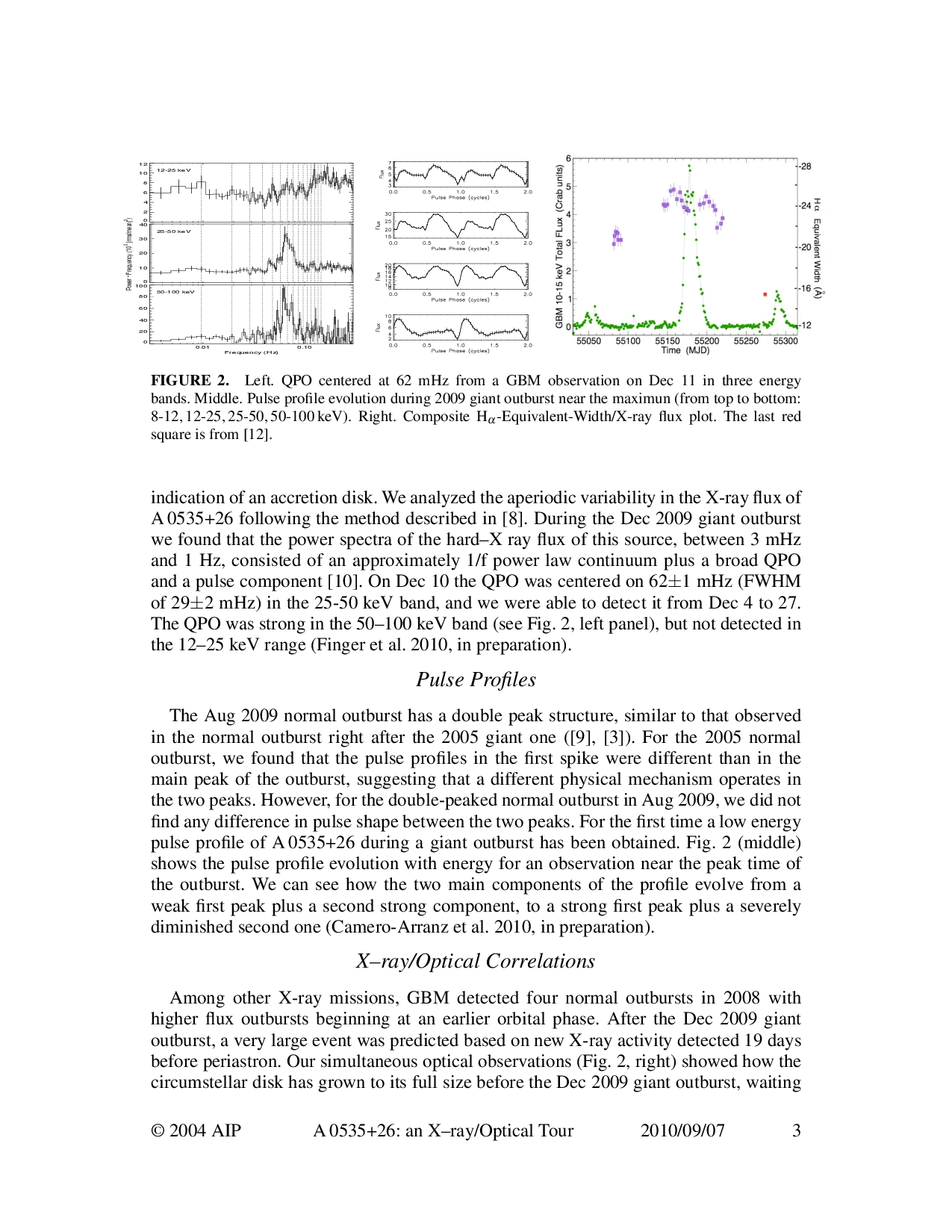
A detailed explanation of our timing technique can be found in [4]. The 10-15 keV total flux was obtained using the Earth Occultation technique with CSPEC data (128 energy channels every 4.096 s) ( [22]) . In the present work we also include photometric archival observations from the HIPPARCOS main catalog, the ASAS catalog, INTE-GRAL/OMC, and observations from the Spanish Astronomical Observatories of Sierra Nevada (OASN) and University of Valencia (OAUV) . We transformed the magnitudes from the HIPPARCOS filter to Visual magnitude, following the procedure found in [15] and applying B-V and U-B values from [18]. In addition, we extracted the V magnitude from [6] based on the work done by [14]. The spectroscopic observations come from the Liverpool Telescope (La Palma Observatory, Spain). indication of an accretion disk. We analyzed the aperiodic variability in the X-ray flux of A 0535+26 following the method described in [8]. During the Dec 2009 giant outburst we found that the power spectra of the hard-X ray flux of this source, between 3 mHz and 1 Hz, consisted of an approximately 1/f power law continuum plus a broad QPO and a pulse component [10]. On Dec 10 the QPO was centered on 62±1 mHz (FWHM of 29±2 mHz) in the 25-50 keV band, and we were able to detect it from Dec 4 to 27.
The QPO was strong in the 50-100 keV band (see Fig.
The Aug 2009 normal outburst has a double peak structure, similar to that observed in the normal outburst right after the 2005 giant one ( [9], [3]). For the 2005 normal outburst, we found that the pulse profiles in the first spike were different than in the main peak of the outburst, suggesting that a different physical mechanism operates in the two peaks. However, for the double-peaked normal outburst in Aug 2009, we did not find any difference in pulse shape between the two peaks. For the first time a low energy pulse profile of A 0535+26 during a giant outburst has been obtained. Fig. 2 (middle) shows the pulse profile evolution with energy for an observation near the peak time of the outburst. We can see how the two main components of the profile evolve from a weak first peak plus a second strong component, to a strong first peak plus a severely diminished second one (Camero-Arranz et al. 2010, in preparation).
Among other X-ray missions, GBM detected four normal outbursts in 2008 with higher flux outbursts beginning at an earlier orbital phase. After the Dec 2009 giant outburst, a very large event was predicted based on new X-ray activity detected 19 days before periastron. Our simultaneous optical observations (Fig. 2, right) showed how the circumstellar disk has grown to its full size before the Dec 2009 giant outburst, waiting © 2004 AIP A 0535+26: an X-ray/Optical Tour 2010/09/07 for the neutron star to arrive and begin accretion. They also revealed a strong H α line in emission during and after the Dec 2009 giant outburst, indicating that the donor star presented a disk around its equator before and after the large event, suggestive of a residual accretion disk present around the neutron star. Later on, strong optical activity of HDE 245770 was observed on March 19, 2010 by [12], an indicator of an incoming X-ray ou
…(Full text truncated)…
This content is AI-processed based on ArXiv data.