Classification and Evaluation the Privacy Preserving Data Mining Techniques by using a Data Modification-based Framework
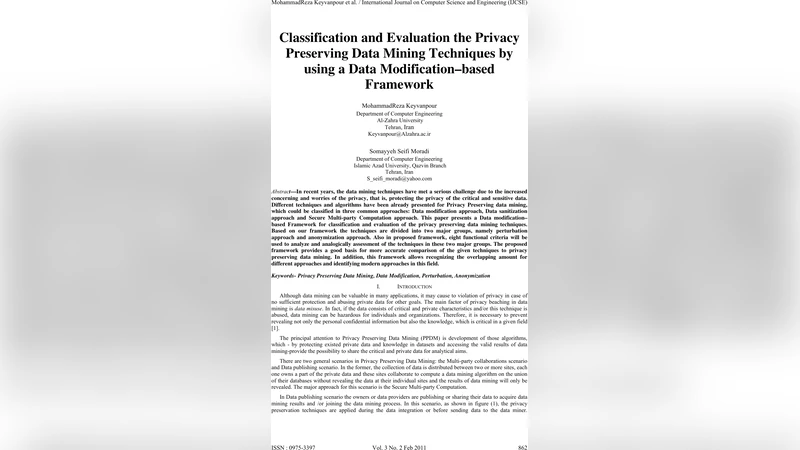
In recent years, the data mining techniques have met a serious challenge due to the increased concerning and worries of the privacy, that is, protecting the privacy of the critical and sensitive data. Different techniques and algorithms have been already presented for Privacy Preserving data mining, which could be classified in three common approaches: Data modification approach, Data sanitization approach and Secure Multi-party Computation approach. This paper presents a Data modification- based Framework for classification and evaluation of the privacy preserving data mining techniques. Based on our framework the techniques are divided into two major groups, namely perturbation approach and anonymization approach. Also in proposed framework, eight functional criteria will be used to analyze and analogically assessment of the techniques in these two major groups. The proposed framework provides a good basis for more accurate comparison of the given techniques to privacy preserving data mining. In addition, this framework allows recognizing the overlapping amount for different approaches and identifying modern approaches in this field.
💡 Research Summary
The paper addresses the growing concern that data‑mining techniques can compromise the privacy of sensitive information. It focuses on the “data‑modification” branch of privacy‑preserving data mining (PPDM) and proposes a systematic classification and evaluation framework. The authors first distinguish two main PPDM scenarios: multi‑party collaboration, where Secure Multi‑Party Computation (SMC) is the dominant approach, and data‑publishing, where data owners release or share datasets for mining. Within the data‑publishing scenario, they further split techniques into three broad families—data modification, data sanitization, and SMC—then concentrate on data‑modification methods.
The core of the framework is a two‑level taxonomy. At the top level, techniques are divided into perturbation and anonymization. The anonymization branch includes classic models such as k‑anonymity, l‑diversity, and t‑closeness. k‑anonymity guarantees that each record is indistinguishable from at least k‑1 others with respect to a set of quasi‑identifiers, typically using generalization or suppression. Its limitations are well‑known: difficulty in selecting quasi‑identifiers, vulnerability to linkage, homogeneity, and background‑knowledge attacks, and the fact that optimal generalization is NP‑hard. l‑diversity extends k‑anonymity by requiring at least l “well‑represented” sensitive values in each equivalence class, but it can still suffer from similarity attacks when distinct values convey the same semantic information. t‑closeness further refines the model by bounding the distance between the distribution of a sensitive attribute in an equivalence class and its distribution in the whole table, thereby mitigating background‑knowledge attacks; however, setting an appropriate distance threshold is non‑trivial and scalability to high‑dimensional data remains an issue.
The perturbation branch is richer and is subdivided into value‑based perturbation, random‑response techniques, data‑mining‑task‑based perturbation, and dimension‑reduction‑based perturbation.
-
Random Noise Addition injects i.i.d. noise into each attribute, preserving statistical moments that allow reconstruction of aggregate distributions via Bayesian or EM methods. While this enables accurate mining of global patterns, spectral analysis can sometimes separate noise from true data, exposing privacy risks.
-
Randomized Response scrambles survey answers by asking paired contradictory questions and letting respondents answer probabilistically (with probability θ for the true answer). Aggregated estimates of the sensitive attribute can be recovered, but the method requires large sample sizes for acceptable accuracy and is mainly suited for categorical data.
-
Condensation groups records into clusters of size K, computes cluster‑level means and covariances, and releases synthetic records that preserve these statistics. It works well for K‑Nearest‑Neighbour classifiers but struggles to balance covariance preservation with privacy, especially when clusters are small.
-
Random Rotation multiplies the data matrix by a random orthonormal matrix, preserving Euclidean distances and inner products. Linear and kernel‑based classifiers (e.g., SVM) remain accurate on rotated data. However, attacks such as Independent Component Analysis (ICA), rotation‑center inference, and distance‑based inference can recover original values if the attacker possesses auxiliary information.
-
Geometric Perturbation combines rotation, translation, and additive noise. The translation component thwarts rotation‑center attacks, while the noise component mitigates distance‑inference attacks. This hybrid approach offers stronger privacy guarantees while maintaining classifier performance for kernel, SVM, and linear models.
-
Dimension‑Reduction‑Based Perturbation employs techniques such as PCA, SVD, or Non‑negative Matrix Factorization (NMF) to project data onto a lower‑dimensional subspace before adding perturbations. This reduces computational cost, preserves the most informative structure, and can be tailored to specific mining tasks.
To evaluate all these methods, the authors define eight functional criteria: (1) privacy protection level, (2) data utility (mining accuracy), (3) computational complexity, (4) applicability across data types and mining tasks, (5) resistance to known attacks, (6) scalability to high dimensionality, (7) implementation difficulty, and (8) practical deployment considerations. Each technique is scored qualitatively against these criteria. The analysis reveals a clear trade‑off: anonymization techniques excel in privacy protection but often degrade utility and struggle with high‑dimensional data; perturbation techniques preserve utility better but provide weaker privacy guarantees unless combined with additional safeguards (e.g., translation, noise).
The paper also highlights overlap zones where techniques from both branches can be integrated. For instance, applying random noise to k‑anonymous tables, or using dimensionality reduction before enforcing l‑diversity, yields hybrid solutions that aim to balance privacy and utility more effectively. Recent research trends, as noted by the authors, are moving toward such hybrid or “privacy‑preserving data transformation” frameworks.
In conclusion, the proposed classification‑evaluation framework offers a structured lens for comparing existing PPDM methods, identifying their strengths and weaknesses, and guiding future work toward more nuanced, task‑aware, and hybrid privacy‑preserving strategies. The framework itself can serve as a benchmark for new algorithms, helping researchers and practitioners select the most appropriate technique for their specific privacy‑utility requirements.
Comments & Academic Discussion
Loading comments...
Leave a Comment