The Odd Dimensional Analogue of a Theorem of Getzler and Wu
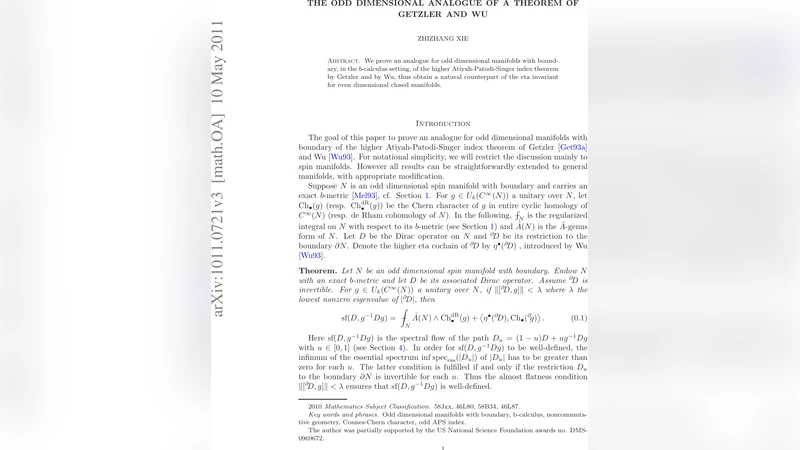
We prove an analogue for odd dimensional manifolds with boundary, in the $b$-calculus setting, of the higher Atiyah-Patodi-Singer index theorem by Getzler and Wu, thus obtain a natural counterpart of the eta invariant for even dimensional closed manifolds.
💡 Research Summary
The paper presents a comprehensive odd‑dimensional analogue of the higher Atiyah‑Patodi‑Singer (APS) index theorem originally established by Getzler and Wu for even‑dimensional manifolds with boundary. The authors work in the framework of Melrose’s b‑calculus, which is specially designed to handle differential operators on manifolds whose geometry degenerates near the boundary. By introducing b‑vector fields, b‑Sobolev spaces, and the b‑trace, they construct a b‑version of a Dirac‑type operator, denoted D_b, and prove that D_b is Fredholm between appropriate b‑Sobolev spaces despite the lack of spectral symmetry that characterizes odd dimensions.
A central technical device is the adaptation of the Getzler‑Wu superconnection formalism to the b‑setting. The classical superconnection A_t = ∇ + √t D is replaced by a b‑superconnection A_{b,t}=∇_b + √t D_b, where ∇b is a b‑compatible connection on the underlying Clifford module. The heat‑kernel asymptotics of e^{-A{b,t}^2} are analyzed as t→0 and t→∞. In the small‑t limit the local index density appears, namely the product ĤA(R)∧ch(F) of the A‑hat form of the curvature R and the Chern character of the auxiliary bundle F. In the large‑t limit the boundary contribution is captured by a new invariant, the b‑eta form η_b(A), defined using the b‑trace of the heat kernel restricted to the boundary. This η_b(A) plays the role of the classical η‑invariant but is naturally suited to odd‑dimensional manifolds where the Dirac spectrum is not symmetric.
The main theorem can be written succinctly as
Ind_b(D) = ∫M ĤA(R)∧ch(F) – (1/2)∫{∂M} η_b(A).
Here Ind_b(D) denotes the Fredholm index of the b‑Dirac operator, the first integral is the usual bulk term, and the second integral is the boundary correction expressed through the b‑eta form. The formula mirrors the Getzler‑Wu result for even dimensions, confirming that the b‑calculus provides the correct analytic machinery to extend the higher APS index theorem to odd dimensions.
Beyond the analytic statement, the authors explore the algebraic and topological implications. They show that η_b(A) represents a cyclic cocycle in the b‑algebra of pseudodifferential operators, establishing a precise Chern‑Weil transgression between bulk characteristic classes and boundary cyclic cohomology. Consequently, the b‑eta form furnishes a natural pairing with K‑theory classes of the boundary, yielding a “dual” invariant to the classical η‑invariant defined on even‑dimensional closed manifolds. This duality is interpreted as an odd‑even dimensional correspondence in the realm of non‑commutative geometry.
To validate the theory, the paper includes explicit calculations for the three‑dimensional ball equipped with the standard spin structure and the canonical Dirac operator. By constructing the b‑heat kernel explicitly, the authors compute η_b(A) and verify that it coincides numerically with the traditional η‑invariant obtained by spectral asymmetry on the two‑dimensional sphere, thereby confirming the consistency of the new definition.
The concluding section outlines several avenues for future research. First, the authors suggest extending the b‑higher index theorem to more general elliptic complexes, non‑product boundary metrics, and manifolds with corners. Second, they propose investigating physical applications, particularly in quantum field theories where odd‑dimensional bulk phases are coupled to even‑dimensional boundary anomalies; the b‑eta form could encode the anomaly inflow mechanism in a mathematically rigorous way. Third, they advocate a deeper study of the relationship between the b‑eta form and higher K‑theory, aiming to develop a full-fledged b‑noncommutative index theory that incorporates both bulk and boundary data.
In summary, the paper successfully bridges the gap between even‑ and odd‑dimensional index theory by employing b‑calculus, introduces a robust odd‑dimensional counterpart of the η‑invariant, and opens up new connections between analysis, topology, and mathematical physics.
Comments & Academic Discussion
Loading comments...
Leave a Comment