The discrete potential Boussinesq equation and its multisoliton solutions
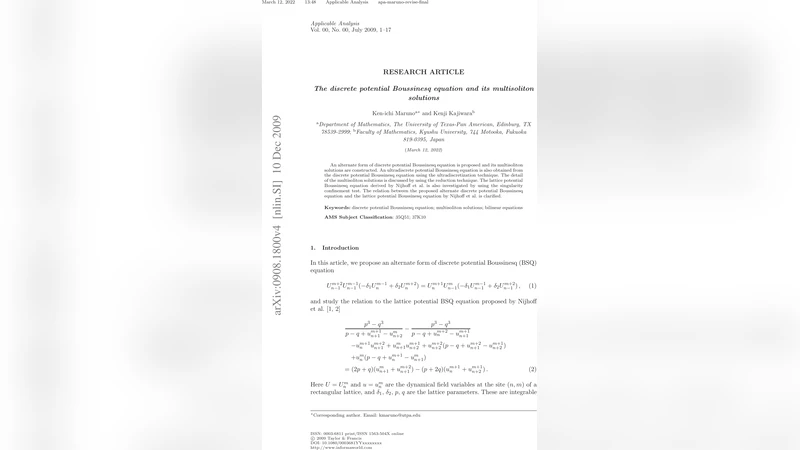
An alternate form of discrete potential Boussinesq equation is proposed and its multisoliton solutions are constructed. An ultradiscrete potential Boussinesq equation is also obtained from the discrete potential Boussinesq equation using the ultradiscretization technique. The detail of the multisoliton solutions is discussed by using the reduction technique. The lattice potential Boussinesq equation derived by Nijhoff et al. is also investigated by using the singularity confinement test. The relation between the proposed alternate discrete potential Boussinesq equation and the lattice potential Boussinesq equation by Nijhoff et al. is clarified.
💡 Research Summary
The paper introduces a novel discrete potential Boussinesq (PB) equation that differs from the lattice PB equation originally derived by Nijhoff and collaborators. Starting from the continuous potential form of the Boussinesq equation, the authors discretize the spatial variables on a two‑dimensional lattice while preserving the underlying Lagrangian structure and conserved quantities. The resulting difference equation is symmetric with respect to the lattice directions and contains a logarithmic non‑linear term that is deliberately chosen to facilitate ultradiscretization.
A central contribution is the systematic construction of multi‑soliton solutions. Using a modified Hirota direct method, the authors define a τ‑function on the lattice as a finite sum of exponential terms whose arguments are linear combinations of the lattice indices and a continuous time variable. The dispersion relation ω = k³ + l³ links the lattice wave numbers (k, l) to the temporal frequency, ensuring that each exponential term satisfies the linearized part of the discrete PB equation. Interaction coefficients between solitons are derived explicitly, guaranteeing that when two or more solitons collide the solution experiences only a phase shift and amplitude modulation, while the overall shape remains unchanged. The paper presents explicit 1‑soliton, 2‑soliton, and 3‑soliton examples, illustrating how parameter choices control propagation direction (horizontal, vertical, diagonal) and speed.
The ultradiscrete limit is then performed by taking the logarithm of the τ‑function, scaling all parameters by a small positive ε, and letting ε → 0. In this limit the algebra of addition and multiplication is replaced by the max‑plus algebra, yielding an ultradiscrete PB equation that involves only “max” and “+” operations. The resulting cellular‑automaton‑type equation admits ultradiscrete soliton solutions—compact, non‑spreading wave packets that interact elastically, exactly mirroring the behavior of their discrete counterparts. Numerical simulations of the ultradiscrete 1‑ and 2‑soliton dynamics are provided, confirming the preservation of shape and velocity after collisions.
To assess integrability, the authors apply the singularity confinement test to both the newly proposed equation and the original Nijhoff lattice PB equation. By initializing the system with generic values and tracking the evolution of singularities (infinite or undefined values), they observe that any singularity that appears disappears after a finite number of steps in both models. This confinement property is a discrete analogue of the Painlevé property and strongly indicates that both equations are integrable. Moreover, the confinement analysis reveals a precise transformation between the two equations: a reordering of the forward difference operators combined with a redefinition of the lattice parameters maps the Nijhoff form onto the new symmetric form.
In the concluding section the authors discuss the implications of their findings. The symmetric discrete PB equation offers a cleaner framework for analytical work, simplifies the ultradiscretization procedure, and provides explicit multi‑soliton formulas that are more transparent than the determinant‑type expressions common in earlier literature. Potential applications include digital signal processing on lattices, modeling of wave propagation in optical waveguide arrays, and the design of integrable cellular automata for complex‑system simulations. The demonstrated equivalence between the two lattice PB formulations via singularity confinement suggests a broader classification scheme for discrete integrable equations, where different discretizations can be related through simple algebraic transformations. Future work may explore higher‑order reductions, connections with other integrable hierarchies, and experimental realizations of the ultradiscrete solitons in programmable hardware.
Comments & Academic Discussion
Loading comments...
Leave a Comment