Results from the ANTARES neutrino telescope
The ANTARES underwater neutrino telescope is located in the Mediterranean Sea about 40 km from Toulon at a depth of 2475 m. In its 12 line configuration it has almost 900 photomultipliers in 275 “floors”. The performance of the detector is discussed and several results are presented, including the measurements of downgoing muons, search for a diffuse flux of high energy muon neutrinos, search for cosmic point sources of neutrinos, search for fast magnetic monopoles, etc. A short discussion is also made on Earth and Sea Science studies with a neutrino telescope.
💡 Research Summary
The paper presents a comprehensive overview of the ANTARES (Astronomy with a Neutrino Telescope and Abyss environmental RESearch) neutrino telescope, its technical design, data‑taking performance, and a selection of physics and Earth‑science results obtained with the 12‑line configuration. ANTARES is installed at a depth of 2475 m in the Mediterranean Sea, 40 km off the French coast. The detector consists of 12 flexible mooring lines, each holding up to 25 storeys. Every storey carries three optical modules, each containing a 10‑inch photomultiplier tube (PMT) oriented 45° downwards. In total, nearly 900 PMTs form a three‑dimensional array that records the arrival time and position of Cherenkov photons emitted by relativistic charged particles in seawater.
Data acquisition follows an “all‑data‑to‑shore” scheme: all hits above a 0.3 photo‑electron threshold are digitised and transmitted to a shore‑based computer farm, where a trigger based on local coincidences selects candidate events. Precise positioning is achieved with an acoustic triangulation system and optical beacons, yielding centimetre‑level knowledge of each optical module’s location. The reconstruction algorithms determine the direction of muon tracks, allowing discrimination between up‑going muons (produced by neutrino interactions) and the far more abundant down‑going atmospheric muons.
The first physics result discussed is the measurement of atmospheric muons. These muons dominate the trigger rate and are used to validate detector response, timing calibration, and Monte‑Carlo simulations. ANTARES measured the vertical muon intensity as a function of equivalent water depth and found agreement within about 10 % with previous measurements from Baikal, AMANDA, and other experiments. The observation of the Moon shadow confirmed an angular resolution better than 0.5°, an essential benchmark for point‑source searches.
The core astrophysical program focuses on high‑energy muon neutrinos. Up‑going muon candidates are selected with a quality parameter Λ > −5.5, which reduces the contamination from mis‑reconstructed atmospheric muons to about 5 %. An energy estimator based on the number of photon “repetitions” (R) in each optical module shows an approximately linear relationship with the logarithm of the true muon energy in the range 10³·⁸–10⁶ GeV. Using data collected from December 2007 to December 2009 (334 days of livetime, with 9–12 lines operational), ANTARES set a 90 % confidence level upper limit on a diffuse E⁻² flux of muon neutrinos and antineutrinos of
E² Φ < 5.3 × 10⁻⁸ cm⁻² s⁻¹ sr⁻¹
valid between 20 TeV and 2.5 PeV. This limit is comparable to or slightly better than those from AMANDA, Super‑Kamiokande, and MACRO. A sky map in galactic coordinates was produced from the 2007–2008 data set, and a targeted search was performed on a predefined list of promising astrophysical objects (e.g., the Galactic Centre, known TeV γ‑ray sources). No statistically significant excess was observed, and 90 % CL flux upper limits were derived, as shown in the paper’s Figure 6.
The search for exotic particles includes fast intermediate‑mass magnetic monopoles (IM‑MM) with masses in the range 10¹⁰–10¹⁴ GeV. Such monopoles would travel at relativistic speeds and generate intense Cherenkov light. ANTARES analyzed the data for the characteristic bright, straight‑track signatures and derived preliminary 90 % CL limits that are competitive with those from AMANDA, Baikal, and MACRO, approaching the Parker bound for monopole flux.
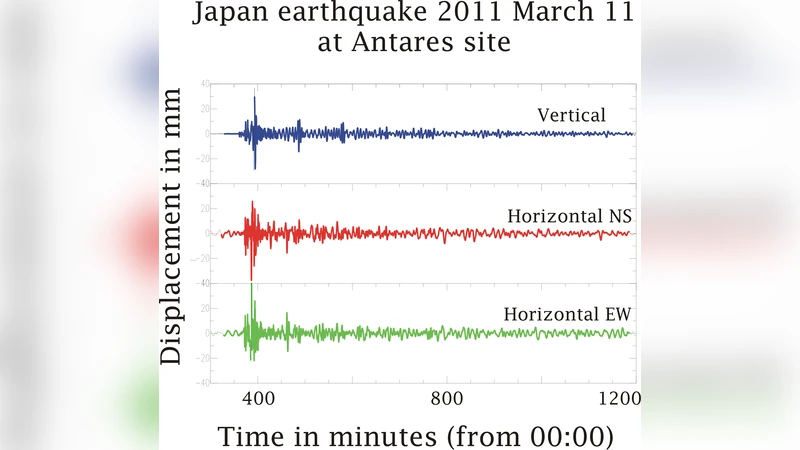
Beyond particle physics, ANTARES operates a suite of oceanographic and seismological instruments. An underwater seismometer recorded the 2011 Tōhoku earthquake and associated tsunami with clear waveforms, demonstrating the detector’s capability for real‑time geophysical monitoring. Additional sensors measure temperature, salinity, and deep‑water currents with high precision, while an underwater camera captures bioluminescent bacteria and larger marine organisms. Correlations between light bursts and current variations have been observed, opening a new interdisciplinary research avenue.
The paper concludes with an outlook toward KM3NeT, the next‑generation cubic‑kilometre neutrino telescope planned for the Mediterranean Sea. The operational experience, calibration techniques, and data‑analysis methods developed with ANTARES constitute a valuable test‑bed for KM3NeT’s design and scientific program. Continued data taking with ANTARES will improve the sensitivity to point sources, diffuse fluxes, and exotic particles, while its Earth‑science instrumentation will keep providing valuable marine and geophysical observations.
Comments & Academic Discussion
Loading comments...
Leave a Comment