Optimal Computation of Symmetric Boolean Functions in Collocated Networks
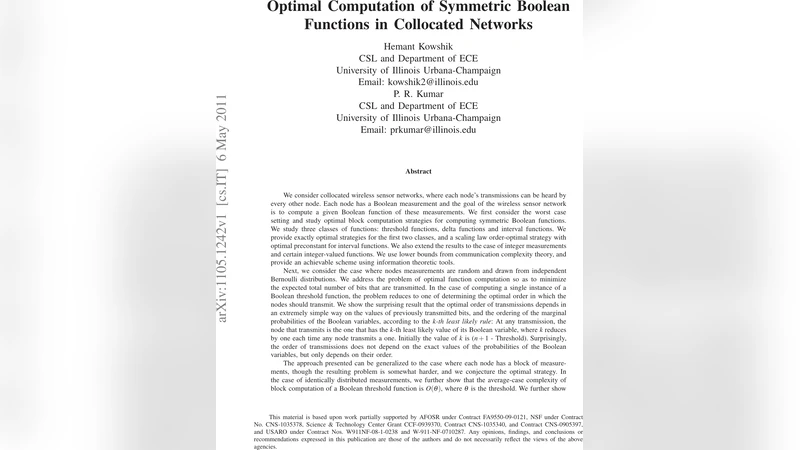
We consider collocated wireless sensor networks, where each node has a Boolean measurement and the goal is to compute a given Boolean function of these measurements. We first consider the worst case setting and study optimal block computation strategies for computing symmetric Boolean functions. We study three classes of functions: threshold functions, delta functions and interval functions. We provide exactly optimal strategies for the first two classes, and a scaling law order-optimal strategy with optimal preconstant for interval functions. We also extend the results to the case of integer measurements and certain integer-valued functions. We use lower bounds from communication complexity theory, and provide an achievable scheme using information theoretic tools. Next, we consider the case where nodes measurements are random and drawn from independent Bernoulli distributions. We address the problem of optimal function computation so as to minimize the expected total number of bits that are transmitted. In the case of computing a single instance of a Boolean threshold function, we show the surprising result that the optimal order of transmissions depends in an extremely simple way on the values of previously transmitted bits, and the ordering of the marginal probabilities of the Boolean variables. The approach presented can be generalized to the case where each node has a block of measurements, though the resulting problem is somewhat harder, and we conjecture the optimal strategy. We further show how to generalize to a pulse model of communication. One can also consider the related problem of approximate computation given a fixed number of bits. In this case, the optimal strategy is significantly different, and lacks an elegant characterization. However, for the special case of the parity function, we show that the greedy strategy is optimal.
💡 Research Summary
The paper investigates the fundamental communication cost of computing symmetric Boolean functions in a collocated wireless sensor network, where every node can hear every other node’s transmission and at most one node transmits at a time. Two complementary settings are considered: worst‑case (zero‑error) block computation and average‑case computation when node measurements are independent Bernoulli random variables.
In the worst‑case regime the authors model the problem as a collision‑free interactive protocol and define the broadcast computation complexity C(f) as the asymptotic per‑instance bit cost when block length N→∞. Lower bounds are obtained via fool‑ing sets from communication‑complexity theory. For the AND function of n nodes they prove a tight bound C(∧)=log₂(n+1) bits, using a prefix‑free code that lets each node transmit its block in turn. This technique is generalized to three families of symmetric functions:
-
Threshold functions (output 1 iff the number of 1’s ≥ θ). An optimal protocol simply lets nodes transmit sequentially; after each transmission the current count of 1’s is updated and the protocol stops as soon as the count reaches θ or it becomes impossible to reach θ with the remaining nodes. The resulting complexity matches the fool‑ing‑set lower bound, proving optimality.
-
Delta functions (output 1 iff the number of 1’s equals a prescribed k). The same sequential scheme with a stop‑condition “count = k” is shown to be optimal.
-
Interval functions (output 1 iff θ₁ ≤ #1 ≤ θ₂). Exact optimality is more elusive; the authors present a scaling‑law optimal strategy whose bit cost is Θ(log n) with a precisely derived pre‑constant that is provably the best possible up to lower‑order terms.
The analysis is further extended to non‑Boolean measurements, yielding optimal protocols for integer‑valued threshold functions and a near‑optimal scheme for the MAX function.
In the average‑case setting each node i observes Xᵢ∼Bernoulli(pᵢ) independently. The goal is to minimize the expected total number of transmitted bits required for zero‑error computation of a single instance of a Boolean threshold function. The authors discover a remarkably simple optimal ordering rule, called the k‑th least likely rule: initially set k = n+1−θ. Whenever a node transmits a ‘1’, decrement k by one; the next transmitting node is the one whose marginal probability of being ‘1’ is the k‑th smallest among the still‑silent nodes. Thus the ordering depends only on the ranking of the pᵢ’s, not on their exact values. This rule is proved optimal without resorting to dynamic programming, and it yields an expected communication cost that scales linearly with the threshold θ when each node holds a block of N bits (average‑case complexity O(θ)).
The paper also adapts the optimal policy to a pulse‑communication model where nodes send unit‑energy pulses instead of bits, showing that the same ordering principle remains optimal. Finally, the authors study approximate computation under a fixed bit budget. In this regime the optimal strategy diverges from the exact‑computation rule; for the parity function they prove that a greedy policy that always queries the node with the highest entropy (i.e., the most uncertain bit) is optimal.
Overall, the work provides tight worst‑case bounds, exact optimal protocols for several important symmetric functions, and an elegant, probability‑ranking based ordering rule that achieves optimal expected communication in the average case. These results have direct implications for the design of energy‑efficient data‑aggregation protocols in dense sensor deployments, where exploiting function symmetry and the broadcast nature of the medium can dramatically reduce the number of transmissions required for collective decision making.
Comments & Academic Discussion
Loading comments...
Leave a Comment