This paper presents some experiments regarding applications development on high performance media processors included in Philips Nexperia Family. The PNX1302 dedicated DVB-T kit used has some limitations. Our work has succeeded to overcome these limitations and to make possible a general-purpose use of this kit. For exemplification two typical applications, important both for multimedia and DVB, are analyzed: MPEG2 video stream decoding and MP3 audio decoding. These original implementations are compared (in speed, memory requirements and costs) with Philips Nexperia Library.
Deep Dive into Considerations and Results in Multimedia and DVB Application Development on Philips Nexperia Platform.
This paper presents some experiments regarding applications development on high performance media processors included in Philips Nexperia Family. The PNX1302 dedicated DVB-T kit used has some limitations. Our work has succeeded to overcome these limitations and to make possible a general-purpose use of this kit. For exemplification two typical applications, important both for multimedia and DVB, are analyzed: MPEG2 video stream decoding and MP3 audio decoding. These original implementations are compared (in speed, memory requirements and costs) with Philips Nexperia Library.
Modern multimedia embedded applications are present in different forms in our life. DVB set-top boxes, DVD players, satellite receivers are few examples of this kind of well-known products. Implementing embedded multimedia applications is possible only by using high performance processors. Using general PC based platforms for development is possible, but the goals to achieve lowest cost, lowestconsumption products are possible only by using so called "media processors". Such processors are present in the offer of many large semiconductor companies. Some examples are given in [1], [2]. Philips, a recognized pioneer in video-audio technology is involved in development of a highperformance, low-cost media processors, Nexperia PNX1300 Series which delivers up to 200 MHz of power to a variety of multimedia applications. PNX1300 Series processors achieve over seven billion operations per second in applications requiring real-time processing of video, audio, graphics, and communications datastreams. PNX1300 processors are ideal building blocks for devices required to process several types of multimedia datastreams simultaneously, including the latest standards such as MPEG-4, MPEG-2, H.263, MP3, and Dolby Digital®. With ample computational power available to capture, compress, and decompress many video and audio data formats in real time, PNX1300s are well suited for a broad range of applications such as Internet appliances, Web-cams, smart display pads, video and screen phones, PVR, videoconferencing, video editing, video based security, Internet radios, DVD playback, wireless LAN devices, and digital TV sets and set-top boxes. They also support applications in a JavaTM virtual machine environment. Supported by the comprehensive TriMediaTM SDE software development environment, PNX1300s are comparable in ease of programmability to generalpurpose processors. The SDE enables multimedia application development entirely in the C and C++ languages. Our work was intended to make an exploration of the Trimedia (Nexperia) and integrate this technology into a general multimedia system development. Our previous work in DVB technology was rather theoretical [3], and this occasion, to use a high performance processor has offered the opportunity to start real-time embedded multimedia implementations.
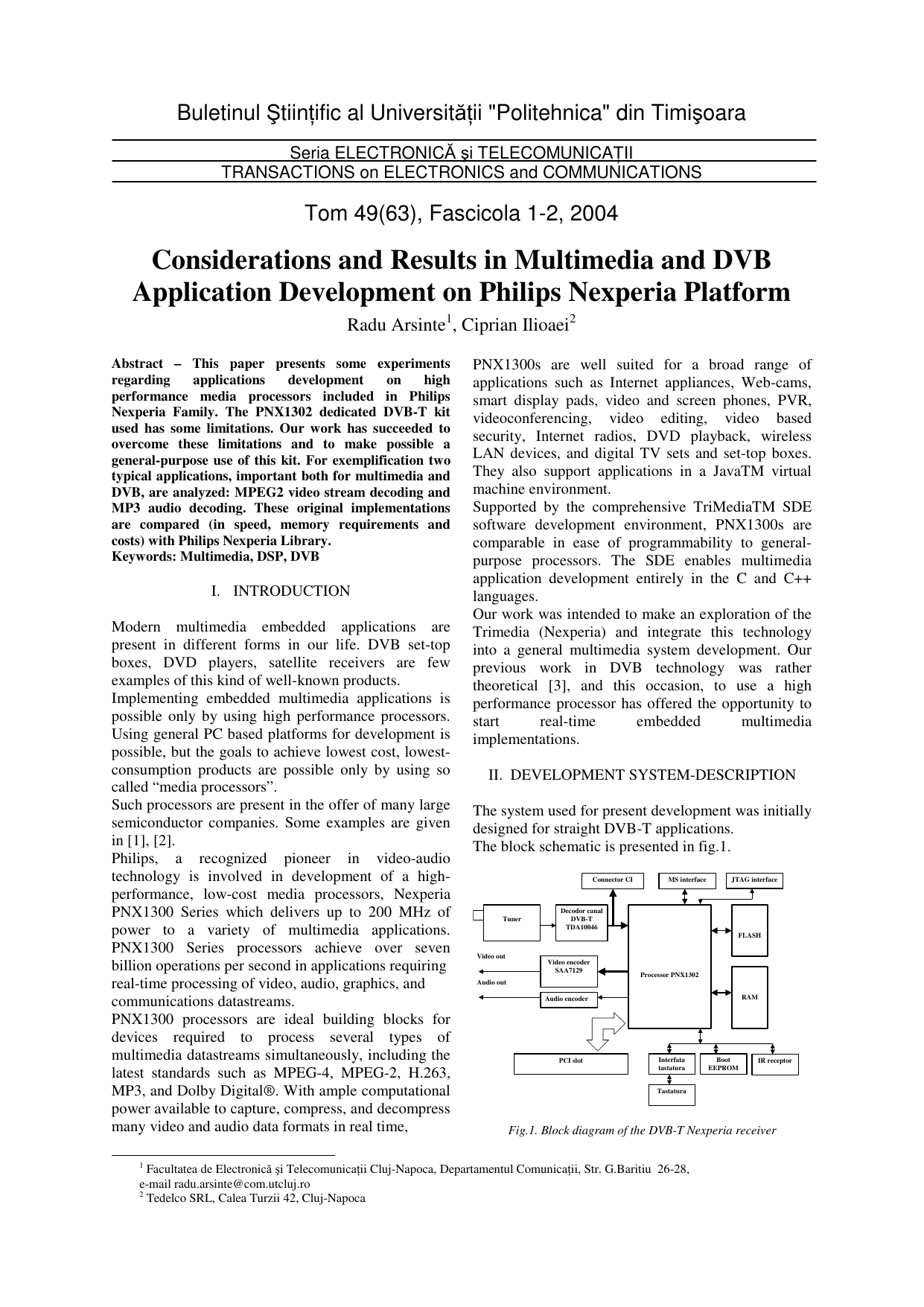
The system used for present development was initially designed for straight DVB-T applications. The block schematic is presented in fig. 1. -video: libraries for the video components like Video Digitizer ,Video Renderer ,Mpeg decoder etc.
-tssa: libraries for some components that make some actions like File Reader or Copy IO -mdm: libraries for Transport Stream Demux and Programme Stream Demux components -net :libraries for HTTP network communication support and for RPC sockets -build: the directory where we built components file libraries and the applications for our board.
-sas: contains the SAS environment support.
IV. RESULTS
The development system was used to test some original applications useful in laboratory works and demonstrations. Most applications avoid the copyright problems using original implementations for algorithms and code sequences. This was a requirement of the project, making the applications independent of IADK, witch costs about 10.000$ for the smallest configuration. It is necessary to have only NDK, witch has an affordable cost.
Here are some of the applications and brief results of tests.
1.PCM Player: this application plays PCM files (*.pcm), which contain audio PCM sequences Characteristics:
-program was tested on and works fine -using non-streaming architecture -has a video interface, coming from YUV files -limitation given by the RAMDISK size -compiled with nohost option for our board 2.YUV Player: this application displays images that are read from the .y, .u and .v files Characteristics:
-program was tested on Philips ATV1 board and works good -using non-streaming architecture -no memory limitation -compiled with nohost option for our board -program was tested on Philips_ATV1 board -using non-streaming architecture -limitation given by RAMDISK size -the program works fine for the small AVI’s -compiled with nohost option for our board 7.MPEG-2 video decoder: this application implements the MPEG-2 decoding algorithm (IDCT, Huffman, etc) and displays the images Characteristics: -program was tested on Philips_ATV1 board and it works fine -almost reaches real-time(93-95%) -using non-streaming architecture -compiled with nohost option for our board 8.Image processing: some standard operations like binarization, edge detection were implemented over a picture.
Our activity brought us the following achievements:
- Work with the compiler and with the other Trimedia tools. 2. Unterstanding the way makefiles work. 3. Creating the executables (*.out) for some specific applications 4. Simulating those executable files with tmsim. 5. Building the support for all given platforms: foxbox (ATV),DVE , le
…(Full text truncated)…
This content is AI-processed based on ArXiv data.