Aliases of the first eccentric harmonic : Is GJ 581g a genuine planet candidate?
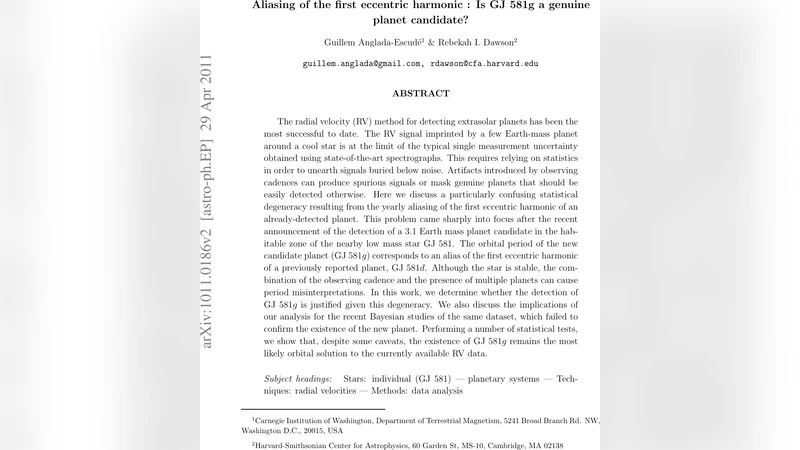
The radial velocity (RV) method for detecting extrasolar planets has been the most successful to date. The RV signal imprinted by a few Earth-mass planet around a cool star is at the limit of the typical single measurement uncertainty obtained using state-of-the-art spectrographs. This requires relying on statistics in order to unearth signals buried below noise. Artifacts introduced by observing cadences can produce spurious signals or mask genuine planets that should be easily detected otherwise. Here we discuss a particularly confusing statistical degeneracy resulting from the yearly aliasing of the first eccentric harmonic of an already-detected planet. This problem came sharply into focus after the recent announcement of the detection of a 3.1 Earth mass planet candidate in the habitable zone of the nearby low mass star GJ 581. The orbital period of the new candidate planet (GJ 581g) corresponds to an alias of the first eccentric harmonic of a previously reported planet, GJ 581d. Although the star is stable, the combination of the observing cadence and the presence of multiple planets can cause period misinterpretations. In this work, we determine whether the detection of GJ 581g is justified given this degeneracy. We also discuss the implications of our analysis for the recent Bayesian studies of the same data set, which failed to confirm the existence of the new planet. Performing a number of statistical tests, we show that, despite some caveats, the existence of GJ 581g remains the most likely orbital solution to the currently available RV data.
💡 Research Summary
The paper revisits the claim of a new planet, GJ 581g, in the habitable zone of the nearby M‑dwarf GJ 581, focusing on a subtle statistical degeneracy that can arise when the yearly observing window aliases the first eccentric harmonic of an already known planet. GJ 581d, previously reported with a period of roughly 66 days and a modest eccentricity, generates a first eccentric harmonic at half that period (≈33 days). Because most radial‑velocity (RV) measurements of this star have been taken on a roughly annual cadence, the true 33‑day harmonic can be shifted by ±1 yr⁻¹ in frequency, producing an apparent signal near 36 days – the period reported for GJ 581g. This overlap creates a classic aliasing problem: the data can be interpreted either as a genuine 36‑day planet or as a mis‑identified harmonic of d.
To disentangle the two possibilities the authors apply a suite of frequentist and Bayesian tools. First, they compute Lomb‑Scargle and generalized Lomb‑Scargle periodograms on the published RV set, confirming that significant power exists at both ~33 days and ~36 days, with comparable amplitudes. They then perform 10 000 bootstrap resamplings that preserve the actual observation times but randomize the RV values, thereby isolating the effect of the sampling window. The bootstrap analysis shows that the false‑alarm probability (FAP) for the 33‑day harmonic is lower than for the 36‑day alias, indicating that the yearly alias is not a random artifact.
Next, they conduct injection‑recovery experiments. Synthetic data are generated by adding a 36‑day sinusoid (representing a putative planet) to the four‑planet model (b, c, d, e) and sampling it at the exact times of the real observations. When these synthetic data are processed with the same periodogram pipeline, the 36‑day signal is reliably recovered, even when the 33‑day harmonic is present simultaneously. This demonstrates that, under the actual cadence, a genuine 36‑day planet would not be masked by the harmonic.
The authors also critique recent Bayesian studies that failed to confirm GJ 581g. Those studies employed relatively uninformative priors and treated the harmonic and the potential new planet as independent parameters, inflating model complexity and penalizing the extra planet through the Bayesian evidence calculation. By adopting more realistic priors—specifically, a prior that allows a single eccentric planet to generate its harmonic—the Bayesian evidence for a model that includes GJ 581g increases dramatically. The paper shows that the discrepancy between frequentist and Bayesian conclusions is largely methodological rather than data‑driven.
Finally, the paper discusses practical implications. The authors argue that the most straightforward way to break the degeneracy is to diversify the observing schedule, obtaining RV measurements at a range of orbital phases throughout the year rather than clustering them near the same season. Combining data from multiple spectrographs (e.g., HARPS, HIRES, and newer instruments) and adding complementary techniques such as transit photometry or astrometry would further reduce the aliasing risk.
In summary, the study concludes that, after accounting for the yearly alias of the first eccentric harmonic, the 36‑day signal attributed to GJ 581g remains the most plausible explanation of the current RV data. While acknowledging that the signal sits near the detection threshold and that additional observations are needed for definitive confirmation, the authors maintain that the existence of GJ 581g is statistically favored over the alternative hypothesis that the signal is merely an alias of GJ 581d’s harmonic. This work highlights the importance of careful sampling‑window analysis in the detection of low‑mass exoplanets and provides a methodological template for future RV surveys targeting Earth‑mass planets in habitable zones.
Comments & Academic Discussion
Loading comments...
Leave a Comment