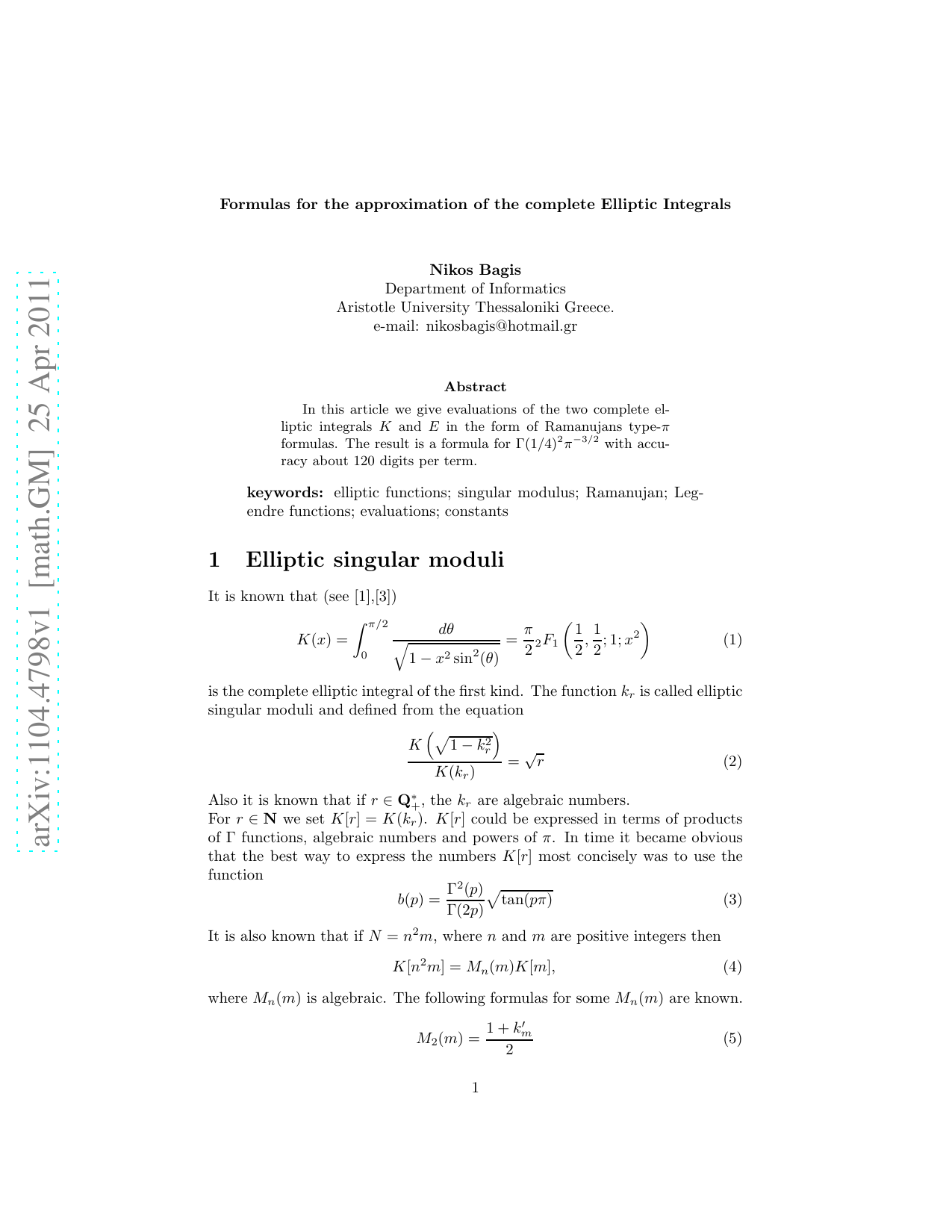
In this article we give evaluations of the two complete elliptic integrals $K$ and $E$ in the form of Ramanujans type-$\pi$ formulas. The result is a formula for $\Gamma(1/4)^2\pi^{-3/2}$ with accuracy about 120 digits per term.
Deep Dive into Formulas for the approximation of the complete Elliptic Integrals.
In this article we give evaluations of the two complete elliptic integrals $K$ and $E$ in the form of Ramanujans type-$\pi$ formulas. The result is a formula for $\Gamma(1/4)^2\pi^{-3/2}$ with accuracy about 120 digits per term.
It is known that (see [1], [3])
is the complete elliptic integral of the first kind. The function k r is called elliptic singular moduli and defined from the equation
Also it is known that if r ∈ Q * + , the k r are algebraic numbers. For r ∈ N we set K[r] = K(k r ). K[r] could be expressed in terms of products of Γ functions, algebraic numbers and powers of π. In time it became obvious that the best way to express the numbers K[r] most concisely was to use the function
It is also known that if N = n 2 m, where n and m are positive integers then
where M n (m) is algebraic. The following formulas for some M n (m) are known.
These formulas for finding K[4r], K[9r] and K[25r] depend only on knowing k r . Also we consider the complete elliptic integral of the second kind, which is
and related with K(x) from the relation
The function a(r) is called elliptic alpha function (see [4]).
We will use the elliptic functions theory to evaluate values of K(k r ) and E(k r ) in high precision using Ramanujan’s type-π formulas, but now the constant will be not
the precision of the application formula, which is our more interesting result in this paper is an about 120 digits per term.
Our methods consists Legendre functions, and we not use the function a(r).
The Legendre P function is defined by
Then derivating φ we have
then
From ( 11),( 12) and (13) we have Theorem 1.
It is known (see [1]), that
hence if we set µ = -3/2 and ν = 0, then we have Proposition 1.
where
The result of the Proposition 1 is not trivial since the ϑ 3 -function can be evaluated from the identity
in which the two constants e and π involved.
We know that
Hence
Hence
or
Setting r → 4r we get
or Lemma.
If r > 0, then
3 Applications
then
From the duplication formula is
Also from (22) we have
But it is known that
hence we get an about 120 digits per term formula for 1 π b(1/4):
The evaluation of E(k r )/π follows if we use the formula
Then one can arrive with the same method as in Proposition 1, to Proposition 2.
This content is AI-processed based on ArXiv data.