📝 Original Info
- Title: Universal Algebra and Mathematical Logic
- ArXiv ID: 1104.4606
- Date: 2011-04-26
- Authors: Researchers from original ArXiv paper
📝 Abstract
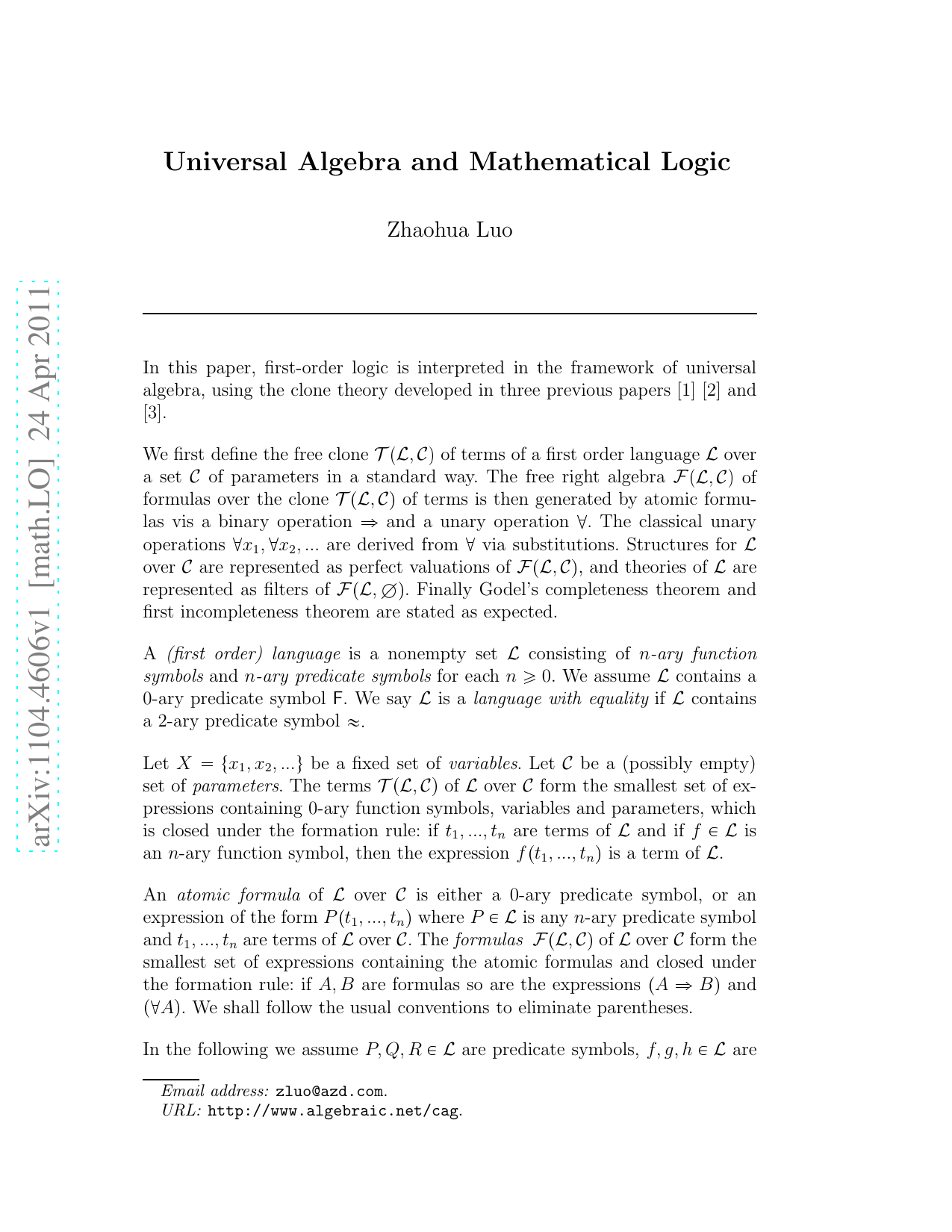
In this paper, first-order logic is interpreted in the framework of universal algebra, using the clone theory developed in three previous papers. We first define the free clone T(L, C) of terms of a first order language L over a set C of parameters in a standard way. The free right algebra F(L, C) of formulas over T(L, C) is then generated by atomic formulas. Structures for L over C are represented as perfect valuations of F(L, C), and theories of L are represented as filters of F(L). Finally Godel's completeness theorem and first incompleteness theorem are stated as expected.
💡 Deep Analysis
Deep Dive into Universal Algebra and Mathematical Logic.
In this paper, first-order logic is interpreted in the framework of universal algebra, using the clone theory developed in three previous papers. We first define the free clone T(L, C) of terms of a first order language L over a set C of parameters in a standard way. The free right algebra F(L, C) of formulas over T(L, C) is then generated by atomic formulas. Structures for L over C are represented as perfect valuations of F(L, C), and theories of L are represented as filters of F(L). Finally Godel’s completeness theorem and first incompleteness theorem are stated as expected.
📄 Full Content
Proposition 1 (cf. [3]) 1. T ÔL, CÕ is a locally finite clone, which is a free algebra over the free basis X C with function symbols as the signature.
- F ÔL, CÕ is a locally finite free predicate algebra over the clone T ÔL, CÕ generated by atomic formulas.
Suppose D is a term or formula. We say D is independent of a variable Denote by F n ÔL, CÕ the set of formulas with a rank n 0
- ÔÔx i ÕAÕÖt 1 , t 2 , …× ÔyÕÔAÖt 1 , …, t i¡1 , y, t i 1 , …×Õ if t j is independent of y for any j i such that x j is free in A.
A perfect valuation (or Henkin valuation) of L (over C) is a subset U of F ÔL, CÕ satisfying the following conditions for any A, B È F ÔL, CÕ and t, t 1 , t 2 , … È T ÔL, CÕ:
- ÔAÕ È U iff AÖt, x 1 , x 2 , …× È U for any term t. (or equivalently, for any x, ÔxÕA È U iff AÖtßx× È U for any term t).
If L is a language with equality then we also assume that the following conditions are satisfied. 4. n Ôx xÕ È U for any n 0. 5. n Ôx y ÔA AÖyßx×ÕÕ È U for any n 0.
Denote by AÔL, CÕ the set of atomic formulas of L over C. A subset E of AÔL, CÕ such that F Ê E is called an atomic valuation of L over C. Since F ÔL, CÕ is generated by atomic formulas under operations and inductively, a perfect valuation U of L is uniquely determined by the atomic valuation U AÔL, CÕ. Conversely any atomic valuation determines a perfect valuation for any language L without equality.
..Õ for some U and t 1 , t 2 , … as above. A subset V of F ÔLÕ is called a logical valuation of L if there is a valuation W of L (over some set C of parameters) such that V F ÔLÕ W . A subset of F ÔLÕ is called logically closed if it is an intersection of logical valuations of L. A formula A È F ÔLÕ is called logically valid if it belongs to any logical valuation of L.
A structure for L is a pair M ÔM, γÕ where M is a set and γ is an operation
Any structure M ÔM, γÕ determines a left algebra M over the clone T ÔL, MÕ such that f Ôx 1 , .
ioms:
📸 Image Gallery
Reference
This content is AI-processed based on ArXiv data.