Rounding Semidefinite Programming Hierarchies via Global Correlation
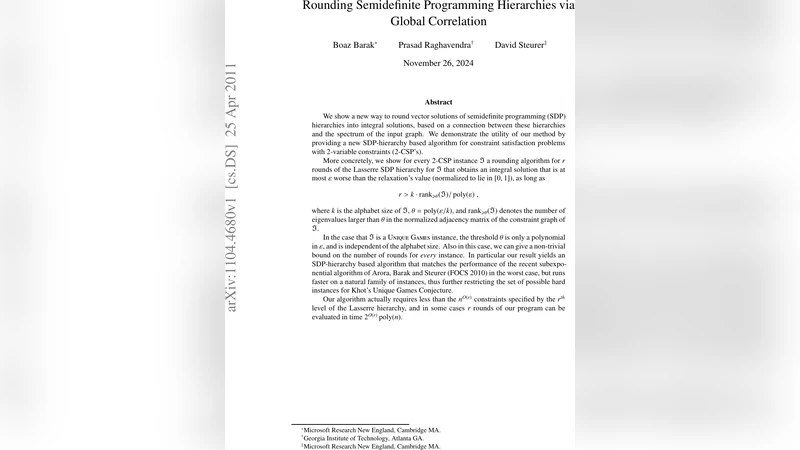
We show a new way to round vector solutions of semidefinite programming (SDP) hierarchies into integral solutions, based on a connection between these hierarchies and the spectrum of the input graph. We demonstrate the utility of our method by providing a new SDP-hierarchy based algorithm for constraint satisfaction problems with 2-variable constraints (2-CSP’s). More concretely, we show for every 2-CSP instance I a rounding algorithm for r rounds of the Lasserre SDP hierarchy for I that obtains an integral solution that is at most \eps worse than the relaxation’s value (normalized to lie in [0,1]), as long as r > k\cdot\rank_{\geq \theta}(\Ins)/\poly(\e) ;, where k is the alphabet size of I, $\theta=\poly(\e/k)$, and $\rank_{\geq \theta}(\Ins)$ denotes the number of eigenvalues larger than $\theta$ in the normalized adjacency matrix of the constraint graph of $\Ins$. In the case that $\Ins$ is a \uniquegames instance, the threshold $\theta$ is only a polynomial in $\e$, and is independent of the alphabet size. Also in this case, we can give a non-trivial bound on the number of rounds for \emph{every} instance. In particular our result yields an SDP-hierarchy based algorithm that matches the performance of the recent subexponential algorithm of Arora, Barak and Steurer (FOCS 2010) in the worst case, but runs faster on a natural family of instances, thus further restricting the set of possible hard instances for Khot’s Unique Games Conjecture. Our algorithm actually requires less than the $n^{O(r)}$ constraints specified by the $r^{th}$ level of the Lasserre hierarchy, and in some cases $r$ rounds of our program can be evaluated in time $2^{O(r)}\poly(n)$.
💡 Research Summary
The paper introduces a novel rounding technique for semidefinite programming (SDP) hierarchies that leverages global correlations in the high‑dimensional SDP solution together with spectral properties of the underlying constraint graph. The authors focus on 2‑variable constraint satisfaction problems (2‑CSPs) and, in particular, on the Unique Games problem, showing that a relatively small number of Lasserre hierarchy rounds suffices to obtain an integral solution whose value is within ε of the SDP optimum.
The main technical contribution is the identification of a “global correlation” measure: if the vectors produced by an r‑round Lasserre SDP exhibit non‑trivial average correlation across the whole instance, then a rounding algorithm can convert them into a near‑optimal integral assignment using only O(1) additional rounds. To bound this global correlation the authors relate it to the spectrum of the normalized adjacency matrix of the constraint graph. They define the threshold rank rank_{>θ}(G) as the number of eigenvalues larger than a threshold θ and prove that when the graph has low threshold rank, the SDP vectors are essentially confined to a low‑dimensional subspace. This low‑dimensional structure forces a high global correlation, which the rounding algorithm exploits.
For a general 2‑CSP with alphabet size k, they show that if r > k·rank_{>θ}(𝕀)/poly(ε) where θ = poly(ε/k), then the r‑round Lasserre SDP value sdpopt(𝕀) satisfies sdpopt(𝕀) ≤ val(𝕀) + ε, and a polynomial‑time rounding scheme can recover an assignment of value at least val(𝕀) – ε. In the case of Unique Games, the threshold θ can be taken as a polynomial in ε independent of k, yielding a bound that depends only on the graph’s threshold rank. Moreover, they prove that a sublinear (in fact, a small root) number of rounds suffices even in the worst case, and that the number of rounds can be expressed in terms of rank_{>1–cε}(𝕀) for a constant c.
The algorithm does not require the full set of constraints of the r‑th Lasserre level. By using a relaxed variant of the hierarchy and a carefully chosen random subset of constraints, the authors achieve an implementation running in time 2^{O(r)}·poly(n), substantially faster than the n^{O(r)} time needed to solve the full Lasserre SDP. The rounding itself is a propagation process: after fixing the label of a seed vertex, labels are propagated through the graph according to the SDP vectors, and the low‑rank structure guarantees that the propagation incurs only ε loss.
The paper also discusses concrete families of graphs with small threshold rank. Random d‑regular graphs have rank_{>θ}=O(1) for any θ > c/√d, and small‑set expanders have polynomially bounded threshold rank. For these natural families, the new algorithm matches the performance of the subexponential algorithm of Arora, Barak, and Steurer (FOCS 2010) in the worst case, but runs significantly faster on low‑rank instances, thereby narrowing the class of potential hard instances for the Unique Games Conjecture.
In comparison with prior work, the authors improve upon subspace‑enumeration methods that required low rank of the label‑extended graph, and they provide a more robust SDP‑based approach that works directly on the original constraint graph. Their results are parallel to those of Guruswami and Sinop (2011), but with a different analysis of local‑to‑global correlation and with stronger runtime guarantees.
Overall, the paper establishes a deep connection between SDP hierarchy rounding, global correlation, and graph spectral properties, delivering both theoretical insight and practical algorithms for a broad class of constraint satisfaction problems, especially those related to the Unique Games Conjecture.
Comments & Academic Discussion
Loading comments...
Leave a Comment