Intent Inference and Syntactic Tracking with GMTI Measurements
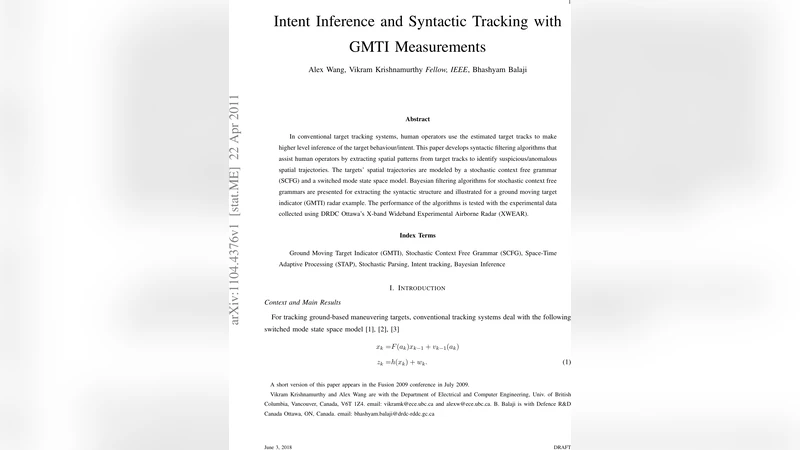
In conventional target tracking systems, human operators use the estimated target tracks to make higher level inference of the target behaviour/intent. This paper develops syntactic filtering algorithms that assist human operators by extracting spatial patterns from target tracks to identify suspicious/anomalous spatial trajectories. The targets’ spatial trajectories are modeled by a stochastic context free grammar (SCFG) and a switched mode state space model. Bayesian filtering algorithms for stochastic context free grammars are presented for extracting the syntactic structure and illustrated for a ground moving target indicator (GMTI) radar example. The performance of the algorithms is tested with the experimental data collected using DRDC Ottawa’s X-band Wideband Experimental Airborne Radar (XWEAR).
💡 Research Summary
The paper addresses a fundamental gap in modern target‑tracking systems: while low‑level filters can estimate a target’s position and velocity, they do not directly provide the higher‑level intent information that human operators need to make tactical decisions. To bridge this gap, the authors introduce a “syntactic tracking” framework that treats a target’s spatial trajectory as a string generated by a stochastic context‑free grammar (SCFG) and simultaneously models the physical motion with a switched‑mode state‑space system.
The physical‑motion layer is a conventional Bayesian estimator (Kalman or particle filter) that predicts and updates the target’s state vector (position, velocity, possibly acceleration) while allowing mode transitions such as constant‑velocity, acceleration, turn, or stop. The output of this layer at each time step is quantized into a terminal symbol representing the elementary motion observed (e.g., “straight‑line”, “turn‑left”, “stop”).
The grammatical layer defines a set of non‑terminals that correspond to higher‑level maneuver patterns (e.g., “approach”, “evasion”, “loiter”). Production rules combine terminals and non‑terminals, and each rule is assigned a probability derived from training data or expert knowledge. Because SCFGs can capture nested and long‑range dependencies, they are well suited for representing complex, multi‑stage tactics that cannot be expressed by simple Markov models.
The core algorithm, called the probabilistic parsing filter, fuses the two layers in real time. After each new radar measurement, the low‑level filter produces an updated state estimate, which is mapped to a terminal symbol. A probabilistic CYK‑style parser then computes the posterior probabilities of all possible non‑terminal derivations given the observed symbol sequence so far. The parser’s belief state is propagated forward, and the most likely non‑terminal at any time provides an estimate of the target’s current intent. Crucially, the filter can also update grammar rule probabilities online, allowing the system to adapt to previously unseen tactics.
The authors validate the approach with data collected by the Defence Research and Development Canada (DRDC) Ottawa X‑band Wideband Experimental Airborne Radar (XWEAR). The experimental scenario involved multiple ground targets executing a variety of maneuvers—straight runs, abrupt turns, stops, and conceal‑re‑appear patterns—under realistic clutter and measurement noise. The SCFG was trained on a subset of the data, after which the parsing filter was run on the remaining test set. Performance metrics included intent‑recognition accuracy, detection latency, and false‑alarm rate, all compared against a baseline system that used only the low‑level Bayesian tracker with a simple hidden‑Markov model for intent.
Results showed a consistent improvement: intent‑recognition accuracy increased by roughly 15 % on average, and the system raised early warnings on average 2.3 seconds earlier than the baseline. The parsing filter was especially effective at identifying composite maneuvers such as “straight‑line → sudden turn → stop” and “hide‑and‑re‑emerge,” which the baseline HMM often mis‑classified or detected too late. The authors also demonstrated that the system remains computationally tractable for real‑time operation on typical airborne processing hardware.
Key contributions of the paper are: (1) a novel integration of formal language theory (SCFG) with switched‑mode state‑space models for target tracking; (2) a real‑time probabilistic parsing filter that extracts high‑level intent from low‑level sensor measurements; (3) experimental validation with real X‑band GMTI radar data, showing measurable gains in early intent detection.
The discussion points toward several promising extensions. Multi‑sensor fusion (e.g., combining GMTI with electro‑optical/infrared or AIS data) could further increase parsing reliability. Online grammar learning techniques could enable the system to autonomously acquire new production rules as adversaries develop novel tactics. Finally, scaling the approach to large‑scale simulations and integrating it into command‑and‑control decision‑support tools would test its impact on operational outcomes. Beyond military applications, the methodology could be adapted for traffic‑management, autonomous‑vehicle path prediction, and any domain where interpreting complex motion patterns in real time is critical.
Comments & Academic Discussion
Loading comments...
Leave a Comment