Global sensitivity analysis for models with spatially dependent outputs
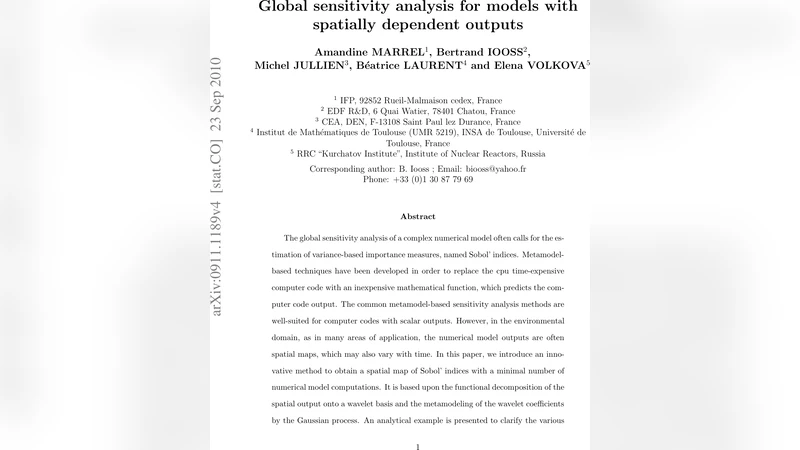
The global sensitivity analysis of a complex numerical model often calls for the estimation of variance-based importance measures, named Sobol’ indices. Metamodel-based techniques have been developed in order to replace the cpu time-expensive computer code with an inexpensive mathematical function, which predicts the computer code output. The common metamodel-based sensitivity analysis methods are well-suited for computer codes with scalar outputs. However, in the environmental domain, as in many areas of application, the numerical model outputs are often spatial maps, which may also vary with time. In this paper, we introduce an innovative method to obtain a spatial map of Sobol’ indices with a minimal number of numerical model computations. It is based upon the functional decomposition of the spatial output onto a wavelet basis and the metamodeling of the wavelet coefficients by the Gaussian process. An analytical example is presented to clarify the various steps of our methodology. This technique is then applied to a real hydrogeological case: for each model input variable, a spatial map of Sobol’ indices is thus obtained.
💡 Research Summary
The paper addresses the challenge of performing variance‑based global sensitivity analysis (GSA) on numerical models whose outputs are spatial fields, a situation common in environmental and geoscientific applications. Traditional Sobol’ index estimation relies on a large number of model evaluations and is well suited only for scalar responses. To overcome this limitation, the authors propose a two‑stage methodology that combines a functional decomposition of the spatial output with a surrogate‑based GSA. First, the model output (Y(\mathbf{s})) defined over a spatial domain (\mathbf{s}) is projected onto a wavelet basis ({\psi_k(\mathbf{s})}_{k=1}^{K}). This wavelet transform yields a set of coefficients (\beta_k) that capture both local and global features of the field while dramatically reducing dimensionality. Second, each coefficient (\beta_k) is modeled independently with a Gaussian process (GP) emulator. The GP learns the possibly nonlinear relationship between the input vector (\mathbf{X}) (the model parameters) and the coefficient, providing both a mean prediction and an associated uncertainty. Because Sobol’ indices can be expressed analytically for a GP surrogate, the authors compute first‑order and total‑order indices for each (\beta_k) and then reconstruct spatially resolved Sobol’ index maps (S_i(\mathbf{s})) by back‑projecting the coefficient‑level indices onto the original wavelet basis. This approach yields a full map of sensitivity information while requiring only a modest number of expensive model runs to train the GP surrogates.
The methodology is illustrated on two examples. An analytical one‑dimensional function (f(x)=\sin(2\pi x)+0.5x) is used to demonstrate each step, verify the correctness of the wavelet‑GP pipeline, and quantify approximation errors. The second example is a realistic hydrogeological model that simulates groundwater flow and contaminant transport in three dimensions. The model has ten uncertain input parameters (e.g., hydraulic conductivity, porosity, boundary conditions). The authors generate 200 model evaluations, fit GP surrogates to the wavelet coefficients, and compute spatial Sobol’ maps for each parameter. The results show that (i) hydraulic conductivity dominates sensitivity in the recharge zone, while boundary conditions are most influential near discharge areas; (ii) globally, permeability and initial contaminant concentration have the highest total‑order indices; (iii) the surrogate‑based Sobol’ estimates agree with direct Monte‑Carlo estimates within a 5 % relative error, confirming the accuracy of the approach. Moreover, the GP provides confidence intervals for the Sobol’ maps, allowing decision makers to assess uncertainty in the sensitivity information.
The authors discuss several advantages of their framework: (1) drastic reduction in the number of costly simulations; (2) simultaneous capture of multi‑scale spatial features through wavelets; (3) built‑in quantification of surrogate uncertainty; and (4) the ability to produce full‑field sensitivity maps rather than a single aggregated index. They also acknowledge limitations, such as the need to choose an appropriate wavelet family and the number of retained coefficients, and the computational cost of fitting many GP models when the number of coefficients is large. Future work is suggested on extending the method to spatio‑temporal outputs, exploring adaptive or data‑driven basis functions, and comparing alternative Bayesian surrogates such as deep Gaussian processes or Bayesian neural networks. In summary, the paper delivers a novel, efficient, and statistically rigorous tool for global sensitivity analysis of models with spatially dependent outputs, opening new possibilities for uncertainty quantification in environmental modeling, climate science, and other fields where high‑dimensional spatial predictions are routine.
Comments & Academic Discussion
Loading comments...
Leave a Comment