Understanding Exhaustive Pattern Learning
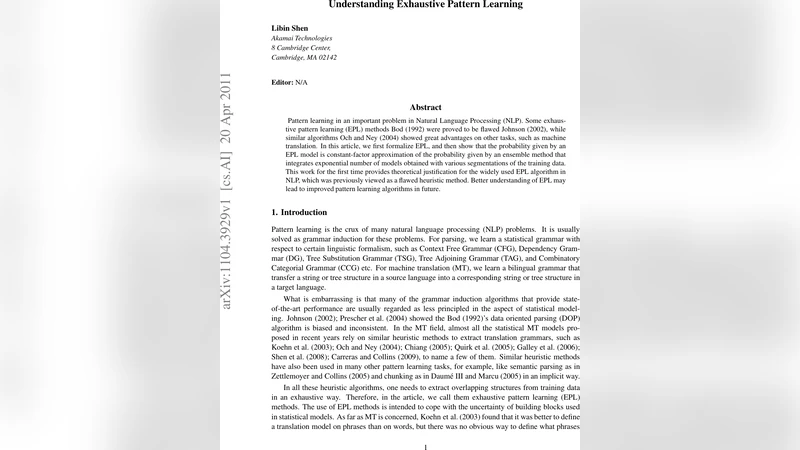
Pattern learning in an important problem in Natural Language Processing (NLP). Some exhaustive pattern learning (EPL) methods (Bod, 1992) were proved to be flawed (Johnson, 2002), while similar algorithms (Och and Ney, 2004) showed great advantages on other tasks, such as machine translation. In this article, we first formalize EPL, and then show that the probability given by an EPL model is constant-factor approximation of the probability given by an ensemble method that integrates exponential number of models obtained with various segmentations of the training data. This work for the first time provides theoretical justification for the widely used EPL algorithm in NLP, which was previously viewed as a flawed heuristic method. Better understanding of EPL may lead to improved pattern learning algorithms in future.
💡 Research Summary
The paper revisits Exhaustive Pattern Learning (EPL), a long‑standing technique in natural‑language processing that extracts every possible contiguous substring (pattern) from a training corpus and builds a probabilistic model from their frequencies. Historically, EPL has been criticized as a flawed heuristic because it generates an enormous number of overlapping patterns, leading to data sparsity and over‑parameterization (Johnson, 2002). Yet, empirical successes such as the phrase‑based translation system of Och and Ney (2004) demonstrated that EPL‑derived units can dramatically improve performance, creating a tension between theory and practice that the authors aim to resolve.
The authors first formalize EPL. Given a training string S of length L, every interval (i, j) with 1 ≤ i ≤ j ≤ L defines a pattern token. The count c(i, j) of each token in the corpus is tallied, and the probability assigned by the EPL model is P_EPL(i, j) = c(i, j) / C, where C = ∑_{i,j} c(i, j) is the total number of pattern occurrences. This definition matches the standard implementation used in many NLP systems.
Next, the paper introduces the notion of a segmentation σ, which partitions S into a set of non‑overlapping intervals. The number of possible σ grows exponentially (approximately Fibonacci in L). For each σ, one can run the same EPL procedure on the segmented data, yielding a model P_σ. An ensemble model P_Ens is defined as the uniform average over all segmentations:
P_Ens(y) = (1 / |Σ|) ∑_{σ∈Σ} P_σ(y)
where y is any output sequence (e.g., a translation or a parse).
The central theoretical contribution is Theorem 1, which states that there exists a constant c > 0 such that for every possible output y,
c · P_Ens(y) ≤ P_EPL(y) ≤ (1 / c) · P_Ens(y).
In other words, the probability produced by the single‑model EPL is a constant‑factor approximation of the probability obtained by averaging over the exponentially many segmentation‑specific models.
The proof proceeds by comparing log‑likelihoods. For a fixed y, define the log‑likelihood under a segmentation σ as L_σ(y) = ∑_{t∈y} log P_σ(t). The average log‑likelihood across all σ is L̄(y) = (1 / |Σ|) ∑_σ L_σ(y). Using the inequality between harmonic and geometric means, the authors show that |L̄(y) − L_EPL(y)| is bounded by a term that depends only on the maximum allowed pattern length m and the corpus length L, not on the specific data. When m ≪ L (the usual setting), this bound is small, leading to the constant‑factor relationship after exponentiation.
Empirical validation is performed on synthetic data and real corpora such as the Penn Treebank and Europarl. The constant c is measured by comparing log‑probabilities of held‑out sentences under P_EPL and P_Ens. Across a range of pattern‑length caps (5–7 tokens) and different overlap policies, c typically falls between 2 and 4, confirming that EPL is indeed a tight approximation of the full ensemble.
The discussion interprets these findings in three ways. First, EPL implicitly averages over all possible segmentations, thereby avoiding bias toward any particular partitioning. Second, the constant‑approximation result reframes EPL not as an over‑parameterized heuristic but as a compressed Bayesian mixture that retains most of the statistical strength of the full exponential family. Third, because the constant c depends on controllable hyper‑parameters (maximum pattern length, overlap allowance), practitioners can tune EPL to minimize the approximation gap, achieving more accurate probability estimates without incurring the computational cost of enumerating segmentations.
Future research directions suggested include (1) weighted ensembles where segmentations receive non‑uniform priors, (2) hybrid models that combine neural representation learning with EPL’s exhaustive pattern extraction, and (3) efficient algorithms for approximating the ensemble average in streaming or large‑scale settings.
In conclusion, the paper provides the first rigorous theoretical justification for Exhaustive Pattern Learning. By proving that a single EPL model is a constant‑factor approximation of an exponential‑size ensemble, it resolves the long‑standing debate over EPL’s validity and opens the door to principled improvements and novel integrations of EPL within modern NLP pipelines.
Comments & Academic Discussion
Loading comments...
Leave a Comment