On mean-square boundedness of stochastic linear systems with quantized observations
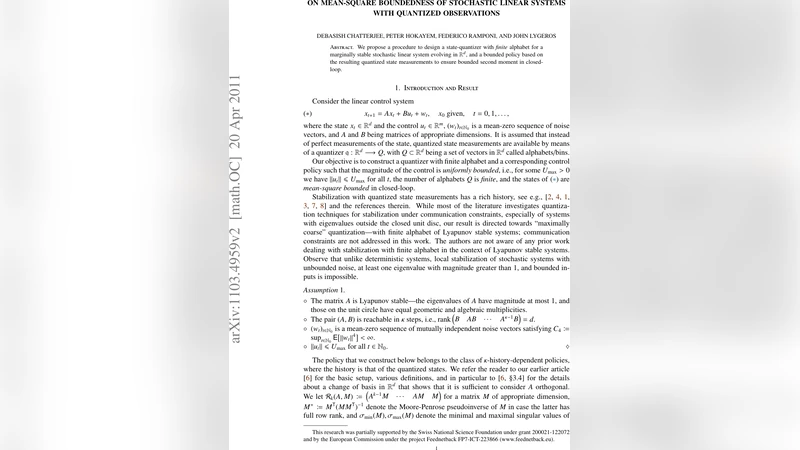
We propose a procedure to design a state-quantizer with finitely many bins for a marginally stable stochastic linear system evolving in $\R^d$, and a bounded policy based on the resulting quantized state measurements to ensure bounded second moment in closed-loop.
💡 Research Summary
The paper addresses the problem of guaranteeing mean‑square boundedness for discrete‑time stochastic linear systems when only quantized state measurements are available. The plant dynamics are given by
(x_{t+1}=A x_{t}+w_{t}),
where (A\in\mathbb{R}^{d\times d}) is marginally stable (spectral radius ≤ 1) and ({w_{t}}) is an i.i.d. zero‑mean noise sequence with finite covariance (\Sigma_{w}). Classical results on mean‑square stability assume continuous‑valued state feedback; however, in digital communication settings the sensor output must be quantized before transmission, which introduces a new source of error.
The authors propose a two‑stage design. First, they construct a finite‑bin state quantizer. The state space (\mathbb{R}^{d}) is partitioned into a central spherical cell of radius (r) around the origin and a collection of outer spherical cells of equal radius (R). Each cell is represented by its center (\xi_{i}). The quantizer (Q:\mathbb{R}^{d}\rightarrow\mathcal{C}) maps any state to the center of the cell containing it. By choosing the number of cells (N=2^{B}) (where (B) is the number of bits) and the radii appropriately, the quantization error (e_{t}=x_{t}-Q(x_{t})) satisfies (|e_{t}|\le\delta) for a known bound (\delta) that depends on (R) and the geometry of the partition.
Second, a bounded feedback law based on the quantized state is introduced:
(u_{t}=K,\hat{x}{t},\qquad \hat{x}{t}=Q(x_{t})).
The gain matrix (K\in\mathbb{R}^{m\times d}) is selected so that the closed‑loop matrix (A_{\text{cl}}=A+BK) has spectral radius (\rho(A_{\text{cl}})<1). The authors formulate a linear matrix inequality (LMI) that incorporates the quantization error bound (\delta) and the noise covariance (\Sigma_{w}). Feasibility of this LMI yields a gain (K) that simultaneously stabilizes the nominal system and compensates for the quantization distortion.
The core theoretical contribution is a Lyapunov‑type inequality for the second moment. With a positive‑definite matrix (P) defining (V(x)=x^{\top}Px), one obtains
\
Comments & Academic Discussion
Loading comments...
Leave a Comment