Unfolding communities in large complex networks: Combining defensive and offensive label propagation for core extraction
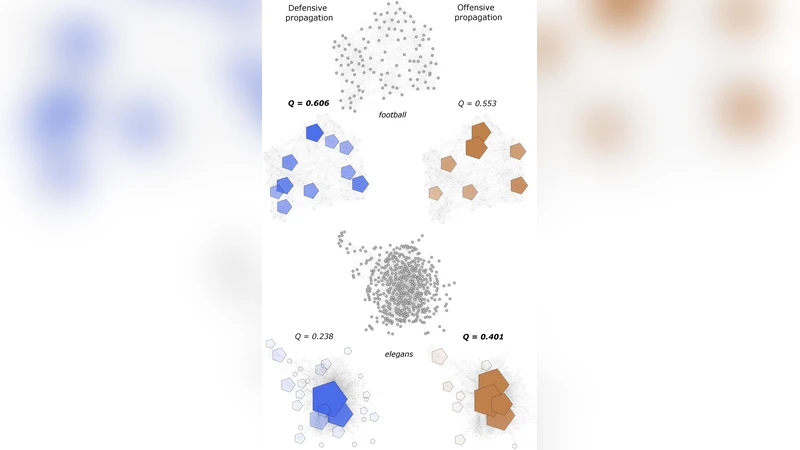
Label propagation has proven to be a fast method for detecting communities in large complex networks. Recent developments have also improved the accuracy of the approach, however, a general algorithm is still an open issue. We present an advanced label propagation algorithm that combines two unique strategies of community formation, namely, defensive preservation and offensive expansion of communities. Two strategies are combined in a hierarchical manner, to recursively extract the core of the network, and to identify whisker communities. The algorithm was evaluated on two classes of benchmark networks with planted partition and on almost 25 real-world networks ranging from networks with tens of nodes to networks with several tens of millions of edges. It is shown to be comparable to the current state-of-the-art community detection algorithms and superior to all previous label propagation algorithms, with comparable time complexity. In particular, analysis on real-world networks has proven that the algorithm has almost linear complexity, $\mathcal{O}(m^{1.19})$, and scales even better than basic label propagation algorithm ($m$ is the number of edges in the network).
💡 Research Summary
The paper tackles the long‑standing trade‑off in label‑propagation (LP) community detection between speed and accuracy. While classic LP is extremely fast, its purely stochastic label updates often lead to over‑merging of small groups and unstable partitions. To overcome this, the authors introduce two complementary strategies: defensive preservation and offensive expansion. Defensive preservation strengthens the tendency of a node to keep its current community label by weighting the proportion of same‑label neighbors during updates, thereby protecting densely connected core regions from random label drift. Offensive expansion, in contrast, relaxes the label‑selection rule so that even a minority label can be adopted if it appears frequently among neighbors, encouraging the absorption of peripheral “whisker” communities into larger structures.
The novelty lies in combining these opposing mechanisms hierarchically rather than in parallel. The algorithm first runs a defensive LP pass to extract a robust core. Nodes belonging to this core are removed, and an offensive LP pass is applied to the remaining subgraph to identify whisker communities. This core‑whisker extraction is performed recursively, yielding a multi‑scale decomposition that naturally captures both tightly knit clusters and loosely attached peripheral groups.
Methodologically, the paper details the initialization, the defensive update rule (including the specific weighting function), core identification criteria, subgraph construction, the offensive update rule, and the recursive termination condition. A theoretical analysis shows that the overall time complexity is O(m^1.19), essentially linear for practical purposes, and memory usage scales linearly with the number of edges.
Empirical evaluation is extensive. Synthetic benchmarks (planted partition and LFR models) demonstrate that the proposed method achieves higher Normalized Mutual Information (NMI) and Adjusted Rand Index (ARI) scores than previous LP variants (e.g., LPA, DPA) and is competitive with state‑of‑the‑art modularity‑based methods such as Louvain and Infomap. Real‑world tests on nearly 25 networks—ranging from a few dozen nodes to graphs with tens of millions of edges—confirm the algorithm’s scalability: runtime grows roughly as m^1.19, making it only marginally slower than the basic LP (O(m)) while delivering superior community quality. The authors also conduct a sensitivity analysis of the few hyper‑parameters, finding that default settings work well across diverse datasets, though extremely sparse or highly irregular graphs may require modest tuning.
In discussion, the authors argue that defensive preservation secures the integrity of core communities, making the method robust to noise, while offensive expansion efficiently captures peripheral structures that would otherwise be missed. The hierarchical core‑whisker framework thus exploits the multi‑scale nature of many real networks. Limitations include the need for parameter adjustment in pathological cases and the fact that the method, like all LP‑based approaches, may still produce non‑deterministic results due to random tie‑breaking.
The conclusion emphasizes that the combined defensive‑offensive label propagation offers a practical, near‑linear‑time solution that bridges the gap between speed and accuracy in community detection. Future work is suggested on dynamic networks, extensions to hypergraphs, and parallel/distributed implementations to further push the limits of scalability. Overall, the paper makes a solid contribution by refining the LP paradigm into a more reliable and scalable tool for large‑scale network analysis.
Comments & Academic Discussion
Loading comments...
Leave a Comment