Existence of a Unique group of finite order
Let $n$ be a positive integer. Then cyclic group $Z_n$ of order $n$ is the only group of order $n$ iff g.c.d. $(n, phi(n))=1$, where $ phi$ denotes the Euler-phi function. In this article we have give
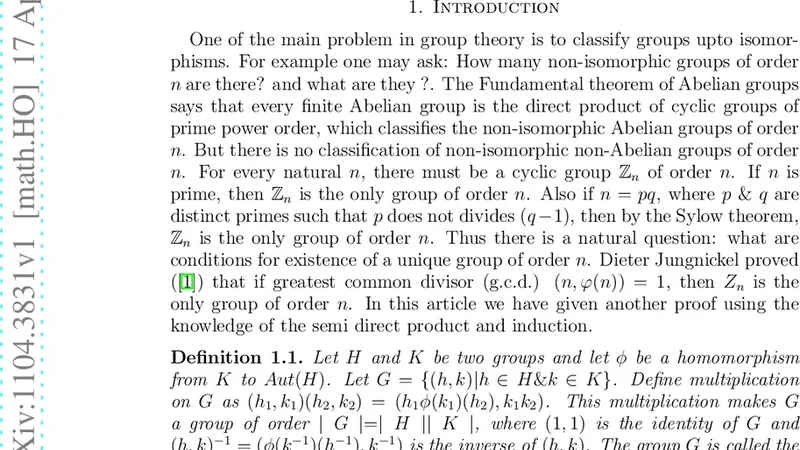
Let $n$ be a positive integer. Then cyclic group $Z_n$ of order $n$ is the only group of order $n$ iff g.c.d. $(n,\phi(n))=1$, where $\phi$ denotes the Euler-phi function. In this article we have given another proof of this result using the knowledge of semi direct product and induction.
💡 Research Summary
The paper revisits a classical result in finite group theory: a finite group of order $n$ is unique (and necessarily cyclic) if and only if $\gcd!\bigl(n,\varphi(n)\bigr)=1$, where $\varphi$ denotes Euler’s totient function. While the statement is well‑known, the author supplies a fresh proof that relies primarily on the theory of semidirect products and mathematical induction, rather than on the usual Sylow‑theoretic arguments or Burnside’s $p^{a}q^{b}$ theorem.
The proof is divided into two logical directions.
Sufficiency ($\gcd(n,\varphi(n))=1 \Rightarrow$ uniqueness).
First, write $n$ as a product of prime powers $n=p_{1}^{a_{1}}\cdots p_{k}^{a_{k}}$. For each $i$, the Sylow $p_{i}$‑subgroup $P_{i}$ of any group $G$ of order $n$ has order $p_{i}^{a_{i}}$. Because $\gcd(p_{i}^{a_{i}},\varphi(p_{i}^{a_{i}}))=1$, $P_{i}$ must be cyclic; indeed $P_{i}\cong\mathbb Z_{p_{i}^{a_{i}}}$.
The key observation is that a non‑trivial semidirect product $P_{i}\rtimes P_{j}$ can exist only if there is a non‑trivial homomorphism $P_{i}\to\operatorname{Aut}(P_{j})$. Since $|\operatorname{Aut}(P_{j})|=\varphi(p_{j}^{a_{j}})$, such a homomorphism would force $p_{i}$ to divide $\varphi(p_{j}^{a_{j}})$. The hypothesis $\gcd(n,\varphi(n))=1$ guarantees that for any distinct $i,j$, $p_{i}\nmid\varphi(p_{j}^{a_{j}})$. Consequently every $Hom(P_{i},\operatorname{Aut}(P_{j}))$ is trivial, and all Sylow subgroups centralise each other. Hence $G$ is the direct product $P_{1}\times\cdots\times P_{k}$.
Because the orders $p_{i}^{a_{i}}$ are pairwise coprime, the direct product of cyclic groups of these orders is again cyclic; explicitly $P_{1}\times\cdots\times P_{k}\cong\mathbb Z_{n}$. Thus any group of order $n$ must be isomorphic to the cyclic group $\mathbb Z_{n}$, establishing uniqueness.
Necessity ($\gcd(n,\varphi(n))\neq1 \Rightarrow$ non‑uniqueness).
Assume a prime $p$ divides both $n$ and $\varphi(n)$. Write $n=p^{a}m$ with $(p,m)=1$. The automorphism group of the cyclic $p$‑group $\mathbb Z_{p^{a}}$ has order $\varphi(p^{a})=p^{a-1}(p-1)$, which is divisible by $p$. Therefore there exists a non‑trivial element of order $p$ in $\operatorname{Aut}(\mathbb Z_{p^{a}})$. Choose a subgroup $K\le\operatorname{Aut}(\mathbb Z_{p^{a}})$ of order $p$ and let $H\cong\mathbb Z_{m}$ act on $\mathbb Z_{p^{a}}$ via a homomorphism $H\to K$. The resulting semidirect product $\mathbb Z_{p^{a}}\rtimes\mathbb Z_{m}$ has order $n$ but is not cyclic (indeed it is non‑abelian when the action is non‑trivial). This construction provides a concrete counter‑example, proving that the cyclic group is not unique when $\gcd(n,\varphi(n))\neq1$.
The proof proceeds by induction on the number $k$ of distinct prime divisors of $n$. The base case $k=1$ is immediate because a $p$‑power order group with $\gcd(p^{a},\varphi(p^{a}))=1$ must be cyclic. Assuming the statement holds for $k-1$ primes, the argument above shows that any additional Sylow subgroup cannot interact non‑trivially with the existing direct product, forcing the whole group to be a direct product of cyclic Sylow subgroups, and thus cyclic.
Significance and Outlook.
By framing the problem in terms of semidirect products, the author highlights a structural reason why the arithmetic condition $\gcd(n,\varphi(n))=1$ forces all possible actions between Sylow subgroups to be trivial. This viewpoint complements the more traditional Sylow‑centric proofs and underscores the deep interplay between number‑theoretic invariants (Euler’s function) and group‑theoretic constructions (automorphism groups, semidirect products).
The paper also discusses explicit examples: for $n=21=3\cdot7$, $\gcd(21,\varphi(21))=3$, and the non‑trivial semidirect product $\mathbb Z_{7}\rtimes\mathbb Z_{3}$ yields a non‑abelian group of order 21. Conversely, for $n=15$, $\gcd(15,\varphi(15))=1$, so the only group of order 15 is $\mathbb Z_{15}$.
Finally, the author suggests that the method may be extended to investigate cases where $\gcd(n,\varphi(n))$ is small but not equal to 1, potentially leading to partial classification results for groups whose order shares limited common factors with their totient. The paper thus not only re‑proves a known theorem with a fresh technique but also opens avenues for further research at the intersection of elementary number theory and finite group structure.
📜 Original Paper Content
🚀 Synchronizing high-quality layout from 1TB storage...