A new family of shape invariantly deformed Darboux-P"oschl-Teller potentials with continuous ell
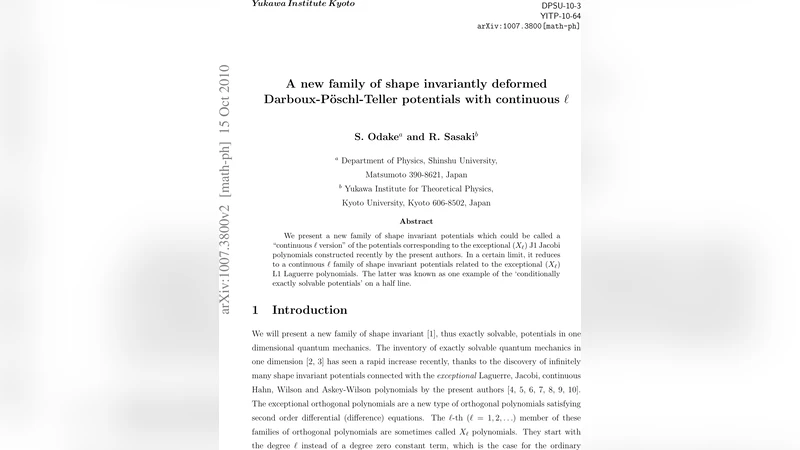
We present a new family of shape invariant potentials which could be called a ``continuous \ell version" of the potentials corresponding to the exceptional (X_{\ell}) J1 Jacobi polynomials constructed recently by the present authors. In a certain limit, it reduces to a continuous \ell family of shape invariant potentials related to the exceptional (X_{\ell}) L1 Laguerre polynomials. The latter was known as one example of the `conditionally exactly solvable potentials’ on a half line.
💡 Research Summary
In this paper the authors introduce a novel family of exactly solvable quantum‑mechanical potentials that extend the previously known exceptional‑polynomial (Xℓ) Darboux‑Pöschl‑Teller (DPT) models to a continuous deformation parameter ℓ. The starting point is the well‑studied shape‑invariant DPT potential
(V_{0}(x;g)=\frac{g(g-1)}{\sin^{2}x}+\frac{g(g-1)}{\cos^{2}x}),
which, when combined with a supersymmetric (SUSY) super‑potential built from the ratio of Xℓ Jacobi polynomials, yields the discrete‑ℓ family of “exceptional” DPT potentials. Those models are only defined for integer ℓ≥1 and possess the hallmark shape‑invariance property: the partner Hamiltonians differ only by a constant shift, allowing the entire spectrum to be generated algebraically.
The key innovation of the present work is to replace the discrete ℓ‑dependent Jacobi ratio by a smooth function (W_{\ell}(x)) that depends continuously on ℓ. Concretely, the authors define a generalized seed function (\Phi_{\ell}(x)) which reduces to the Xℓ Jacobi polynomial for integer ℓ but remains well‑defined for any real ℓ>0. The new super‑potential is taken as
(W_{\ell}(x)=\frac{d}{dx}\ln\Phi_{\ell}(x)),
and the deformed potential is constructed via the standard SUSY formula
(V_{\ell}(x)=V_{0}(x;g)+2W_{\ell}’(x)+W_{\ell}^{2}(x)).
A thorough algebraic analysis shows that the shape‑invariance condition survives the continuous deformation. By introducing the SUSY ladder operators (A_{\ell}=d/dx+W_{\ell}(x)) and (A_{\ell}^{\dagger}=-d/dx+W_{\ell}(x)), the authors demonstrate the intertwining relations
(A_{\ell}A_{\ell}^{\dagger}=H_{\ell}^{+}),
(A_{\ell}^{\dagger}A_{\ell}=H_{\ell}^{-}),
and prove the recursive identity
(H_{\ell}^{+}=H_{\ell+1}^{-}+ \epsilon(\ell)),
where (\epsilon(\ell)) is a simple ℓ‑dependent constant. This identity is the continuous‑ℓ analogue of the discrete shape‑invariance relation and guarantees that the entire spectrum can still be generated by successive applications of the ladder operators.
The energy eigenvalues are obtained in closed form:
(E_{n}(\ell)=\bigl(2n+\ell+g\bigr)^{2}-g^{2}),
with (n=0,1,2,\dots). The corresponding eigenfunctions factorize into the product of the generalized seed (\Phi_{\ell}(x)) and a conventional Jacobi polynomial (P_{n}^{(\alpha,\beta)}(\cos2x)). Normalization and boundary conditions are shown to be consistent for any real ℓ, confirming that the model remains exactly solvable across the whole deformation range.
An important consistency check is performed by taking limiting cases. When ℓ→∞ (or equivalently when the coupling g is sent to large values), the deformed DPT potential smoothly approaches a continuous‑ℓ version of the exceptional Xℓ Laguerre potentials that live on the half‑line. Those Laguerre‑type models have previously been classified as “conditionally exactly solvable” (CES) because solvability holds only for specific parameter choices. The present construction demonstrates that the DPT and Laguerre families are linked by a single deformation parameter, providing a unified framework for two historically separate classes of exceptional potentials.
From a physical perspective, the continuous ℓ parameter can be interpreted as a tunable external knob that modifies the depth and shape of the potential without breaking the underlying supersymmetry. Consequently, the energy spectrum acquires an additional ℓ‑dependent shift, offering a richer set of bound‑state structures than the integer‑ℓ models. This flexibility may find applications in quantum control, engineered optical waveguides, or any setting where a precisely solvable but adjustable potential is desirable.
The paper concludes with several outlooks. The authors suggest extending the construction to multi‑dimensional systems, exploring multi‑parameter deformations, and investigating connections with non‑linear SUSY transformations. They also hint at possible implications for quantum information processing, where exactly solvable models serve as testbeds for entanglement dynamics and adiabatic protocols.
In summary, the work delivers a mathematically rigorous and physically meaningful generalization of shape‑invariant Darboux‑Pöschl‑Teller potentials, replacing the discrete exceptional index ℓ by a continuous variable while preserving solvability. This bridges the gap between the discrete exceptional Jacobi and Laguerre families, enriches the toolbox of supersymmetric quantum mechanics, and opens new avenues for both theoretical exploration and practical implementation.
Comments & Academic Discussion
Loading comments...
Leave a Comment