New developments in event generator tuning techniques
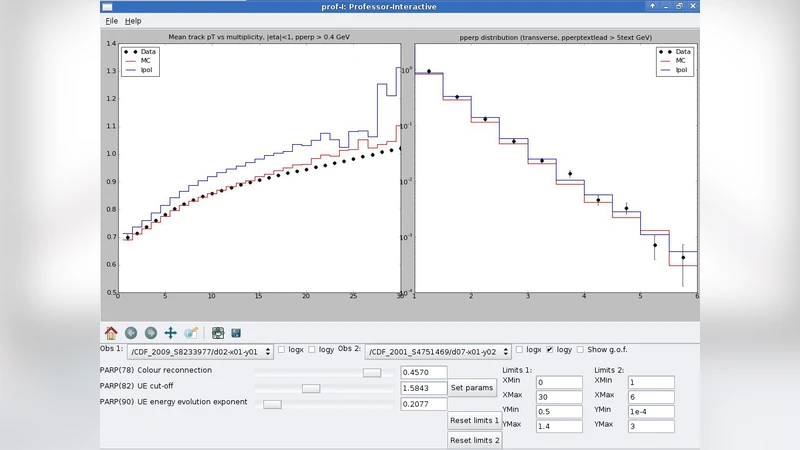
Data analyses in hadron collider physics depend on background simulations performed by Monte Carlo (MC) event generators. However, calculational limitations and non-perturbative effects require approximate models with adjustable parameters. In fact, we need to simultaneously tune many phenomenological parameters in a high-dimensional parameter-space in order to make the MC generator predictions fit the data. It is desirable to achieve this goal without spending too much time or computing resources iterating parameter settings and comparing the same set of plots over and over again. We present extensions and improvements to the MC tuning system, Professor, which addresses the aforementioned problems by constructing a fast analytic model of a MC generator which can then be easily fitted to data. Using this procedure it is for the first time possible to get a robust estimate of the uncertainty of generator tunings. Furthermore, we can use these uncertainty estimates to study the effect of new (pseudo-) data on the quality of tunings and therefore decide if a measurement is worthwhile in the prospect of generator tuning. The potential of the Professor method outside the MC tuning area is presented as well.
💡 Research Summary
The paper addresses a central challenge in modern hadron‑collider physics: the tuning of Monte Carlo (MC) event generators. Generators such as Pythia, Herwig, or Sherpa contain dozens of phenomenological parameters that model perturbative QCD, parton showers, hadronisation, and underlying‑event activity. To obtain reliable background predictions, these parameters must be adjusted so that the generator output matches a broad set of experimental measurements. Traditional tuning is labor‑intensive: each iteration requires a full MC run, histogram production, and visual comparison, often amounting to thousands of CPU hours and repeated human inspection.
The authors present a substantial extension of the Professor system, a framework that replaces the costly iterative MC loop with a fast analytic surrogate model. The method proceeds in three stages. First, a carefully designed sampling of the high‑dimensional parameter space is performed, typically using Latin Hypercube or other space‑filling designs. For each sampled point a modest number of MC events are generated and the relevant observables (histogram bins, cross sections, shape variables) are recorded. Second, each observable is fitted with a multivariate polynomial (or, in more recent implementations, a Gaussian‑process regression) as a function of the generator parameters. This yields a closed‑form expression that can be evaluated instantly for any parameter set. Third, the surrogate model is used in a conventional χ² minimisation (e.g., with Minuit or BFGS) to locate the best‑fit parameters. Because the model is analytic, gradients are readily available, allowing a precise determination of the covariance matrix and, crucially, a robust estimate of the tuning uncertainty that includes both statistical fluctuations and the surrogate‑model approximation error.
A major innovation is the systematic propagation of these uncertainties to assess the impact of prospective measurements. By inserting pseudo‑data—synthetic points with realistic experimental errors—into the χ² function, the authors can predict how much a new observable would tighten the parameter constraints or shift the best‑fit values. This capability enables a quantitative “value‑of‑information” analysis before an experiment is performed, guiding the allocation of detector time and analysis effort toward measurements that most improve generator fidelity.
The paper validates the approach on several standard tunes of Pythia and Herwig. Compared with traditional manual tuning, the Professor‑based procedure reaches comparable or lower χ² values with an order of magnitude fewer full MC runs. The resulting parameter uncertainties are explicitly reported, something rarely done in legacy tunes. Moreover, the authors demonstrate that the surrogate model can be repurposed beyond generator tuning: it can serve as a fast emulator for theory‑parameter scans, for propagating theoretical uncertainties into experimental analyses, or for optimisation studies in detector design.
In summary, the work delivers (1) an efficient sampling‑and‑regression strategy that builds a fast, differentiable surrogate of any MC generator, (2) a rigorous framework for extracting both best‑fit parameters and their full covariance, (3) a pre‑emptive assessment tool for the utility of new (or pseudo) data in tightening those fits, and (4) a proof‑of‑concept that the same methodology can be applied to a wide range of high‑dimensional modelling problems in particle physics and beyond. By dramatically reducing the computational burden of tuning while providing quantitative uncertainty estimates, this development promises to accelerate the feedback loop between experiment and theory, improve the reliability of background predictions, and inform smarter experimental planning in the era of high‑luminosity colliders.
Comments & Academic Discussion
Loading comments...
Leave a Comment