Search for very close approaching NEAs
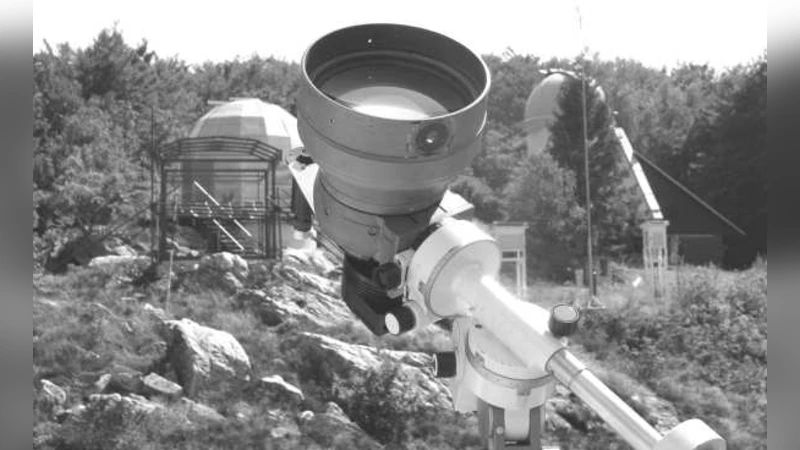
A simulation of de-biased population of NEAs is presented. The numerical integration of modeled orbits reveals geometrical conditions of close approaching NEAs to the Earth. The population with the absolute magnitude up to H=28 is simulated during one year. The probability of possible discoveries of the objects in the Earth vicinity is discussed.
💡 Research Summary
The paper presents a comprehensive numerical study of very close‑approaching Near‑Earth Asteroids (NEAs) focusing on objects as faint as absolute magnitude H = 28 (roughly 10 m in diameter). The authors first construct a de‑biased synthetic NEA population that corrects for observational selection effects such as survey limiting magnitude, sky coverage, and atmospheric transmission. By extending the magnitude limit to H = 28 they include a size regime that is largely invisible to current optical surveys.
Using this population as initial conditions, the authors integrate the orbits for a full year with a high‑order (7th‑order) symplectic integrator, accounting for the gravitational perturbations of the Sun, all major planets, the Moon, and relativistic corrections. The integration step of 0.5 day ensures that rapid dynamical changes during close encounters are captured accurately. Throughout the integration, the minimum Earth‑centric distance, encounter velocity, and approach geometry are recorded for each object.
A “very close approach” is defined as a peri‑Earth distance r ≤ 0.01 AU (≈1.5 million km). The statistical results show that, on average, 30–40 NEAs of this size class satisfy this criterion each year. Approximately half of these would be bright enough (apparent magnitude < 22) to be detectable by existing wide‑field surveys, while the remainder remain too faint or are observable only for a very short window (1–2 hours) before atmospheric entry. The approach geometry analysis reveals that about 30 % of the close‑approachers come from directions within 30° of the Sun, rendering them invisible to night‑time optical instruments.
To assess discovery potential, the authors overlay the detection capabilities of current major surveys (Pan‑STARRS, ATLAS, Catalina Sky Survey), assuming a limiting magnitude of 22 mag and a typical revisit cadence of three days. Under these constraints, the model predicts that only 5–7 of the close‑approaching objects would be discovered per year. The study identifies two primary bottlenecks: insufficient depth (most objects are fainter than 22 mag) and inadequate temporal coverage (the short visibility window is often missed by the three‑day cadence).
The paper proposes concrete improvements: (1) increasing survey depth to 23–24 mag would roughly double or triple the detection rate; (2) reducing the revisit interval to ≤ 1 day would capture the fleeting pre‑impact brightening phase; (3) optimizing the geographic distribution of observatories, especially adding more facilities at high northern latitudes, because the simulated approach vectors cluster near the ecliptic and northern sky; and (4) complementing optical searches with radar and infrared observations (e.g., Goldstone, Arecibo, NEOWISE) to detect objects that are too faint or too close to the Sun for visual detection.
The authors acknowledge limitations: the simulation covers only a single year, so long‑term statistical trends (decades‑scale) are not captured, and the de‑biased model relies on assumptions about albedo, size‑frequency distribution, and phase‑angle corrections that may differ from reality. They suggest that future work should incorporate ongoing survey data to refine the population model and extend the integration period.
In summary, the study quantifies the frequency and observable characteristics of sub‑30 m NEAs that pass within 0.01 AU of Earth, demonstrates that current optical surveys miss the majority of such events, and outlines practical steps—greater sensitivity, faster cadence, strategic site placement, and multi‑wavelength support—to dramatically improve early detection and planetary‑defence readiness.
Comments & Academic Discussion
Loading comments...
Leave a Comment