Kan Extensions in Context of Concreteness
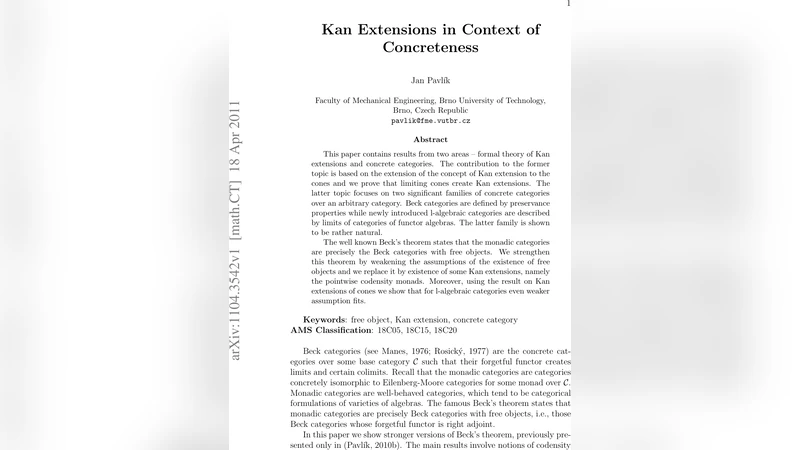
This paper contains results from two areas – formal theory of Kan extensions and concrete categories. The contribution to the former topic is based on the extension of the concept of Kan extension to the cones and we prove that limiting cones create Kan extensions. The latter topic focuses on two significant families of concrete categories over an arbitrary category. Beck categories are defined by preservance properties while newly introduced l-algebraic categories are described by limits of categories of functor algebras. The latter family is shown to be rather natural. The well known Beck’s theorem states that the monadic categories are precisely the Beck categories with free objects. We strengthen this theorem by weakening the assumptions of the existence of free objects and we replace it by existence of some Kan extensions, namely the pointwise codensity monads. Moreover, using the result on Kan extensions of cones we show that for l-algebraic categories even weaker assumption fits.
💡 Research Summary
The paper bridges two traditionally separate areas: the formal theory of Kan extensions and the study of concrete categories. Its first contribution is a categorical generalisation of Kan extensions from functors to cones. By working in a 2‑category setting, the author defines a Δ‑2‑universal object (a limiting cone) and shows that such cones automatically generate right Kan extensions. The central result (Theorem 1.10) states that “limiting cones create Kan extensions”: given a diagram D:𝔻→CAT with limit L and limiting cone L={Lₙ:L→Dₙ}, for any functors V:A→B and S:A→L, the existence of Ran Δ V K (where K=L∘Δ S) guarantees the existence of Ran V S, and moreover Ran V S is obtained by composing L with Ran Δ V K. Dually, limiting cones also create left Kan extensions. This establishes a powerful universal property: any limit in a 2‑category yields a family of Kan extensions without extra construction.
The second part turns to concrete categories over a base category C. Two families are examined. Beck categories (originally introduced by Manes and Rosický) are concrete categories whose forgetful functor creates all limits and U‑absolute coequalisers; they include all algebraic categories and are known to be monadic precisely when they possess free objects (Beck’s theorem). The author introduces a new class, called l‑algebraic categories, defined as limits of categories of functor algebras Alg F for various endofunctors F:C→C. This construction captures most familiar algebra‑like structures (monad algebras, varieties, etc.) and is shown to be a natural, closed under limits, and automatically a Beck category.
The core achievement is a strengthening of Beck’s theorem. Instead of requiring free objects, the paper replaces this hypothesis with the existence of a pointwise codensity monad for the forgetful functor. For a concrete category (A,U), the codensity monad M is the right Kan extension Ran U U; when this Kan extension is pointwise, each object of C admits a limit of the corresponding comma category, yielding a monad whose Eilenberg–Moore category is precisely the category of U‑algebras. The main characterisations proved are:
- A Beck category equipped with a pointwise codensity monad is monadic.
- An l‑algebraic category equipped with a (not necessarily pointwise) codensity monad is monadic.
The proof exploits the earlier result on cones: limiting cones in the diagram of functor‑algebra categories produce the required Kan extensions, thereby guaranteeing the existence of the codensity monad without needing free objects. Consequently, the monadicity of a concrete category can be established under much weaker assumptions.
The paper works within Von Neumann–Bernays–Gödel set theory with classes, allowing both small and large categories. It shows that the meta‑category Con C of C‑concrete categories is closed under limits in the slice CAT/C, and that the functor Alg turns colimits into limits, preserving the algebraic structure needed for the constructions.
In summary, the work provides:
- A novel 2‑categorical perspective on Kan extensions of cones, proving that limits generate Kan extensions.
- The introduction of l‑algebraic categories as a broad, natural class of concrete categories.
- A strengthened version of Beck’s theorem, replacing free objects with (pointwise) codensity monads, and further weakening the hypothesis for l‑algebraic categories. These results deepen the interplay between universal constructions (Kan extensions) and the algebraic structure of concrete categories, offering new tools for recognizing monadicity in a wide range of categorical contexts.
Comments & Academic Discussion
Loading comments...
Leave a Comment