A Correspondence Between Distances and Embeddings for Manifolds: New Techniques for Applications of the Abstract Boundary
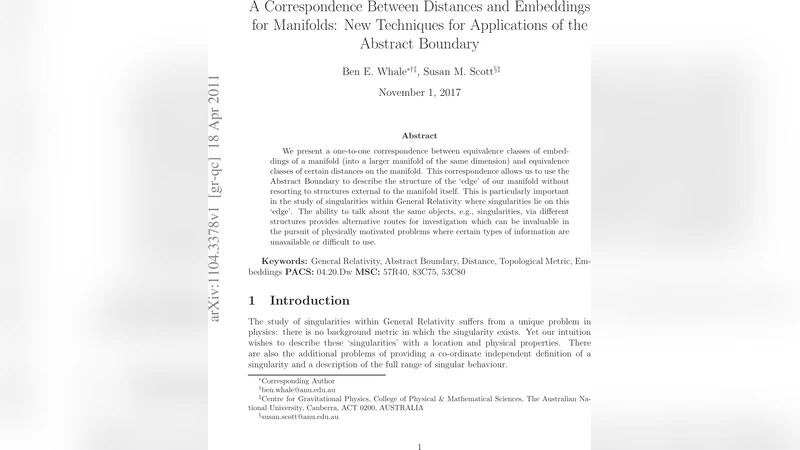
We present a one-to-one correspondence between equivalence classes of embeddings of a manifold (into a larger manifold of the same dimension) and equivalence classes of certain distances on the manifold. This correspondence allows us to use the Abstract Boundary to describe the structure of the edge' of our manifold without resorting to structures external to the manifold itself. This is particularly important in the study of singularities within General Relativity where singularities lie on this edge’. The ability to talk about the same objects, e.g., singularities, via different structures provides alternative routes for investigation which can be invaluable in the pursuit of physically motivated problems where certain types of information are unavailable or difficult to use.
💡 Research Summary
The paper establishes a rigorous one‑to‑one correspondence between equivalence classes of embeddings (also called “envelopments”) of a manifold M into another manifold of the same dimension and equivalence classes of certain distance functions defined on M itself. The motivation stems from the long‑standing problem in General Relativity of describing singularities without relying on an external background metric. Traditional boundary constructions—g‑boundary, b‑boundary, and c‑boundary—use the space‑time metric to locate “missing points” and to attach them to the manifold, but each suffers from various pathologies (dependence on coordinate choices, non‑uniqueness, discontinuities). The Abstract Boundary (a‑boundary) avoids these metric‑related flaws by using only topological information: it considers all possible embeddings of M into larger manifolds of the same dimension and defines boundary points as equivalence classes of limit points of sequences under these embeddings.
However, the a‑boundary’s reliance on the totality of possible embeddings makes it practically inaccessible: to know the complete a‑boundary one would need to catalogue every conceivable embedding, an impossible task for generic space‑times. The authors’ key insight is that the same information can be encoded in a suitably chosen family of distance functions on M. They introduce two parallel equivalence relations:
-
Embedding equivalence (≈) – two embeddings φ and ψ are equivalent if they generate the same set of abstract boundary points, i.e., their partial cross‑sections σ_φ and σ_ψ coincide. This can be expressed in terms of sequences: for every boundary point x of φ(M) there exists a boundary point y of ψ(M) such that the families of sequences converging to x under φ are exactly those converging to y under ψ, and vice‑versa.
-
Distance equivalence (∼) – two distances d and d′ on M are equivalent if they induce the same Cauchy structure on M, meaning that the completions (M_d, d̂) and (M_{d′}, d̂′) are homeomorphic in a way that respects the original manifold points.
The central theorem (Section 5) proves that the quotient set of embeddings modulo ≈ is in bijection with the quotient set of distances modulo ∼. The proof proceeds by constructing three homeomorphisms:
- A homeomorphism f : φ(M) → ψ(M) satisfying f ∘ φ = ψ, showing that equivalent embeddings are related by a topological change of coordinates on the image.
- A homeomorphism between the Cauchy completions (M_d, d̂) and (M_{d′}, d̂′) for equivalent distances.
- A homeomorphism between the closure of φ(M) in its ambient manifold and the Cauchy completion of (M, d_φ), where d_φ is a distance naturally induced by the embedding φ.
The existence of these maps relies on an extension theorem for functions defined on dense subsets of Cauchy spaces, which the authors obtain by invoking the theory of Caucy spaces (a generalisation of metric spaces where uniform continuity is not required). Propositions 3.5, 4.8 and Corollary 4.9 give the precise technical statements guaranteeing the extensions.
Section 6 provides a concrete illustration: a two‑dimensional manifold with a puncture is embedded into the plane, and a distance that “blows up” near the puncture is constructed. The authors show that the abstract boundary point corresponding to the puncture can be recovered either by the embedding or by the distance, confirming the correspondence in a simple setting.
The implications for General Relativity are significant. Since distance functions can often be inferred from physical observables (e.g., proper time along causal curves) even when the full metric is unavailable, the correspondence offers a new route to characterise singularities and other “edge” phenomena without constructing the full set of embeddings. Moreover, distance‑based methods are more amenable to numerical implementation, potentially allowing the computation of abstract boundary structures in simulations of space‑time evolution.
The paper also situates its contribution within the broader landscape of boundary constructions. By showing that the a‑boundary is tightly linked to Caucy‑type completions, the authors bridge the gap between purely topological approaches and metric‑based compactifications such as the Stone‑Čech or Gromov compactifications. This unifies several previously disparate frameworks and suggests that many results proved for one type of boundary may be translated into the language of distances.
Nevertheless, the work has limitations. The correspondence is proved under the assumption that M is a smooth, second‑countable manifold and that the distances considered induce Hausdorff completions. Extensions to non‑Hausdorff or non‑paracompact settings are not addressed. The practical selection of a “good” distance for a given physical space‑time remains an open problem; the authors acknowledge that further work is needed to develop criteria (e.g., curvature bounds, causal compatibility) that would guide this choice. Finally, while the authors claim that the full abstract boundary can be reconstructed from distances, an explicit constructive algorithm for doing so in generic space‑times is left for future research.
In summary, the paper delivers a mathematically elegant and physically promising bridge between embedding‑based and distance‑based descriptions of manifold boundaries. It enriches the toolkit for singularity analysis in General Relativity, opens avenues for computational approaches to the abstract boundary, and deepens the conceptual connections among various boundary constructions in differential geometry.
Comments & Academic Discussion
Loading comments...
Leave a Comment