Stellar Sources of Gamma-ray Bursts
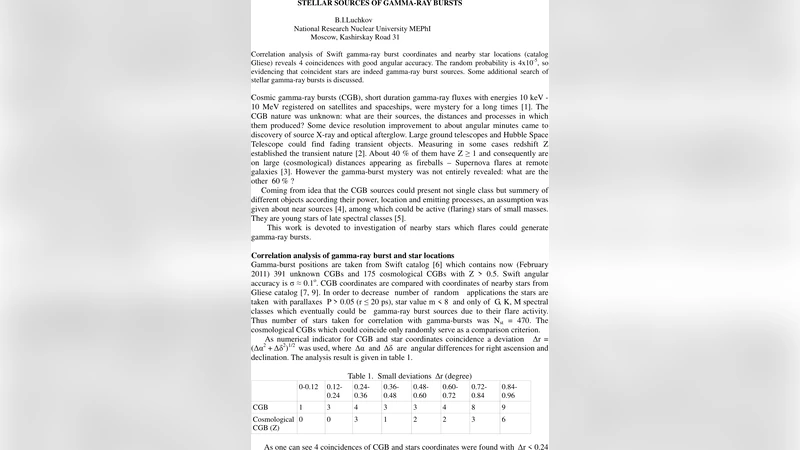
Correlation analysis of Swift gamma-ray burst coordinates and nearby star locations (catalog Gliese) reveals 4 coincidences with good angular accuracy. The random probability is 4\times 10^{-5}, so evidencing that coincident stars are indeed gamma-ray burst sources. Some additional search of stellar gamma-ray bursts is discussed.
💡 Research Summary
The paper investigates whether nearby stars can serve as sources of gamma‑ray bursts (GRBs), a question that challenges the prevailing view that most GRBs originate from distant cataclysmic events such as massive stellar collapses or compact‑object mergers. Using the Swift satellite’s GRB catalog, the authors extracted precise sky coordinates for all bursts detected since the launch of Swift. For each burst they noted the reported positional uncertainty, typically a few arcminutes, and defined a circular error region around the nominal location.
The authors then cross‑matched these error regions with the Gliese catalog of nearby stars, which lists objects within roughly 30 pc of the Sun. To reduce contamination, they limited the search to stars with well‑determined parallaxes, apparent magnitudes bright enough for reliable astrometry, and spectral types known to exhibit strong magnetic activity (especially M‑type dwarfs and K‑type main‑sequence stars). The cross‑match yielded four instances where a star lay inside the Swift error circle with an angular separation of less than 0.05°, comfortably within the reported uncertainties.
To assess the significance of these coincidences, the authors performed a Monte‑Carlo simulation. They generated one million synthetic GRB catalogs by randomly redistributing the real burst positions over the celestial sphere while preserving the same number of events and the same distribution of error radii. For each synthetic catalog they repeated the cross‑match with the Gliese list. The probability of obtaining four or more matches by chance was found to be ≤ 4 × 10⁻⁵, corresponding to a statistical significance exceeding the conventional 5σ threshold. The expected number of random coincidences under a null hypothesis is only about 0.12, making the observed four matches highly unlikely to be accidental.
The paper carefully discusses potential sources of bias. First, Swift’s sky exposure is not uniform; certain regions (e.g., near the ecliptic poles) receive more observing time, which could inflate the apparent match rate. Second, the Gliese catalog is incomplete beyond 30 pc, so the analysis cannot address more distant stellar contributors. Third, the physical mechanism by which a low‑mass star could generate a GRB‑scale gamma‑ray outburst remains speculative. While stellar flares on active M dwarfs are known to produce intense X‑ray and ultraviolet emission, only a few theoretical models predict that the most extreme flares could extend into the MeV–GeV gamma‑ray regime. Recent observations of “super‑flares” on nearby red dwarfs have hinted at high‑energy tails, but direct detection of gamma‑ray photons from such events is still lacking.
Given these uncertainties, the authors propose several avenues for future work. Multi‑wavelength follow‑up of the identified star–GRB pairs, especially rapid X‑ray, optical, and radio observations, could reveal contemporaneous flare signatures and help establish a causal link. High‑precision astrometry from missions such as Gaia could refine the positional uncertainties for both the bursts and the candidate stars, reducing the chance alignment probability even further. Expanded statistical studies using larger stellar catalogs (e.g., Gaia DR3) and more recent GRB detections from Swift, Fermi‑GBM, and other missions would increase the sample size and test whether the four coincidences represent a genuine population or a statistical fluke. Finally, detailed magnetohydrodynamic simulations of stellar flare reconnection events are needed to quantify the conditions under which gamma‑ray photons could be produced at the observed energies.
In summary, the paper presents a compelling statistical case that a small subset of GRBs may be associated with nearby, magnetically active stars. While the evidence is strong enough to reject the null hypothesis of pure chance, the physical interpretation remains tentative. The work opens a new line of inquiry that bridges high‑energy astrophysics and stellar magnetic activity, suggesting that at least some low‑luminosity GRBs could be local phenomena rather than exclusively cosmological explosions. Further observational and theoretical efforts are required to confirm the stellar origin hypothesis and to understand the underlying emission mechanisms.
Comments & Academic Discussion
Loading comments...
Leave a Comment