Unfolding in ATLAS
These proceedings present the unfolding techniques used so far in ATLAS. Two representative examples are discussed in detail; one using bin-by-bin correction factors, and the other iterative unfolding.
💡 Research Summary
The paper provides a concise yet thorough overview of the unfolding techniques employed by the ATLAS experiment up to early 2011, focusing on two representative methods: a simple bin‑by‑bin correction‑factor approach and the iterative Bayesian unfolding proposed by D’Agostini. After a brief introduction to the concept of unfolding—recovering the “truth‑level” distribution of an observable from data distorted by detector effects and finite statistics—the authors describe the practical implementation of each method in real ATLAS analyses.
In the first part, the bin‑by‑bin method is illustrated with the inclusive jet transverse‑momentum (pT) measurement. Monte‑Carlo (MC) simulations (PYTHIA 6 QCD) are used to obtain the expected number of events at truth level (Ti) and at detector level after selection (Ri) for each pT bin. The correction factor Ci = Ti / Ri is computed, and the unfolded estimate Ui = Ci · Di is obtained by multiplying the factor with the observed data count Di. Statistical uncertainties are derived from a Neyman construction assuming Poisson fluctuations, approximated by symmetric 68 % confidence intervals. Systematic uncertainties are broken down into four dominant sources: (i) finite MC statistics affecting Ci, (ii) jet‑pT resolution (±15 % assumed), (iii) possible mismodelling of the true spectrum shape, and (iv) the jet energy scale (JES). The JES uncertainty dominates, contributing roughly 40 % of the total error band shown in the unfolded spectrum. The authors discuss how each systematic is propagated, for example by re‑smearing jets, re‑weighting MC spectra, or shifting jet energies by ±1σ and recomputing Ci.
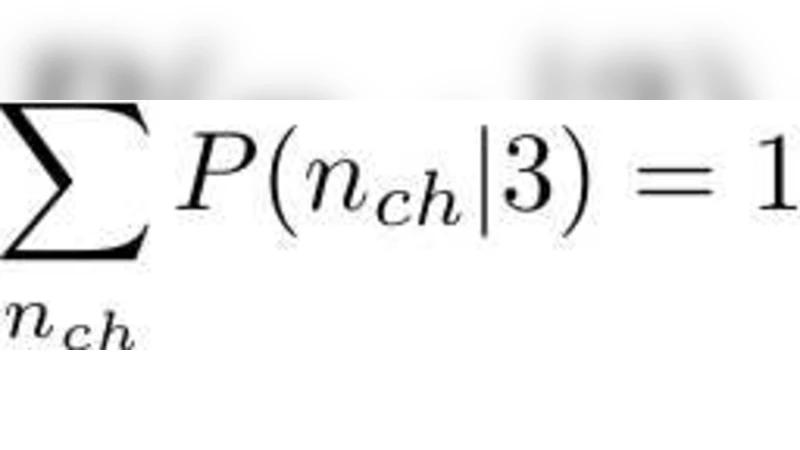
The second part presents the iterative Bayesian unfolding applied to the charged‑particle multiplicity distribution in minimum‑bias pp collisions. Here the “cause” is the true number of charged particles nch and the “effect” is the number of reconstructed tracks ntrk (with ntrk ≤ nch due to tracking inefficiency). A migration matrix P(ntrk | nch) is built from PYTHIA minimum‑bias MC, and Bayes’ theorem is used to obtain the posterior probability P(nch | ntrk). An initial prior P0(nch) is taken from the same MC. The unfolding proceeds iteratively, updating the estimate of the true distribution after each step. The number of iterations is chosen by a convergence criterion based on χ² between successive iterations (χ²/Nbins < 1), which in the ATLAS study leads to four iterations. The efficiency ε(nch) = P(ntrk ≥ 2 | nch) is needed; instead of extracting it directly from MC, the authors model it with a simple parametric form assuming a constant effective track‑finding probability εeff, calibrated to match the MC value for nch = 2. The final unfolded multiplicity spectrum is compared with data and several MC models (PYTHIA AMBT1, MC09, DW, PYTHIA 8, PHOJET), showing reasonable agreement and providing a quantitative assessment of systematic uncertainties.
Throughout the paper the authors emphasize the complementary nature of the two methods. The bin‑by‑bin approach is fast, transparent, and suitable when bin‑to‑bin migrations are small, but it neglects correlations and can be biased if the MC does not accurately describe the true spectrum. The iterative Bayesian method handles full migration matrices and correlations, yielding more reliable results for observables with strong smearing, yet it depends on the choice of prior and the number of iterations, and it is computationally more demanding. The authors note that ATLAS is exploring more sophisticated regularisation techniques and multivariate unfolding to address the limitations identified.
In summary, the paper serves as a practical guide to ATLAS unfolding practices, detailing the mathematical formulation, implementation steps, treatment of statistical and systematic uncertainties, and real‑world performance of both bin‑by‑bin correction factors and iterative Bayesian unfolding. It provides valuable insight for analysts planning precision measurements where the unfolded distribution itself is the quantity of interest.
Comments & Academic Discussion
Loading comments...
Leave a Comment