A Coinductive Calculus for Asynchronous Side-effecting Processes
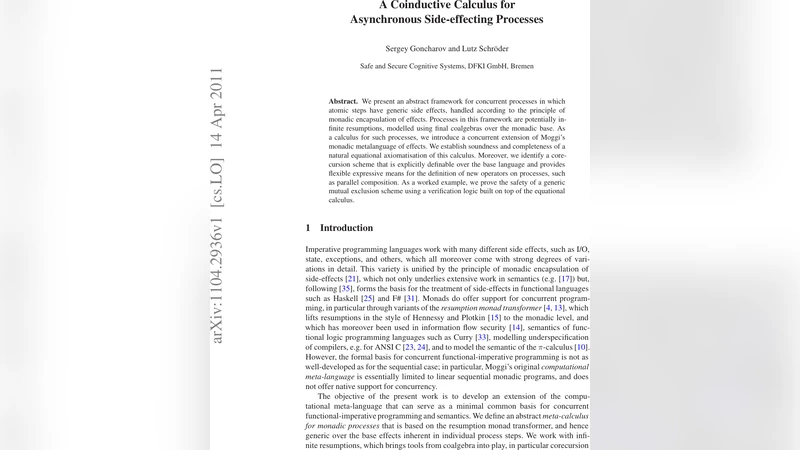
We present an abstract framework for concurrent processes in which atomic steps have generic side effects, handled according to the principle of monadic encapsulation of effects. Processes in this framework are potentially infinite resumptions, modelled using final coalgebras over the monadic base. As a calculus for such processes, we introduce a concurrent extension of Moggi’s monadic metalanguage of effects. We establish soundness and completeness of a natural equational axiomatisation of this calculus. Moreover, we identify a corecursion scheme that is explicitly definable over the base language and provides flexible expressive means for the definition of new operators on processes, such as parallel composition. As a worked example, we prove the safety of a generic mutual exclusion scheme using a verification logic built on top of the equational calculus.
💡 Research Summary
The paper introduces a unified formal framework for modeling concurrent processes that may produce arbitrary side‑effects, by marrying Moggi’s monadic treatment of effects with coalgebraic notions of infinite resumptions. The authors begin by recalling that a monad M encapsulates effectful computations through the operations return and bind, allowing the programmer to separate pure values from effectful actions. To capture potentially unbounded, asynchronous behavior, they model processes as elements of the final coalgebra of the functor F X = M(step × X) + M(done). In this representation a process is either an atomic step together with a continuation (the step × X part) or a terminated computation (the done part), each wrapped in the effect monad. This coalgebraic view yields a mathematically clean notion of resumable processes, also known as resumptions, which can be interleaved indefinitely without losing the ability to observe their effects.
Building on this semantic foundation, the authors extend Moggi’s monadic metalanguage with explicit concurrency primitives. The syntax adds three new constructs: fork e to spawn a new concurrent thread, join e to wait for a previously forked computation, and parallel e₁ e₂ to run two computations side‑by‑side. Types are enriched with effect annotations, so that fork e has type M (Future A) when e : M A, and parallel e₁ e₂ produces a combined effect M (A × B) from e₁ : M A and e₂ : M B. The type system guarantees that effectful interactions remain well‑scoped even when processes are interleaved.
The core contribution is an equational axiomatisation that captures both monadic laws (left identity, associativity) and the algebra of concurrency. Key axioms include commutativity and associativity of parallel, a neutral element skip that represents a terminated process, and a distributivity law linking fork and parallel. The authors prove soundness by showing that each axiom preserves the coalgebraic semantics, i.e., the two sides of any equation denote the same element of the final coalgebra. Completeness is established via a normalisation theorem: every well‑typed term can be rewritten, using the axioms, to a canonical form that uniquely represents its semantic value. This result demonstrates that the axiom system is expressive enough to capture all observable equivalences between effectful concurrent programs.
A novel corecursion scheme is presented to define new operators directly in the base language. By exploiting the final coalgebra’s universal property, the authors give a higher‑order construct corecursive f = νx. g x, where g is a monadic expression possibly involving bind, fork, and parallel. This scheme allows the definition of parallel itself as a corecursive operator, eliminating the need for a primitive definition. The paper proves that any operator defined via this scheme respects the equational theory, thereby providing a systematic method for extending the language with custom combinators while retaining provable properties.
To illustrate the practical impact, the authors formalise a generic mutual exclusion protocol (a lock/unlock scheme) within their framework. The protocol’s actions—acquire, release, and critical section—are modelled as monadic steps that manipulate a shared token effect. Using the equational calculus, they derive a safety property: at most one process can be in the critical section at any time. The proof proceeds by unfolding the corecursive definitions of the parallel composition of two lock‑using processes, applying the concurrency axioms, and showing that any reachable state respects the invariant that the token is held by at most one thread. This example demonstrates that the calculus is not merely theoretical but can serve as a verification logic for real concurrent algorithms.
In summary, the paper delivers a coinductive calculus for asynchronous side‑effecting processes that integrates monadic effect handling with coalgebraic resumptions, supplies a robust equational theory, and offers a corecursive mechanism for defining new concurrent operators. The work bridges a gap between effectful functional programming and process algebra, providing a solid foundation for future language designs and formal verification tools targeting asynchronous, effectful concurrency.
Comments & Academic Discussion
Loading comments...
Leave a Comment