Notes on bimonads and Hopf monads
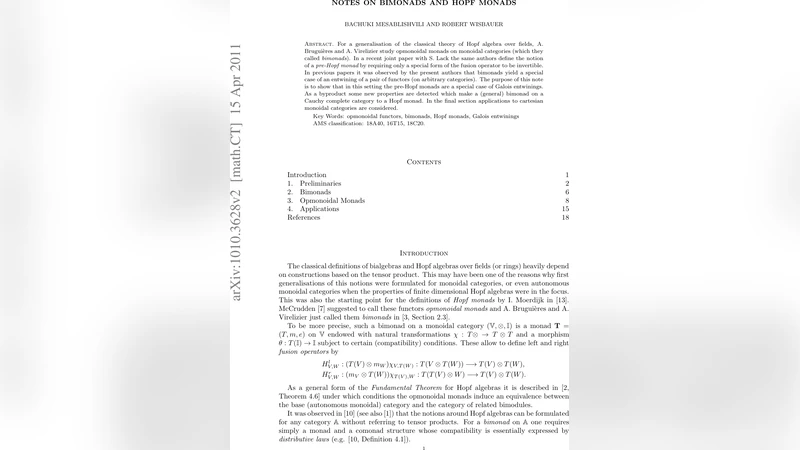
For a generalisation of the classical theory of Hopf algebra over fields, A. Brugui`eres and A. Virelizier study opmonoidal monads on monoidal categories (which they called {\em bimonads}). In a recent joint paper with S. Lack the same authors define the notion of a {\em pre-Hopf monad} by requiring only a special form of the fusion operator to be invertible. In previous papers it was observed by the present authors that bimonads yield a special case %Hopf monads may be considered as a special case of an entwining of a pair of functors (on arbitrary categories). The purpose of this note is to show that in this setting the pre-Hopf monads are a special case of Galois entwinings. As a byproduct some new properties are detected which make a (general) bimonad on a Cauchy complete category to a Hopf monad. In the final section applications to cartesian monoidal categories are considered.
💡 Research Summary
The paper “Notes on bimonads and Hopf monads” investigates the relationship between two categorical generalisations of Hopf algebras: bimonads (also called op‑monoidal monads) and the more recent notion of pre‑Hopf monads introduced by Bruguières, Virelizier and Lack. A bimonad on a monoidal category carries both a monad structure and an op‑monoidal structure that interact in a way reminiscent of the multiplication and comultiplication of a Hopf algebra. The pre‑Hopf monad weakens the classical Hopf monad definition by requiring only a special component of the fusion operator to be invertible, rather than the whole fusion map.
The central contribution of the note is to show that pre‑Hopf monads are precisely a special case of Galois entwinings. An entwining is a natural transformation between the composite of two functors that intertwines a monad and a comonad. When the entwining satisfies the Galois condition (i.e., the associated canonical map is an isomorphism), the structure behaves like a Hopf object. The authors construct explicitly the entwining associated to any bimonad and prove that the invertibility of the distinguished fusion component exactly corresponds to the Galois condition for this entwining. Consequently, every pre‑Hopf monad can be viewed as a bimonad whose associated entwining is Galois.
A further significant result concerns the passage from a general bimonad to a full Hopf monad. Working in a Cauchy complete category—one in which every idempotent splits—the authors identify simple sufficient conditions: if the unit and multiplication of the bimonad are split monomorphisms (or, dually, split epimorphisms) and these splittings are preserved by the Cauchy completeness, then the fusion operator becomes automatically invertible. This yields a clean criterion that replaces many technical hypotheses appearing in earlier works on Hopf monads.
The final section applies the theory to cartesian monoidal categories, such as Set, Top, and Graph, where the tensor product is just the categorical product. In this setting the op‑monoidal structure reduces to familiar product‑preserving properties, and the entwining maps acquire a concrete description. The authors examine classic examples—list monad, multiset monad, powerset monad—and verify that they satisfy the pre‑Hopf condition and hence give rise to Galois entwinings. For instance, the fusion operator for the list monad corresponds to concatenation followed by a canonical splitting of a list into head and tail; its invertibility is witnessed by the obvious re‑assembly map, confirming the pre‑Hopf property.
Overall, the note clarifies the hierarchy of categorical Hopf‑type structures: bimonads ⊃ pre‑Hopf monads ⊃ Hopf monads, with the inclusions characterised by the Galois property of the associated entwining and by additional split‑idempotent conditions in Cauchy complete settings. By situating pre‑Hopf monads within the well‑studied framework of Galois entwinings, the authors provide a unifying perspective that both simplifies existing theory and opens the door to new examples, especially in cartesian contexts.
Comments & Academic Discussion
Loading comments...
Leave a Comment