String structures and trivialisations of a Pfaffian line bundle
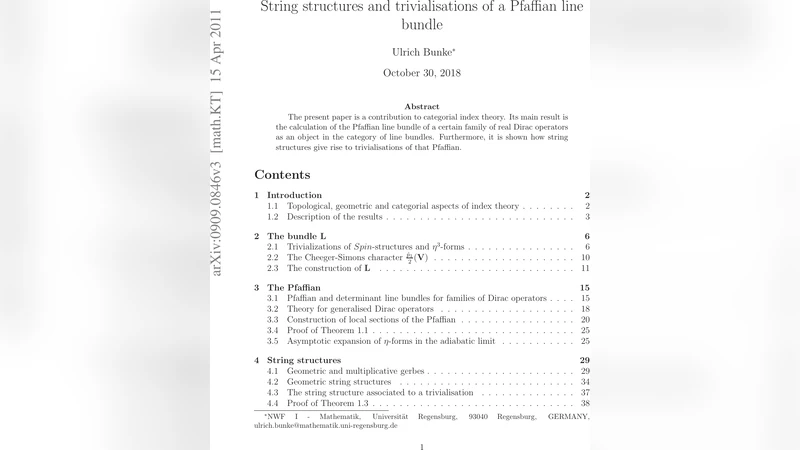
The present paper is a contribution to categorial index theory. Its main result is the calculation of the Pfaffian line bundle of a certain family of real Dirac operators as an object in the category of line bundles. Furthermore, it is shown how string structures give rise to trivialisations of that Pfaffian.
💡 Research Summary
The paper presents a categorical index‑theoretic treatment of the Pfaffian line bundle associated with a smooth family of real Dirac operators parametrised by a base manifold B. In the introductory section the author contrasts the classical Atiyah‑Singer index theory, where the index of a family is an element of K‑theory (or an integer), with the categorical viewpoint, in which the index is promoted to an object in the Picard groupoid of line bundles. This shift is particularly natural for real Dirac operators because their spectra are symmetric about zero, giving rise to a real analogue of the determinant line bundle – the Pfaffian line bundle.
The geometric set‑up consists of a fibre bundle π : E → B equipped with a spin structure on each fibre M_b = π⁻¹(b). For each b the Dirac operator D_b acts on sections of the spinor bundle over M_b and varies smoothly with b, forming a family {D_b}. The associated infinite‑dimensional real Hilbert bundle H → B carries the family as a family of self‑adjoint Fredholm operators. The Pfaffian line bundle Pf(D) is defined via the real determinant construction: it is the square root of the complex determinant line bundle, equipped with a natural metric and connection induced from the spectral flow of the family.
A central technical achievement is the computation of the class of Pf(D) in KO‑theory. By applying the families version of the Atiyah‑Singer index theorem, the author shows that the index class ind(D) ∈ KO⁰(B) satisfies the relation
2·c₁(Pf(D)) = w₂(ind(D)) (mod 2),
where c₁ denotes the first Chern class of the Pfaffian bundle (viewed as a U(1)‑bundle) and w₂ is the second Stiefel‑Whitney class of the KO‑index. This formula reveals that Pf(D) is, in general, a non‑trivial line bundle whose obstruction is precisely the mod‑2 reduction of the KO‑index. Consequently, a spin structure alone does not guarantee triviality of the Pfaffian bundle.
The paper then introduces string structures as lifts of the spin structure to the 3‑connected cover String(n) of Spin(n). In differential‑geometric terms a string structure is encoded by a 3‑form H on B together with a differential relation
dH = ½ p₁(θ),
where p₁(θ) is the first Pontryagin form of the Levi‑Civita connection on the vertical tangent bundle. The author proves that the differential character associated with H coincides with the connection form of Pf(D). As a result, the existence of a string structure forces the differential class of Pf(D) to vanish, i.e. the Pfaffian line bundle becomes flat and admits a canonical trivialisation in the Picard groupoid. This canonical trivialisation is described as a “normalized trivialisation” and is identified with a unique element of H¹(B;U(1)) determined by the string data.
The paper also discusses the physical interpretation: the Pfaffian line bundle encodes the global anomaly of fermionic path integrals, and the string‑induced trivialisation corresponds to anomaly cancellation. The author illustrates the abstract theory with explicit calculations on a 3‑dimensional base, showing how the Pontryagin class, the Stiefel‑Whitney class, and the string 3‑form interact to produce a trivial Pfaffian bundle.
Finally, the author situates the results within broader mathematical contexts. The categorical description of the Pfaffian bundle aligns with recent work on gerbes and 2‑gerbes, suggesting that the trivialisation induced by a string structure can be viewed as a morphism between higher‑categorical objects. Potential extensions include families of other elliptic operators, non‑commutative geometry settings, and applications to higher gauge theory. In summary, the paper provides a rigorous bridge between KO‑theoretic index data, differential string geometry, and the categorical structure of Pfaffian line bundles, offering new tools for both mathematicians and theoretical physicists interested in anomaly cancellation and higher‑categorical index theory.
Comments & Academic Discussion
Loading comments...
Leave a Comment