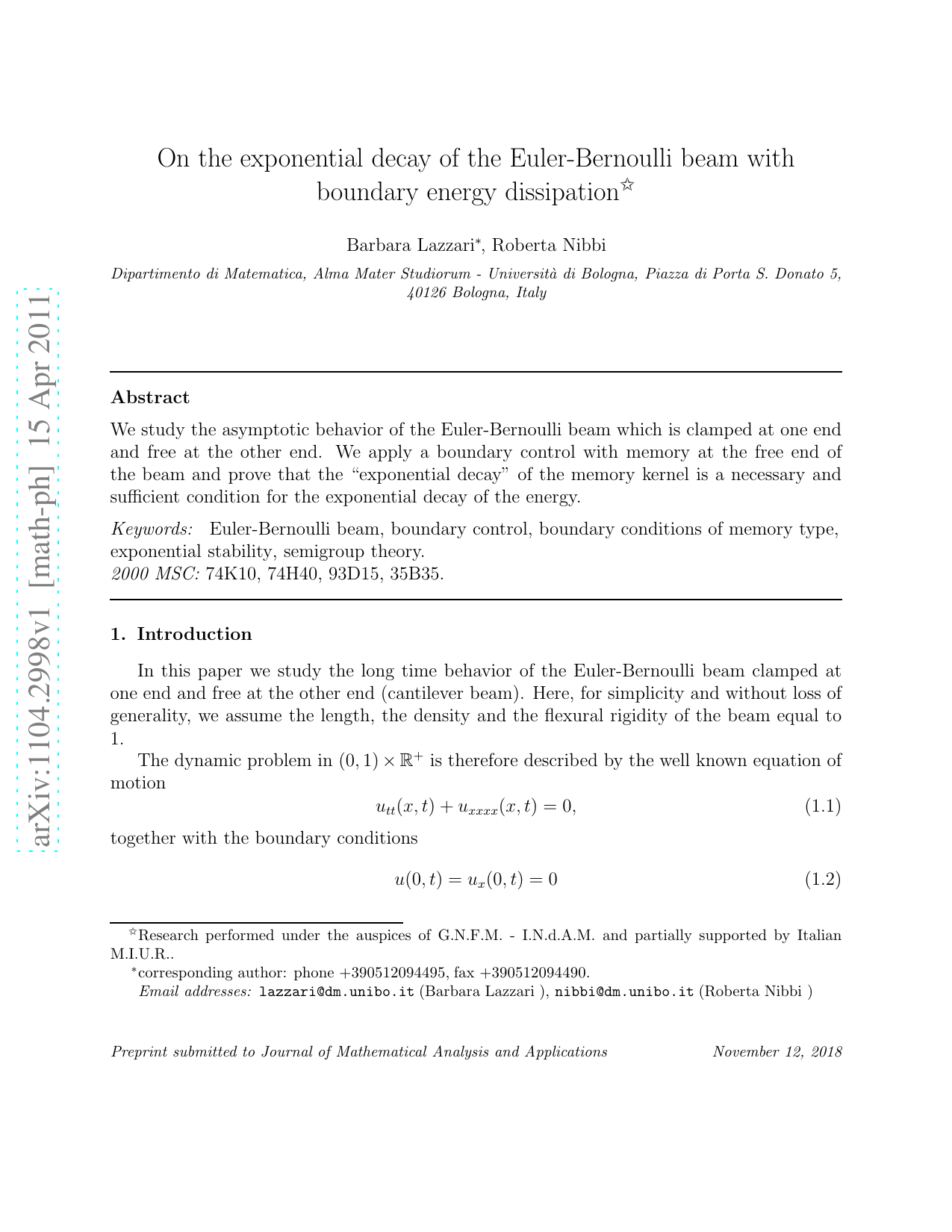
We study the asymptotic behavior of the Euler-Bernoulli beam which is clamped at one end and free at the other end. We apply a boundary control with memory at the free end of the beam and prove that the "exponential decay" of the memory kernel is a necessary and sufficient condition for the exponential decay of the energy.
Deep Dive into On the exponential decay of the Euler-Bernoulli beam with boundary energy dissipation.
We study the asymptotic behavior of the Euler-Bernoulli beam which is clamped at one end and free at the other end. We apply a boundary control with memory at the free end of the beam and prove that the “exponential decay” of the memory kernel is a necessary and sufficient condition for the exponential decay of the energy.
In this paper we study the long time behavior of the Euler-Bernoulli beam clamped at one end and free at the other end (cantilever beam). Here, for simplicity and without loss of generality, we assume the length, the density and the flexural rigidity of the beam equal to 1.
The dynamic problem in (0, 1) × R + is therefore described by the well known equation of motion u tt (x, t) + u xxxx (x, t) = 0, (
together with the boundary conditions u(0, t) = u x (0, t) = 0 (1.2) and
where β(t) and Γ(t) are boundary control terms applied to the free end of the beam. The boundary feedback stabilization problem of this model, that is the problem of finding boundary controls capable to guarantee the exponential stability, has been studied at length (see [1,2,3,4,5] and references therein).
In this paper we choose the following boundary control with memory
where γ 0 ∈ R + and the memory kernel λ : R + -→ R belongs to L 1 (R + ) ∩ H 2 (R + ). This control has been already proposed in [6] and [7] where, in presence of further structural dampings, it has been proved that the energy has the same rate of decay (exponential or polynomial) of the memory kernel.
Here, generalizing energy estimates obtained in [1] for the boundary control
we prove that, whenever the memory kernel decays exponentially, so does the energy of the system.
It is interesting to observe that boundary condition (1.4) ensures the exponential decay of the energy for the cantilever beam, while, in the presence of a memory term at the boundary, such a result is not assured. Indeed, we shall show that the condition
for some δ > 0, turns out to be necessary for the exponential decay of the solution.
Finally, we observe that this control can be also seen as a generalization of the case of a mass attached to the free end of the beam [8,9]. If, in fact, we choose an exponential function as memory kernel, by differentiating (1.3) with respect to time, we obtain
The outline of the paper is the following. In Section 2 we prove existence, uniqueness and regularity of solutions for the related initial boundary problem via semigroup theory. In Section 3, after developing the needed estimates, we prove that the exponential decay of the memory kernel turns out to be a necessary and sufficient condition for the exponential decay of the energy.
Let us consider problem (1.1)-(1.3) together with the initial conditions u(x, 0) = u 0 (x), u t (x, 0) = v 0 (x),
x ∈ (0, 1).
(2.1)
From now on, whenever no ambiguity arises, we shall drop the x variable and we shall refer to problem (1.1)-(1.3)-(2.1) as to problem P . The aim of this section is the proof of the well-posedness of problem P via semigroup theory. To this end we introduce the past history
and rewrite the boundary control term in (1.3) as follows
Evolution problems presenting boundary controls of memory type similar to (2.2) have been studied in several fields, making use of the concepts of dissipative boundary and boundary energy (see [10] and references therein), and the related solutions have been usually found among those with “finite energy”. It should however be noted that in presence of memory, the energy-type functional turns out to be non-unique. Following this approach, (2.2) is compatible with the definition of dissipative boundary if the memory kernel satisfies
- holds, reasoning as in [10], it is possible to prove the well-posedness of problem P in the past histories space H 1 , for which the energy functional
is finite. On the other hand this result is not satisfactory, because H 1 does not contain even all the bounded histories (indeed [11] sinusoidal histories do not belong to H 1 ) and it is therefore desirable to obtain well posedness results in wider past histories spaces.
Certainly the space H 2 of the past histories for which
contains at least all the bounded histories. However, to obtain well-posedness results in this space the memory kernel must satisfy the following more restrictive hypotheses
As observed in [12], it is not necessary to know the past history w at all times, because two different histories w 1 and w 2 satisfying
lead to the same boundary control term in (2.2). It is therefore convenient a formulation which relies only on the minimal information required to determine the boundary control.
To this end, here we study problem P in terms of the new variable
so that (2.2) takes the form
By introducing the functional
(2.9)
we are able to achieve well posedness results in a space wider than H 2 , leaving unchanged the hypotheses (2.6) on the kernel. In fact the following proposition holds.
Proposition 2.1. Let w ∈ H 2 and ȃt defined in terms of w through (2.7), then the functional (2.9) is finite.
Rewriting (2.9) in terms of w and using classical inequalities, it follows that
The thesis follows immediately from the hypothesis w ∈ H 2 . Moreover, the functional ψ b satisfies
since the derivative of ȃt with respect to t is given by
Finally we observe that
…(Full text truncated)…
This content is AI-processed based on ArXiv data.