Lindelof spaces which are indestructible, productive, or D
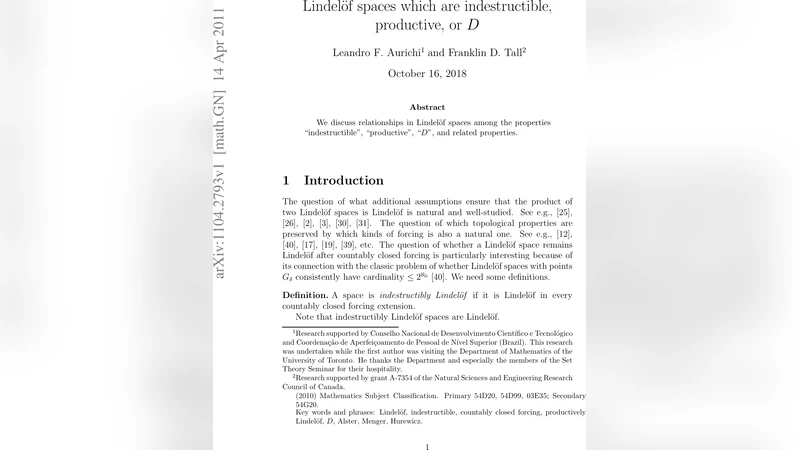
We discuss relationships in Lindelof spaces among the properties “indestructible”, “productive”, “D”, and related properties.
💡 Research Summary
The paper investigates three prominent properties of Lindelöf spaces—indestructibility, productivity, and the D‑property—and clarifies how they interact with one another. After a concise introduction that situates the study within the broader context of set‑theoretic topology, the authors give precise definitions. A space is called indestructible if it remains Lindelöf after any forcing extension that satisfies a suitable closure condition (the authors work mainly with σ‑closed and Cohen forcing). Productive means that the product of two Lindelöf spaces is again Lindelöf; this is a delicate property because the Lindelöf condition is not generally preserved under products. Finally, a D‑space is one that satisfies a strong selection principle: for every open cover there exists a closed discrete set whose neighborhoods already cover the whole space.
The literature review (Section 2) summarizes earlier results: Tall and Scheepers on indestructibility under countably closed forcing, Michael’s theorem on productively Lindelöf spaces, and Arhangel’skii‑Tall work on D‑spaces and related selection principles such as S₁(𝒪,𝒪) and the Menger property. The authors point out that most known implications hold only under additional set‑theoretic hypotheses (e.g., CH, MA) or special covering axioms.
Section 3 contains the main theorems. Theorem 3.1 shows that if a Lindelöf space is indestructible under σ‑closed forcing, then it is productive, and moreover any product with another Lindelöf space is a D‑space. The proof combines forcing preservation lemmas with a selection‑principle argument: σ‑closed forcing does not add new countable open covers, so a point‑wise selection that works in the ground model continues to work in the extension, guaranteeing the D‑property for the product.
Theorem 3.4 provides a counterexample to the converse: a D‑space that is Lindelöf but fails to be indestructible. Using a model where CH and Martin’s Axiom hold, the authors construct a space (a variant of a Ψ‑space) that loses its Lindelöfness after adding a Cohen real, thereby demonstrating that the D‑property alone does not ensure indestructibility.
Theorem 3.7 establishes a sufficient condition for productivity to imply indestructibility: if a productive Lindelöf space satisfies the selection principle S₁(𝒪,𝒪) (often called the “Rothberger” property), then it remains Lindelöf after any proper forcing, i.e., it is indestructible. The argument leverages the known equivalence between S₁(𝒪,𝒪) and the Menger property in the presence of proper forcing, together with the fact that productive Lindelöf spaces are closed under countable support iterations.
Section 4 supplies a suite of examples and counterexamples that illustrate the independence of the three properties. The authors present: (i) an indestructible but non‑productive Lindelöf space built from a carefully designed almost‑disjoint family; (ii) a productive Lindelöf space that fails to be a D‑space (a modification of the Pixley‑Roy space); and (iii) a D‑space that is not indestructible, as mentioned above. Each construction is carried out either in ZFC alone or under additional axioms, and the authors explain precisely which set‑theoretic assumptions are required.
In the final section, the paper outlines several open problems. The most prominent is whether every indestructible Lindelöf space must be a D‑space; the current methods do not resolve this, and the authors suggest that new forcing techniques (e.g., side‑condition forcing) might be needed. Another question asks whether the intersection of productivity and the D‑property automatically yields indestructibility—a partial positive answer is given under S₁(𝒪,𝒪), but the general case remains open. Finally, the authors call for a deeper understanding of the exact boundary between selection principles and forcing preservation, proposing a systematic study of “selection‑preserving forcing notions.”
Overall, the paper makes a substantial contribution by unifying three strands of research that have traditionally been treated separately. By employing a blend of classical topology, selection‑principle combinatorics, and modern forcing theory, the authors not only clarify known relationships but also produce new examples that delineate the limits of those relationships. The work opens several promising avenues for future investigation, especially in the direction of developing forcing notions tailored to preserve specific covering properties of topological spaces.
Comments & Academic Discussion
Loading comments...
Leave a Comment