Towards applied theories based on computability logic
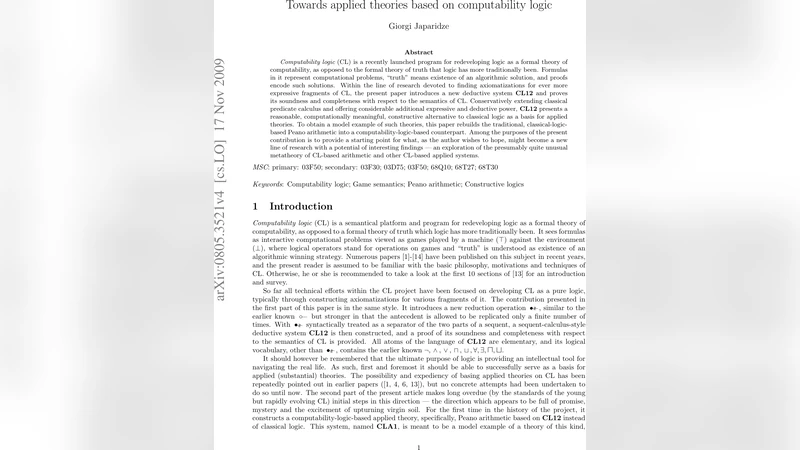
Computability logic (CL) (see http://www.cis.upenn.edu/~giorgi/cl.html) is a recently launched program for redeveloping logic as a formal theory of computability, as opposed to the formal theory of truth that logic has more traditionally been. Formulas in it represent computational problems, “truth” means existence of an algorithmic solution, and proofs encode such solutions. Within the line of research devoted to finding axiomatizations for ever more expressive fragments of CL, the present paper introduces a new deductive system CL12 and proves its soundness and completeness with respect to the semantics of CL. Conservatively extending classical predicate calculus and offering considerable additional expressive and deductive power, CL12 presents a reasonable, computationally meaningful, constructive alternative to classical logic as a basis for applied theories. To obtain a model example of such theories, this paper rebuilds the traditional, classical-logic-based Peano arithmetic into a computability-logic-based counterpart. Among the purposes of the present contribution is to provide a starting point for what, as the author wishes to hope, might become a new line of research with a potential of interesting findings – an exploration of the presumably quite unusual metatheory of CL-based arithmetic and other CL-based applied systems.
💡 Research Summary
The paper presents a significant advance in the program of Computability Logic (CL), a framework that reinterprets logical formulas as interactive computational problems and logical truth as the existence of an algorithmic winning strategy. While earlier work on CL focused on developing axiomatizations for increasingly expressive fragments, this work introduces a new logical connective and a corresponding proof system that substantially increase the expressive and deductive power of CL while preserving its game‑theoretic semantics.
1. The dfb‑reduction connective (•‑≀≀).
The authors observe that existing reduction operators in CL (such as →, ◦‑, and >‑) either forbid any reuse of the antecedent resources or allow unrestricted (potentially infinite) reuse. Neither of these behaviours matches the needs of applied theories, where a finite but unbounded number of copies of a resource may be required. To fill this gap they define a new binary operation, written A₁,…,Aₙ •‑≀≀ B, called “double‑finite‑branching reduction” (dfb‑reduction). Semantically, the game A₁,…,Aₙ •‑≀≀ B is won by the machine (⊤) if it can win B while being allowed to request, at any moment during the play, a fresh copy of any of the antecedent games Aᵢ, provided that the total number of such replications remains finite. If the machine attempts infinitely many replications it loses. This captures precisely the notion of a finite‑resource oracle: the machine may call the oracle any finite number of times, but cannot rely on an infinite supply.
2. The proof system CL12.
Building on the dfb‑reduction, the authors design a sequent‑calculus style deductive system named CL12. Its language contains the usual CL connectives (¬, ∧, ∨, ⊓, ⊔, ∀, ∃) together with the new reduction connective. The inference rules consist of:
- Structural rules that preserve the classical behavior of conjunction, disjunction, quantifiers, etc.;
- Replication rules that explicitly control the finite copying of antecedent resources;
- Reduction rules that allow one to infer a conclusion B from a premise of the form A₁,…,Aₙ •‑≀≀ B.
The system is shown to be a conservative extension of classical predicate logic: any classical sequent provable in first‑order logic remains provable in CL12, and vice‑versa when the reduction connective is not used.
3. Soundness and completeness.
The authors prove two central metatheorems. Uniform‑constructive soundness states that any CL12 proof can be effectively transformed into a uniform winning strategy for the corresponding game, i.e., an algorithm that works for all interpretations of the non‑logical symbols. Completeness shows that if a sequent has a uniform winning strategy (according to the game semantics of CL) then there exists a CL12 proof of that sequent. The proofs rely on a careful analysis of finite‑depth games, the notion of prefixation, and the construction of canonical strategies that respect the finite‑branching restriction.
4. Relation to Turing reducibility.
The paper demonstrates that dfb‑reduction generalizes the classical notion of Turing reducibility. In Turing reducibility a function f is computable relative to oracles g₁,…,gₙ with unrestricted calls; dfb‑reduction imposes a finite‑call restriction, thereby yielding a more fine‑grained notion of relative computability that aligns with resource‑bounded computation. Consequently, CL12 can be used to reason about algorithms that use a bounded number of oracle queries, opening a bridge between CL and traditional complexity theory.
5. A CL‑based arithmetic: CLA1.
To illustrate the applicability of CL12, the authors reconstruct Peano Arithmetic (PA) within the CL framework, producing a theory they call CLA1. CLA1 retains the usual non‑logical axioms of PA (e.g., 0≠Sx, injectivity of the successor, induction) but replaces the classical inference rules with CL12’s rules, especially the constructive induction rule that exploits dfb‑reduction. In CLA1, each theorem comes equipped with a uniform algorithmic solution extracted from its CL12 proof. This satisfies the “uniform‑constructive soundness” property: the proof not only shows that a statement is true in the usual sense but also yields an explicit algorithm solving the corresponding computational problem.
6. Significance and future directions.
The work establishes a concrete, constructive alternative to classical logic for building applied theories. By guaranteeing that every provable statement has an algorithmic witness, CL12 and CLA1 blur the line between proof theory and program synthesis. Potential research avenues include extending CL12 to higher‑order or modal settings, quantifying the exact computational complexity of dfb‑reduction strategies, applying the framework to other mathematical domains (real analysis, set theory), and integrating CL12 into automated theorem provers to obtain executable programs directly from proofs.
In summary, the paper delivers a novel reduction operator that balances flexibility and finiteness, a robust sequent calculus (CL12) that is both sound and complete with respect to CL’s game semantics, and a compelling demonstration of how these tools can rebuild arithmetic in a fully computationally meaningful way. This positions Computability Logic as a promising foundation for future applied logical systems where proofs are synonymous with algorithms.
Comments & Academic Discussion
Loading comments...
Leave a Comment