Asymptotics for the Covariance of the Airy_2 process
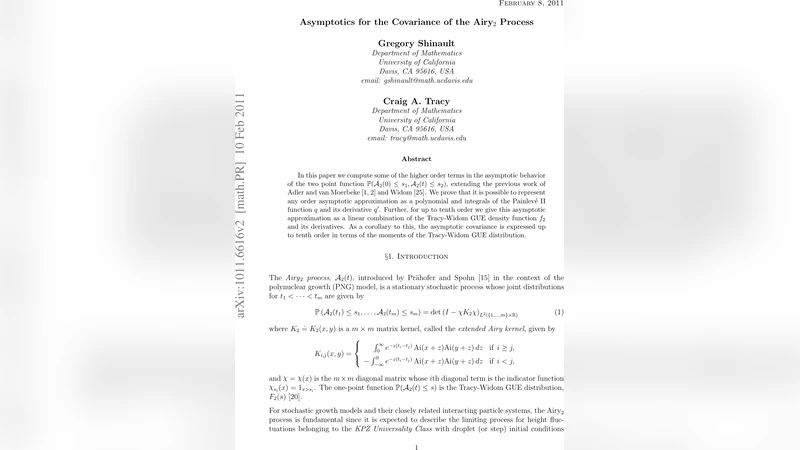
In this paper we compute some of the higher order terms in the large-t asymptotic expansion of the Airy process two-point function, extending the previous work of Adler and van Moerbeke and Widom. We prove that it is possible to represent any order asymptotic approximation as a polynomial and integrals of the Hastings-McLeod Painlev'e II function and its first derivative. Further, for up to tenth order we give this asymptotic approximation as a linear combination of the Tracy-Widom GUE density function f_2 and its derivatives. As a corollary to this, the asymptotic covariance is expressed up to tenth order in terms of the moments of the Tracy-Widom GUE distribution.
💡 Research Summary
The paper addresses the long‑standing problem of obtaining higher‑order terms in the large‑t asymptotic expansion of the two‑point function (covariance) of the Airy₂ process, a central object in random matrix theory and the KPZ universality class. Building on the pioneering works of Adler‑van Moerbeke and Widom, which gave the first two terms in terms of the Hastings‑McLeod solution q(s) of the Painlevé II equation and its derivative q′(s), the authors develop a systematic method that produces any order of the expansion as explicit polynomials and integrals involving q and q′.
The core of the analysis relies on the integrable‑operator representation of the Airy kernel. By writing the Fredholm determinant associated with the Airy kernel as an exponential of a trace series, the authors translate the logarithmic derivative (which yields the covariance) into a hierarchy of operator identities. Using the Riemann–Hilbert characterization of q(s) they show that each term in the series can be reduced to an integral of a polynomial P_k(q,q′) over the whole real line. Crucially, the boundary behavior of the Hastings‑McLeod solution guarantees convergence and allows the integrals to be expressed in terms of the Tracy–Widom GUE density f₂(x)=F′₂(x) and its derivatives.
Explicitly, they prove that for large t \
Comments & Academic Discussion
Loading comments...
Leave a Comment