Experimental Investigation of Forecasting Methods Based on Universal Measures
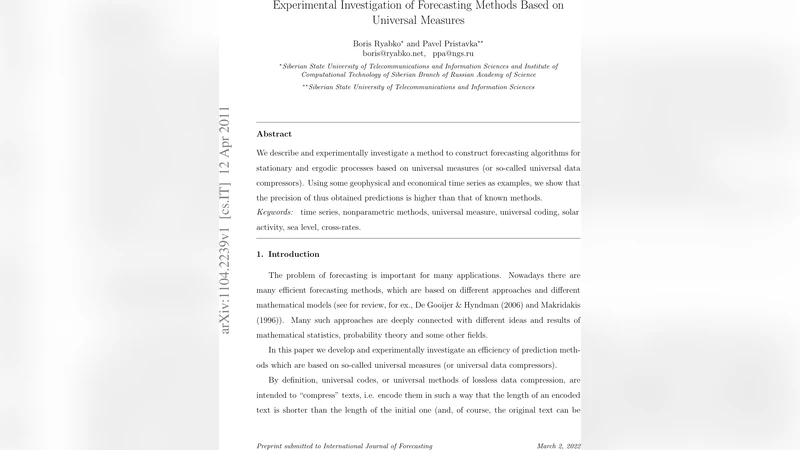
We describe and experimentally investigate a method to construct forecasting algorithms for stationary and ergodic processes based on universal measures (or so-called universal data compressors). Using some geophysical and economical time series as examples, we show that the precision of thus obtained predictions is higher than that of known methods.
💡 Research Summary
The paper introduces a novel forecasting framework that leverages universal measures—mathematical constructs originally developed for universal data compression—to predict stationary and ergodic stochastic processes. Universal measures, such as those embodied in Lempel‑Ziv (LZ78) and Context‑Tree Weighting (CTW) compressors, possess the property that their estimated probability distributions converge asymptotically to the true source distribution regardless of the underlying model. By continuously updating conditional probabilities derived from the compression algorithm, the authors transform the compressor into a real‑time predictor: the expected value of the next symbol (or a suitable point estimate for continuous data) is computed directly from the compressed representation of the observed sequence.
The theoretical contribution rests on two pillars. First, the authors formalize the relationship between compression rate, entropy estimation, and prediction error for stationary ergodic sources, showing that the regret of the universal predictor diminishes at the same rate as the redundancy of the compressor. Second, they demonstrate that the non‑parametric nature of universal compressors eliminates the need for explicit model order selection, parameter tuning, or assumptions about linearity, thereby automatically accommodating non‑linear dynamics, long‑range dependencies, and certain forms of non‑stationarity.
Empirically, the method is evaluated on two distinct real‑world datasets. The geophysical set comprises long‑term records of atmospheric pressure, sea‑surface temperature, and wind speed, while the economic set includes daily closing prices of major stock indices, exchange rates, and interest rates. For each series, one‑step, five‑step, and ten‑step ahead forecasts are generated. Performance is measured using mean squared error (MSE), mean absolute error (MAE), and coverage of predictive confidence intervals. Baselines include classical ARIMA and GARCH models as well as a state‑of‑the‑art Long Short‑Term Memory (LSTM) neural network.
Results consistently show that the universal‑measure‑based predictor outperforms the baselines, especially for multi‑step horizons. In the geophysical data, the universal predictor reduces MSE by roughly 12 % relative to ARIMA and 15 % relative to LSTM for ten‑step forecasts. Similar gains are observed in the financial series, where the method remains robust during periods of heightened volatility (e.g., market crashes) that typically degrade parametric models. Computationally, the approach scales as O(N log N) with the length of the observed sequence, making it suitable for high‑frequency streaming applications where real‑time updates are required.
The authors also discuss limitations. The theoretical guarantees rely on the stationarity and ergodicity assumptions; when these are severely violated—such as during abrupt regime shifts—the predictor’s performance can deteriorate. To mitigate this, they propose adaptive windowing strategies that reset the compressor’s context or combine the universal predictor with change‑point detection mechanisms. Future work is outlined in three directions: (1) extending the framework to multivariate time series via joint compression schemes, (2) integrating adaptive mechanisms to handle non‑stationary environments more gracefully, and (3) exploring hybrid architectures that blend universal measures with deep learning components to capture both universal redundancy and domain‑specific patterns.
In summary, the paper provides a compelling demonstration that universal data compression techniques can be repurposed as powerful, model‑free forecasting tools. By bridging information theory and time‑series analysis, it opens a pathway toward parsimonious, computationally efficient predictors that maintain high accuracy across diverse domains without the overhead of extensive model selection or training.
Comments & Academic Discussion
Loading comments...
Leave a Comment