Trees as Filters of Radioactive Fallout from the Chernobyl Accident
This paper is a copy of an unpublished study of the filtering effect of red maple trees (acer rubrum) on fission product fallout near Binghamton, NY, USA following the 1986 Chernobyl accident. The conclusions of this work may offer some insight into what is happening in the forests exposed to fallout from the Fukushima Daiichi Nuclear Plant accident. This posting is in memory of Noel K. Yeh.
💡 Research Summary
The paper presents an observational study of how a single species of tree—red maple (Acer rubrum)—interacts with radioactive fallout from the 1986 Chernobyl accident in the vicinity of Binghamton, New York. The authors set up a field station about five kilometres southeast of the city, positioning a rain collector in an open area roughly one hundred metres from an eighty‑year‑old, 26‑metre‑tall red maple. A stemflow collector was installed on the tree at one metre above ground to capture water that runs down the trunk after precipitation. Between May 16 and July 12, 1986, fifteen paired samples of rainwater and stemflow were collected simultaneously and analysed by ultra‑low‑background gamma‑ray spectrometry for four radionuclides: iodine‑131, cesium‑137, ruthenium‑103, and beryllium‑7.
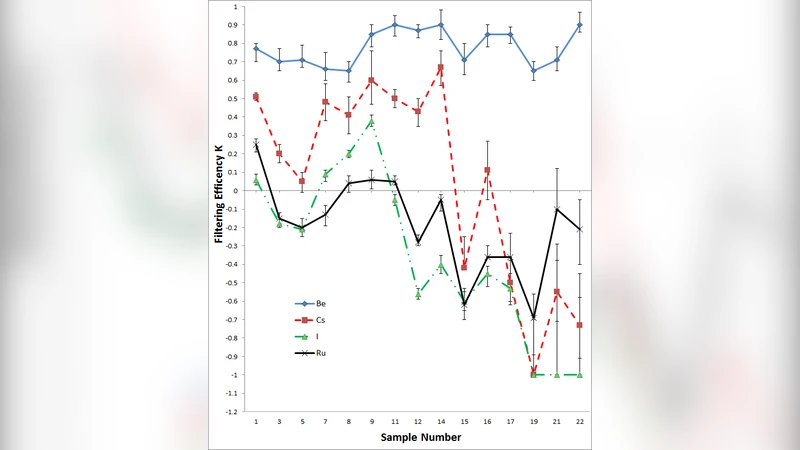
The authors introduce a “filtering efficiency” K, defined as (C_rain – C_stemflow) / (C_rain + C_stemflow). Positive K indicates net removal of the nuclide by the tree (lower concentration in stemflow than in rain), while negative K indicates that the tree is a net source (higher concentration in stemflow). The data are displayed in Figure 1 and discussed in detail.
Key findings:
-
Be‑7 – K values are consistently high (+0.75 on average), showing that the red maple retains almost all of the beryllium‑7 that arrives in precipitation. The concentration in rain varied from 5.4 × 10⁻² to 5.6 × 10⁻¹ Bq L⁻¹, yet the stemflow contained far less, indicating strong adsorption onto bark or foliage. This behavior is attributed to the chemical inertness and small particle size of Be‑7, which favor physical capture.
-
Cs‑137 – The tree exhibits modest net removal (average K ≈ +0.13) while rain concentrations exceed roughly 3.3 × 10⁻³ Bq L⁻¹. Below this threshold, K becomes negative, meaning the tree begins to release previously stored cesium back into the stemflow. Historical stemflow data from 1984‑85 (pre‑Chernobyl) already showed a baseline Cs‑137 level of (1.0 ± 0.1) × 10⁻³ Bq L⁻¹ despite undetectable rain concentrations, implying that the tree can retain cesium for periods longer than the two‑month observation window. Sample 1 (May 16) showed a spike in stemflow Cs‑137 (8.78 ± 0.62 × 10⁻³ Bq L⁻¹), confirming that the tree can act as a source when the external supply dwindles.
-
I‑131 and Ru‑103 – Both isotopes display predominantly negative K values (average –0.28 for I‑131 and –0.18 for Ru‑103). The authors suggest that the residence time of these nuclides in the tree is shorter than their physical half‑lives (8.04 days for I‑131, 39.6 days for Ru‑103), leading to rapid desorption and release into stemflow after the initial deposition phase. Sample 1 is an exception where the tree acted as a sink, likely because the tree had not yet been exposed to fallout.
The authors conclude that forest trees can function as both sinks and sources for different radionuclides, depending on the chemical form, ambient concentration, and the intrinsic retention properties of the species. For long‑lived, particle‑bound nuclides like Cs‑137, red maples (and by extension other hardwoods) can significantly attenuate the flux of radioactivity reaching the forest floor and downstream water bodies. This “filtering” effect could be especially important in forested watersheds that supply surface reservoirs, potentially moderating contamination of drinking‑water supplies after large‑scale atmospheric releases.
The paper acknowledges several limitations: the study focuses on a single tree species, a single site, and a relatively short observation period (≈ 2 months). Seasonal variations, soil chemistry, tree age, and differing precipitation regimes could alter the observed efficiencies. The authors recommend broader, multi‑species, multi‑season investigations to validate the generality of their findings and to refine models of radionuclide transport in forested catchments, especially in the context of more recent incidents such as the Fukushima Daiichi accident.
Comments & Academic Discussion
Loading comments...
Leave a Comment