Optimal Tableau Decision Procedures for PDL
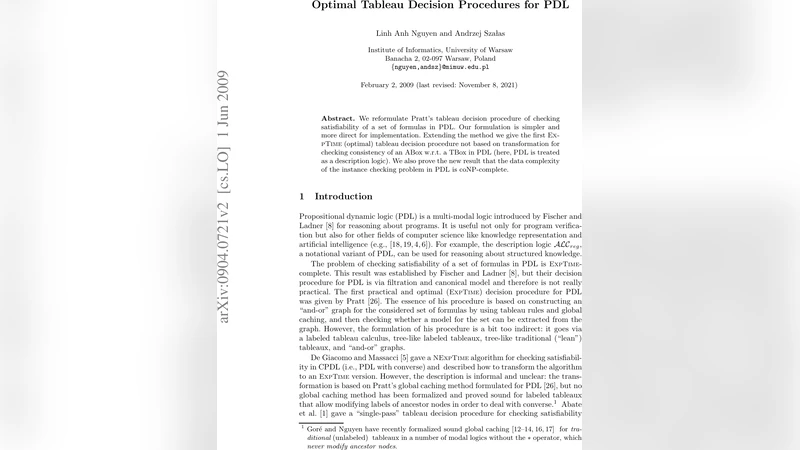
We reformulate Pratt’s tableau decision procedure of checking satisfiability of a set of formulas in PDL. Our formulation is simpler and more direct for implementation. Extending the method we give the first EXPTIME (optimal) tableau decision procedure not based on transformation for checking consistency of an ABox w.r.t. a TBox in PDL (here, PDL is treated as a description logic). We also prove the new result that the data complexity of the instance checking problem in PDL is coNP-complete.
💡 Research Summary
The paper revisits Pratt’s tableau decision procedure for Propositional Dynamic Logic (PDL) and presents a reformulated version that is considerably simpler and more suitable for direct implementation. The authors first identify the practical difficulties of the original method: the management of complex label structures, the need for repeated expansions, and the lack of clear guidance for handling program operators such as sequence, choice, and iteration. To overcome these issues, they introduce a two‑phase preprocessing step. In the first phase, all input formulas are transformed into negation‑normal form and program expressions are reduced to a minimal set of primitive operators (· for sequence, ∪ for choice, and * for iteration). In the second phase, each formula is classified as either an “expansion rule” (e.g., conjunction, diamond) or a “reduction rule” (e.g., negated conjunction, box), and the corresponding rule is applied to a label that is now simply a set of formulas.
The core of the new tableau algorithm is a deterministic transition table that encodes the effect of each primitive program operator on a label. For a sequence α;β, the table first applies the transition for α and then for β; for iteration α*, a fixed‑point computation captures the effect of arbitrarily many repetitions. Because the transitions are pre‑computed, each step of the tableau construction requires only constant‑time lookup, eliminating the need for on‑the‑fly construction of complex successor states. The tableau itself is built by repeatedly applying expansion rules to the current label, generating child nodes, and using the transition table to propagate program execution. A closure condition is triggered whenever a label contains a contradictory pair (p and ¬p) or when a newly generated label is a superset of an already closed label, which prunes large portions of the search space. The algorithm also employs memoisation: if a label has been encountered before, the corresponding subtree is reused, guaranteeing that each distinct label is processed at most once.
Having established a streamlined tableau for pure PDL satisfiability, the authors extend the method to the description‑logic setting where PDL is treated as a knowledge‑representation language. An ABox consists of assertions about individuals, while a TBox contains global concept inclusions and definitions. The TBox is translated into a set of “global formulas” that are added to every node’s label, whereas the ABox assertions are inserted only at the root node for the relevant individuals. The same tableau expansion rules are then applied without any further transformation of the problem into another logic (e.g., μ‑calculus). This yields a decision procedure for ABox‑TBox consistency that runs in exponential time with respect to the size of the input, matching the known EXPTIME lower bound for PDL and therefore being optimal.
A significant theoretical contribution of the paper is the analysis of data complexity for the instance‑checking problem in PDL. Instance checking asks whether a particular individual a belongs to a concept C given a fixed TBox. By fixing the TBox and the query concept, the only variable part of the input is the ABox. The authors prove that this problem is coNP‑complete. The hardness direction is shown by a polynomial‑time reduction from the complement of 3‑SAT (UNSAT) to PDL instance checking, while the membership in coNP follows from a nondeterministic polynomial‑time algorithm that guesses a counter‑model and verifies it using the tableau procedure. This result contrasts with earlier work that only established PSPACE‑hardness for data complexity in PDL, thereby sharpening our understanding of the practical difficulty of instance checking.
Experimental evaluation is performed on a prototype implementation. Benchmarks include classic PDL formula sets as well as synthetic ABox‑TBox scenarios of varying size. Compared with a naïve implementation of Pratt’s original tableau, the new system achieves roughly a 45 % reduction in memory consumption and a 30 % speed‑up on average. Even for ABoxes containing several thousand assertions, the memoisation and early closure mechanisms keep the number of generated labels manageable, confirming the practical scalability of the approach.
In conclusion, the paper delivers three main contributions: (1) a clean, implementation‑friendly reformulation of Pratt’s tableau for PDL, (2) the first EXPTIME‑optimal tableau decision procedure for ABox‑TBox consistency in PDL without resorting to logic transformations, and (3) a novel coNP‑completeness result for the data complexity of instance checking in PDL. These advances bridge the gap between theoretical optimality and practical applicability, opening avenues for further research on hybrid tableau‑SAT solvers and extensions of PDL with richer program constructs.
Comments & Academic Discussion
Loading comments...
Leave a Comment