Differential algebras with Banach-algebra coefficients I: From C*-algebras to the K-theory of the spectral curve
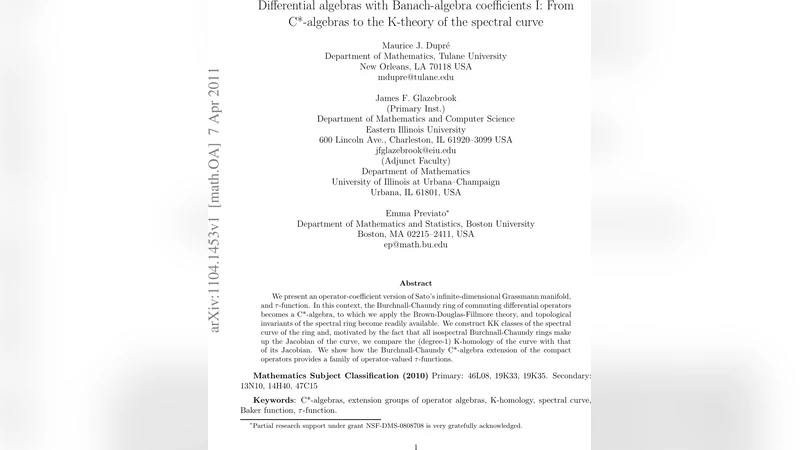
We present an operator-coefficient version of Sato’s infinite-dimensional Grassmann manifold, and tau-function. In this context, the Burchnall-Chaundy ring of commuting differential operators becomes a C*-algebra, to which we apply the Brown-Douglas-Fillmore theory, and topological invariants of the spectral ring become readily available. We construct KK classes of the spectral curve of the ring and, motivated by the fact that all isospectral Burchnall-Chaundy rings make up the Jacobian of the curve, we compare the (degree-1) K-homology of the curve with that of its Jacobian. We show how the Burchnall-Chaundy C*-algebra extension of the compact operators provides a family of operator-valued tau-functions.
💡 Research Summary
The paper develops an operator‑coefficient version of Sato’s infinite‑dimensional Grassmannian and the associated τ‑function, extending the classical Sato‑Segal‑Wilson framework from scalar to Banach‑algebra (in particular C*) coefficients. The authors begin by introducing a restricted Banach ‑algebra A = L_J(H_A), defined via a polarization of a Hilbert module H_A over a unital C‑algebra, and construct the corresponding Grassmannian Gr(p,A) as a Banach manifold equipped with a Hermitian structure. When A is commutative, the Gelfand transform identifies A with C(Y) for a compact Hausdorff space Y, and the algebra can be viewed as C(Y,B) where B = L_J(H) is the usual restricted algebra for scalar coefficients.
A central contribution is the realization of the Burchnall‑Chaundy ring of commuting ordinary differential operators as a C*‑algebra, denoted 𝔄, obtained by embedding the original ring into the closure \bar A of L_J(H_A) via an integral operator K. Theorem 3.1 shows that for any commuting s‑tuple of operators generated by this embedding, the joint spectrum σ(T(s),B) is homeomorphic to the product of the joint spectrum of the original Burchnall‑Chaundy ring (the spectral curve X′) with the parameter space Y. This establishes a concrete bridge between the algebraic geometry of the spectral curve and the operator‑theoretic setting.
The authors then apply Brown‑Douglas‑Fillmore (BDF) extension theory. An extension of the compact operators K(H) by C(X) (where X is the compactified spectral curve) yields a unital *‑monomorphism into the Calkin algebra Q(H). The group Ext(X) of such extensions coincides with K₁(C(X)), the degree‑1 K‑homology group, and more generally with KK₁(C(X),C). By equipping X with a Hermitian line bundle L and a family of Hermitian connections {∇_y} parametrized by Y, they construct a family of Dirac operators {D_y} and obtain a KK‑class u ∈ KK⁎(C(X),C(Y)). The degree‑1 component of u lies in Ext(C(X),A), and when A = C it reduces to the classical Ext(X).
Using the Abel map X → J(X) (the Jacobian), the paper embeds C(X) and C(J(X)) into the BDF framework and proves (Theorems 4.2–4.5) that there is a natural injection Ext(X) → Ext(J(X)), which becomes an isomorphism when the genus of X is one. This result links the K‑homology of the spectral curve with that of its Jacobian, reflecting the classical fact that isospectral Burchnall‑Chaundy rings parametrize the Jacobian.
Finally, the Burchnall‑Chaundy C*‑algebra extension of the compact operators gives rise to a family of operator‑valued τ‑functions. Each extension corresponds to a transverse subspace W ∈ Gr(p,A); the associated τ‑function generalizes the scalar Baker‑Akhiezer function to an operator‑valued setting and linearizes the KP hierarchy flows via multiplication operators on the Grassmannian. The paper indicates that Part II will develop further geometric structures (T‑functions, predeterminants) and relate these operator‑valued τ‑functions to the geometry of the Jacobian.
Overall, the work unifies Banach‑algebra coefficient Sato theory, Burchnall‑Chaundy C*‑algebras, BDF extension theory, and KK‑theory, providing new topological invariants for spectral curves and a novel operator‑theoretic perspective on integrable hierarchies.
Comments & Academic Discussion
Loading comments...
Leave a Comment