Space-based research in fundamental physics and quantum technologies
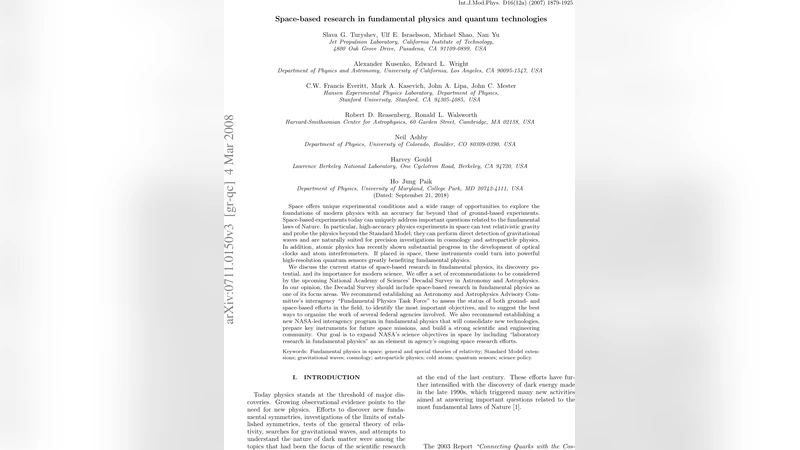
Space-based experiments today can uniquely address important questions related to the fundamental laws of Nature. In particular, high-accuracy physics experiments in space can test relativistic gravity and probe the physics beyond the Standard Model; they can perform direct detection of gravitational waves and are naturally suited for precision investigations in cosmology and astroparticle physics. In addition, atomic physics has recently shown substantial progress in the development of optical clocks and atom interferometers. If placed in space, these instruments could turn into powerful high-resolution quantum sensors greatly benefiting fundamental physics. We discuss the current status of space-based research in fundamental physics, its discovery potential, and its importance for modern science. We offer a set of recommendations to be considered by the upcoming National Academy of Sciences’ Decadal Survey in Astronomy and Astrophysics. In our opinion, the Decadal Survey should include space-based research in fundamental physics as one of its focus areas. We recommend establishing an Astronomy and Astrophysics Advisory Committee’s interagency Fundamental Physics Task Force'' to assess the status of both ground- and space-based efforts in the field, to identify the most important objectives, and to suggest the best ways to organize the work of several federal agencies involved. We also recommend establishing a new NASA-led interagency program in fundamental physics that will consolidate new technologies, prepare key instruments for future space missions, and build a strong scientific and engineering community. Our goal is to expand NASA's science objectives in space by including laboratory research in fundamental physics’’ as an element in agency’s ongoing space research efforts.
💡 Research Summary
The paper makes the case that space‑based experiments uniquely enable high‑precision tests of fundamental physics that are impossible or severely limited on Earth. It begins by outlining the distinctive environment of space—micro‑gravity, ultra‑high vacuum, long‑baseline optical links, and a low‑background radiation field—and explains how these conditions dramatically improve the sensitivity of experiments probing relativistic gravity, physics beyond the Standard Model, gravitational‑wave detection, and cosmology. The authors then categorize the scientific opportunities into four main thrusts. First, tests of general relativity and its extensions can be performed with unprecedented accuracy by comparing optical clocks and laser interferometers over inter‑satellite distances, allowing measurements of tiny spacetime curvature effects and possible violations of the equivalence principle. Second, searches for new particles or forces (e.g., dark‑matter candidates, fifth forces) benefit from the quiet background of space, which reduces systematic noise and enables long integration times. Third, space‑based laser interferometers such as LISA will open the ultra‑low‑frequency gravitational‑wave window (micro‑hertz to millihertz), giving direct access to signals from supermassive black‑hole mergers, early‑universe phase transitions, and exotic sources that ground‑based detectors cannot see. Fourth, recent breakthroughs in quantum metrology—optical lattice clocks reaching fractional uncertainties of 10⁻¹⁸ and atom interferometers achieving acceleration sensitivities below 10⁻¹⁵ g—can be turned into space‑borne quantum sensors. When operated on a spacecraft, these devices can test the constancy of fundamental constants, measure the gravitational redshift across planetary scales, and map variations in the Newtonian constant G with a precision orders of magnitude better than terrestrial experiments.
The paper reviews the status of several flagship and path‑finder missions. MICROSCOPE has already constrained equivalence‑principle violations to the 10⁻¹⁵ level using a drag‑free satellite. The ACES mission on the International Space Station is demonstrating the operation of a high‑performance atomic clock in orbit and performing time‑transfer experiments. NASA’s STE‑QUEST concept and ESA’s LISA Pathfinder have served as technology demonstrators for space‑based atomic clocks and laser interferometry, respectively, establishing key readiness levels for future large‑scale missions. The authors assess the technology readiness of critical components—ultra‑stable lasers, cryogenic cooling, high‑vacuum chambers, precision optical benches, and drag‑free control—and identify remaining gaps that must be closed before a full‑scale fundamental‑physics observatory can be launched.
From a policy perspective, the authors argue that the U.S. Decadal Survey in Astronomy and Astrophysics should explicitly include “space‑based research in fundamental physics” as a core focus area. They propose establishing an interagency Fundamental Physics Task Force under the Astronomy and Astrophysics Advisory Committee to coordinate ground‑ and space‑based efforts across NASA, the NSF, DOE, and other agencies. Moreover, they recommend creating a new NASA‑led interagency program dedicated to fundamental physics, which would consolidate emerging quantum‑sensor technologies, fund the development of flight‑qualified instruments, and nurture a multidisciplinary community of physicists, engineers, and astronomers. Such a program would provide a stable funding stream, facilitate technology maturation, and ensure that the United States remains competitive in the global race to exploit space as a laboratory for the deepest questions in physics.
In conclusion, the paper emphasizes that space‑based platforms are not merely complementary to terrestrial laboratories; they are essential for reaching the next frontier of precision measurement. By leveraging the quiet, expansive environment of space and the rapid progress in quantum metrology, humanity can test the foundations of relativity, explore physics beyond the Standard Model, detect previously inaccessible gravitational‑wave signals, and probe cosmological phenomena with unprecedented clarity. The authors caution that without coordinated federal support and a dedicated program, the field risks fragmented efforts, duplicated costs, and loss of scientific leadership. Therefore, they call for immediate action to embed fundamental‑physics research into NASA’s strategic portfolio and to create the institutional mechanisms needed to turn these ambitious scientific visions into reality.