In this note we show that the known relation between double groupoids and matched pairs of groups may be extended, or seems to extend, to the triple case. The references give some other occurrences of double groupoids.
Deep Dive into Double groupoids, matched pairs and then matched triples.
In this note we show that the known relation between double groupoids and matched pairs of groups may be extended, or seems to extend, to the triple case. The references give some other occurrences of double groupoids.
In this note we show that the known relation between double groupoids and matched pairs of groups may be extended, or seems to extend, to the triple case. The references give some other occurrences of double groupoids.
I hope that someone can pursue these ideas further.
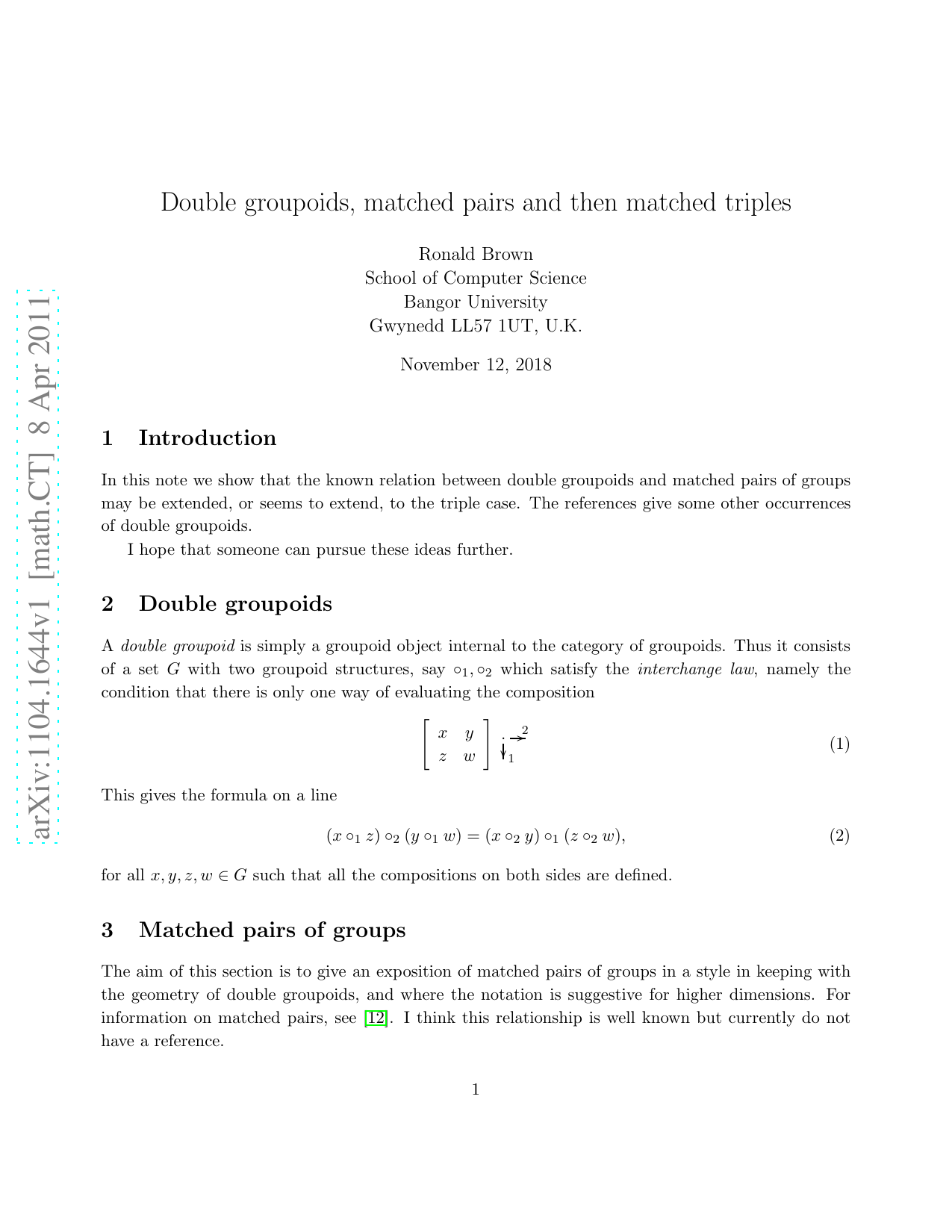
A double groupoid is simply a groupoid object internal to the category of groupoids. Thus it consists of a set G with two groupoid structures, say • 1 , • 2 which satisfy the interchange law, namely the condition that there is only one way of evaluating the composition
This gives the formula on a line
for all x, y, z, w ∈ G such that all the compositions on both sides are defined.
The aim of this section is to give an exposition of matched pairs of groups in a style in keeping with the geometry of double groupoids, and where the notation is suggestive for higher dimensions. For information on matched pairs, see [12]. I think this relationship is well known but currently do not have a reference.
Let the group G be given as the product M N of subgroups M, N such that M ∩ N = 1. Then each element g of G can be uniquely written as mn, m ∈ M, n ∈ N. By taking inverses we see that g can also be written uniquely as n ′ m ′ , n ′ ∈ N, m ′ ∈ M. We therefore write for m ∈ M, n ∈ N mn = m nm n .
We write this pictorially as .
The advantage of this approach is that this easily gives rules for products and these operations, as follows.
Consider the diagram:
.
We obtain immediately that:
Putting p = n -1 in this equation gives
Consider the diagram:
.
This gives the rules:
In this case we deduce
We also note that
If we replace n -1 with n, and m -1 with m, and write m = m -1 , n = n -1 , then we deduce that
At this stage one can begin to see the notation becoming impossible to handle, for example to describe the reconstitution of a group from the above data. We therefore adopt a T E X style approach to superscripts and to left and right actions and write
That is a ∧ before a term raises it to a superscript. The above picture then becomes as follows:
.
This allows us to describe a possible formula for the composition in the group associated with a matched triple. First, the previous formula (3) for nm may now be written as
Even this is too cumbersome, and we therefore define two pairings by
Now adjoining two cubes suggests the formula for a group composition:
There remains to check that this satisfies the group axioms. This should be done as far as possible not by manipulating these formulae on a line but by examining the required cubical diagrams. This situation should occur for a matched triple of subgroups M, N, P of G in which each subpair is a matched pair.
This content is AI-processed based on ArXiv data.