Expectations and Reality: Why an enterprise software system didnt work as planned
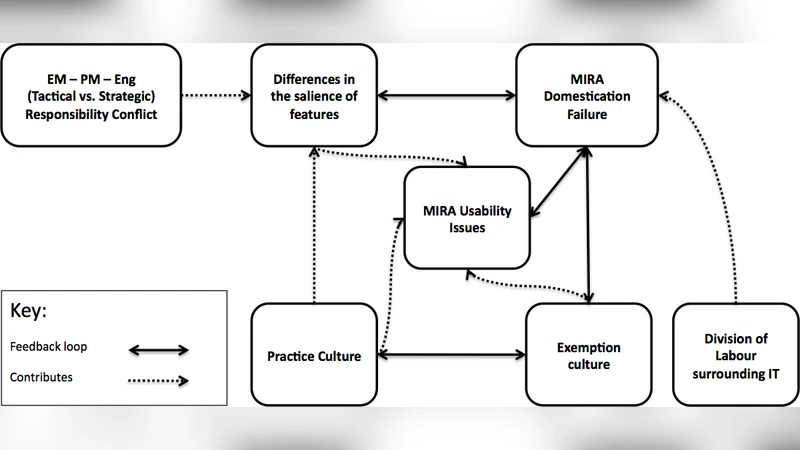
Over two decades, we and other research groups have found that ethnographic and social analyses of work settings can provide insights useful to the process of system analysis and design. Despite this, ethnographic and social analyses have not been widely assimilated into industry practice. Practitioners tend to address sociotechnical factors in an ad-hoc manner, often post-implementation, once system use or outcome has become problematic. In response to this, we have developed a lightweight qualitative approach to provide insights to ameliorate problematic system deployments. Unlike typical ethnographies and social analyses of work activity that inform systems analysis and design; we argue that analysis of intentional and structural factors to inform system deployment and integration can have a shorter time duration and yet can provide actionable insights. We evaluate our approach using a case study of a problematic enterprise document manage-ment system within a multinational systems engineering organization. Our find-ings are of academic and practical significance as our approach demonstrates that structural-intentional analysis scales to enable the timely analysis of large-scale system deployments.
💡 Research Summary
**
The paper addresses a persistent gap between academic research on ethnographic and social analyses of work settings and their adoption in industry practice. While such analyses have been shown to provide valuable insights during system analysis and design, they are rarely integrated into real‑world projects, especially after deployment when sociotechnical problems become evident. To bridge this gap, the authors propose a lightweight “structural‑intentional” analysis method that focuses on the interaction between intentional elements (subjects, mediators, objectives) and structural elements (rules, community, division of labour) as defined by the Activity Space framework.
The method is evaluated through a case study of a problematic electronic document management (EDM) system deployed in a multinational systems‑engineering corporation (referred to as “Company A”). The organization introduced EDM in the early 2000s to replace shared‑folder practices, expecting greater visibility and a unified repository for project documentation. By 2010, engineering management regarded the system as problematic, citing “sociotechnical factors.”
Data were collected via 16 semi‑structured, one‑hour interviews with stakeholders, supplemented by closed‑question scales (semantic differentials and Likert items) probing both technology acceptance constructs (performance expectancy, effort expectancy, information quality, etc.) and organizational change dimensions (role conflict, procedural justice, ownership, etc.). Interview transcripts were coded, mapped onto dialogue maps, and then organized using the Activity Space constructs to surface tensions between intentional and structural components.
Findings fall into three categories.
- Software usability issues – login separation, slow web interface, poor rendering, limited bulk upload, and inadequate search functionality frustrate users but have only a marginal impact on overall productivity or job satisfaction.
- System‑configuration issues – although EDM provides standardized folder hierarchies, users struggle to locate appropriate places for documents, leading to divergent filing practices. The absence of a built‑in document register further hampers discoverability, and network restrictions force some teams to revert to alternative sharing tools, undermining the system’s intended purpose.
- Structural‑intentional tensions – variations in community norms, unclear rules, and ambiguous role responsibilities cause teams to adopt idiosyncratic usage patterns. These patterns satisfy local work practices but conflict with management’s expectation of a “common way” of using EDM. The misalignment between structural elements (e.g., community expectations, division of labour) and intentional elements (e.g., beliefs about the system’s value) creates the core sociotechnical problem.
To remediate these tensions, the authors recommend: (a) establishing a network of “champions” who can provide informal support and advocacy; (b) developing clear, rule‑based guidelines and training for document classification and folder usage; and (c) re‑configuring the system to better align with existing work flows, including adding a document register and relaxing technical constraints where feasible.
The study demonstrates that structural‑intentional analysis can be conducted quickly (without the extensive fieldwork typical of traditional ethnographies) and can scale to large‑scale deployments. By pinpointing the specific sociotechnical mismatches that impede adoption, the approach offers actionable insights that can be implemented promptly, thereby improving the likelihood of successful system integration in complex organizational settings.
Comments & Academic Discussion
Loading comments...
Leave a Comment