A Small PRG for Polynomial Threshold Functions of Gaussians
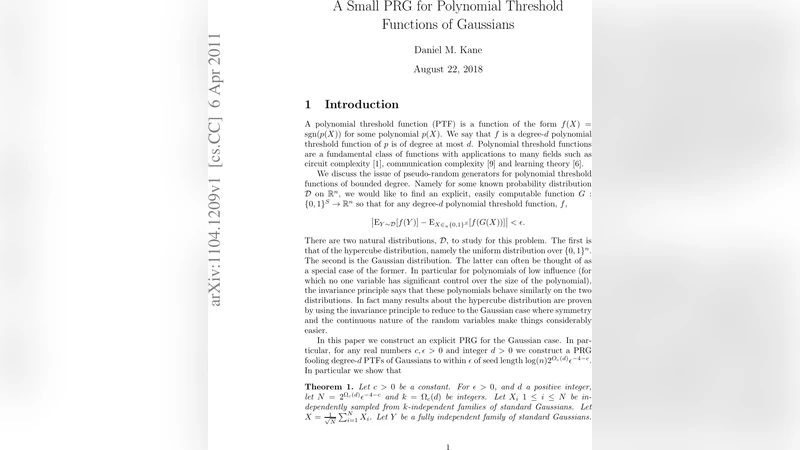
We develop a pseudo-random generator to fool degree-$d$ polynomial threshold functions with respect to the Gaussian distribution. For $c>0$ any constant, we construct a pseudo-random generator that fools such functions to within $\epsilon$ and has seed length $\log(n) 2^{O(d)} \epsilon^{-4-c}$.
💡 Research Summary
The paper “A Small PRG for Polynomial Threshold Functions of Gaussians” addresses the problem of constructing explicit pseudorandom generators (PRGs) that ε‑fool degree‑d polynomial threshold functions (PTFs) when the inputs are drawn from the n‑dimensional standard Gaussian distribution. A PTF is a Boolean function of the form f(x)=sgn(p(x)) where p is a real polynomial of degree at most d. The goal is to find a generator G:{0,1}^S→ℝ^n such that for every degree‑d PTF f, the difference between the expectation of f under the true Gaussian distribution and under the distribution induced by G is at most ε.
The main result (Theorem 1) shows that for any constant c>0, any ε>0, and any integer d≥1, one can choose integers N=2^{Ω_c(d)}·ε^{‑4‑c} and k=Ω_c(d) such that the following holds. Let X₁,…,X_N be independent samples from k‑wise independent families of standard Gaussians, and let X = (1/√N)∑_{i=1}^N X_i. Let Y be a fully independent n‑dimensional Gaussian vector. Then for every degree‑d PTF f, |E
Comments & Academic Discussion
Loading comments...
Leave a Comment