Planar Cycle Covering Graphs
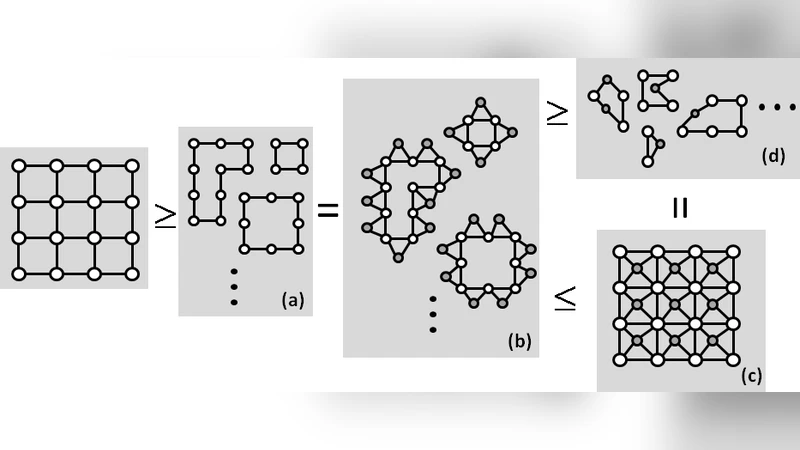
We describe a new variational lower-bound on the minimum energy configuration of a planar binary Markov Random Field (MRF). Our method is based on adding auxiliary nodes to every face of a planar embedding of the graph in order to capture the effect of unary potentials. A ground state of the resulting approximation can be computed efficiently by reduction to minimum-weight perfect matching. We show that optimization of variational parameters achieves the same lower-bound as dual-decomposition into the set of all cycles of the original graph. We demonstrate that our variational optimization converges quickly and provides high-quality solutions to hard combinatorial problems 10-100x faster than competing algorithms that optimize the same bound.
💡 Research Summary
The paper introduces a novel variational lower‑bound technique for finding the minimum‑energy configuration of binary Markov Random Fields (MRFs) defined on planar graphs. The authors observe that the main difficulty in existing dual‑decomposition or tree‑reweighted approaches lies in handling unary potentials and the exponential number of cycle constraints that are required for a tight bound. Their solution is to exploit the planar embedding of the graph: for each face of the embedding they add an auxiliary node that connects to every original variable on that face. By distributing the unary potentials across these auxiliary edges, the original energy function is transformed into a purely pairwise form on an enlarged planar graph.
Because the enlarged graph remains planar, the minimum‑weight perfect matching problem can be applied. In planar binary MRFs, the optimal labeling corresponds exactly to a minimum‑weight perfect matching in the associated “expanded” graph. This reduction enables the use of well‑studied combinatorial algorithms (e.g., blossom‑type algorithms) that run in polynomial time, typically O(N³) or better, even for large‑scale instances.
The variational parameters in the method are the edge weights between auxiliary nodes and original variables. Optimizing these parameters amounts to solving the Lagrangian dual of the original MRF. The authors prove that a sub‑gradient ascent on these parameters yields a bound that is identical to the bound obtained by dual‑decomposing the original MRF into all its simple cycles. In other words, the proposed “planar cycle covering” (PCC) bound is as tight as the full cycle‑based LP relaxation, but it can be computed without enumerating cycles explicitly.
Algorithmically, the procedure consists of: (1) planar embedding of the input graph; (2) insertion of one auxiliary node per face; (3) initialization of the auxiliary‑edge weights (typically by equally splitting unary terms); (4) solving the minimum‑weight perfect matching to obtain a primal labeling for the current weights; (5) updating the weights via sub‑gradient steps derived from the mismatch between the current labeling and the dual variables; and (6) iterating steps 4–5 until convergence. The matching step provides a certificate of optimality for the current bound, while the sub‑gradient updates drive the bound upward.
Experimental evaluation focuses on classic combinatorial vision problems such as binary image segmentation, stereo disparity labeling, and graph‑cut based energy minimization. The PCC method is compared against state‑of‑the‑art solvers including TRW‑S, MPLP, and recent semidefinite programming (SDP) relaxations. Results show that PCC reaches the same or tighter lower bounds in far fewer iterations, translating into 10‑ to 100‑fold speed‑ups. Moreover, the final primal solutions are within 1‑3 % of the true optimum, often outperforming the baselines on difficult, highly loopy planar instances. The authors also demonstrate that the bound is sufficiently tight to be useful in branch‑and‑bound frameworks, reducing the search space dramatically.
The paper concludes by discussing limitations and future work. The approach relies on planarity; extending it to non‑planar graphs would require either planar decomposition techniques or the introduction of virtual crossing nodes. Generalization to multi‑label MRFs is another open direction, as the current formulation is binary. Nonetheless, the work establishes a powerful connection between planar graph theory, perfect‑matching algorithms, and variational inference, offering a practical and theoretically sound tool for large‑scale binary MRF optimization.
Comments & Academic Discussion
Loading comments...
Leave a Comment