DirectLiNGAM: A direct method for learning a linear non-Gaussian structural equation model
Structural equation models and Bayesian networks have been widely used to analyze causal relations between continuous variables. In such frameworks, linear acyclic models are typically used to model the data-generating process of variables. Recently,…
Authors: Shohei Shimizu, Takanori Inazumi, Yasuhiro Sogawa
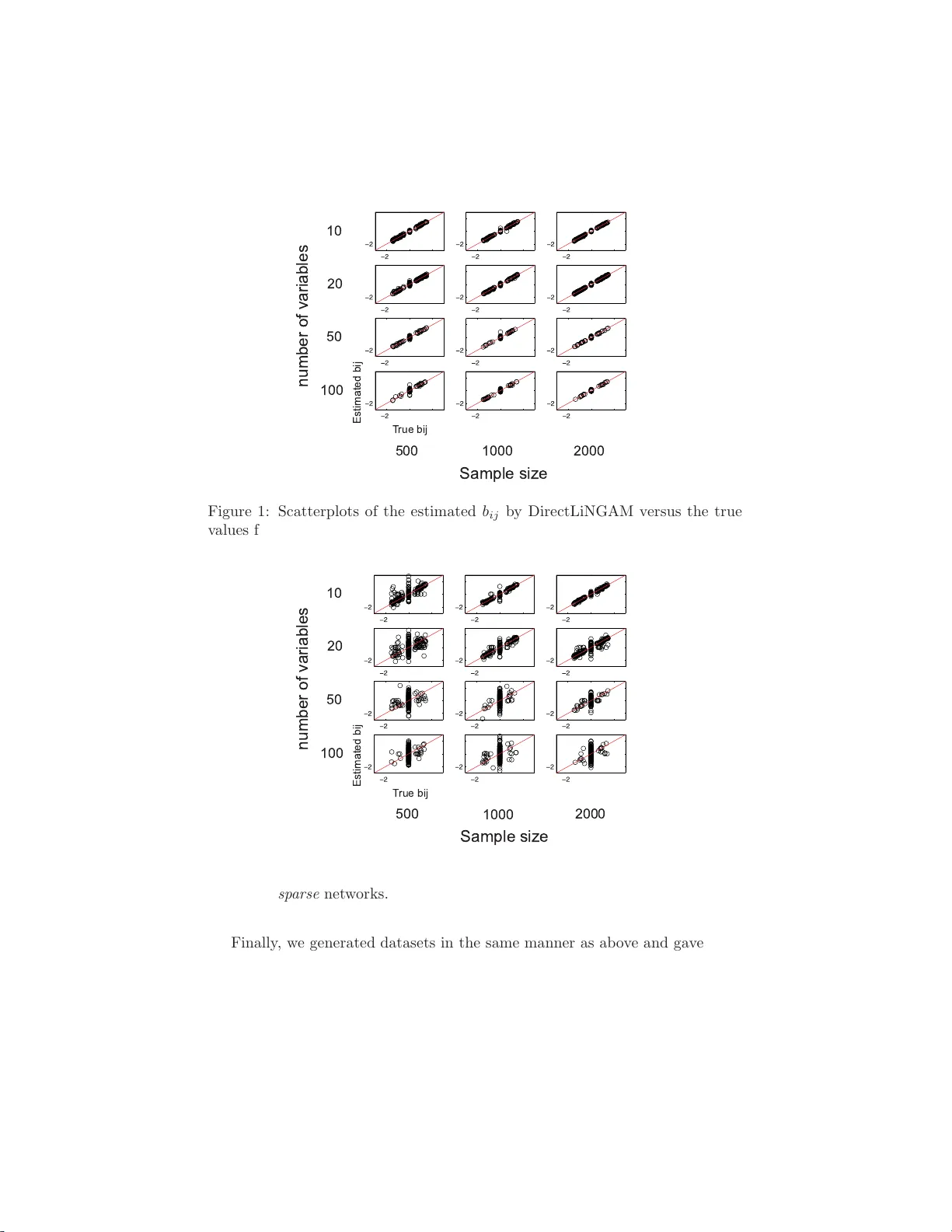
DirectLiNGAM: A direct metho d for learning a linear non-Gaussian structural equation mo del Shohei Shimizu ∗ , T ak a nori Inazumi † , Y asuhiro Soga w a ‡ , Aap o Hyv¨ arinen § , Y oshinobu Kaw ahara ¶ , T ak ashi W ashio k P atrik O. Ho y er ∗∗ , Kenneth Bollen †† , Abstract Structural equation models and Bay esian net w orks ha ve b een widely used to analyze causal relations b etw een conti nuous v ari ables. In such framew orks, linear acyclic models are typically used to mo del th e data- generating process of v ariables. Recently , it was sho wn that u se of n on - Gaussianit y iden tifies the full structu re of a linear acyclic mo del, i .e. , a causal ordering of v ariables a nd their connection strengths, without u sing any prior knowledge on th e netw ork structure, which is not the case with conv en tional metho d s. How ev er, existing estimation metho ds are based on iterativ e searc h algorithms and ma y not conv erge to a correct solution in a fi nite num b er of steps. In t h is pap er, we prop ose a new direct method to estimate a causal ordering and connection strengths based on non- Gaussianit y . In contras t to the previous metho ds, our algorithm requires no algorithmic parameters and is guaran teed to converge to the righ t solution within a smal l fix ed num b er of steps if the data strictly foll ow s the mo del. ∗ The Institute of Scientific and Industrial Research (ISIR), Osak a Univ ersit y , Mihogaok a 8-1, Ibaraki, Osak a 567-0047, Japan. Email: sshimi zu@ar.sank en.osak a-u.ac.jp † The Institute of Scientific and Industrial Research (ISIR), Osak a Univ er s it y , Mihogaok a 8-1, Ibaraki, Osak a 567-0047, Japan. Email: inazumi@ar.sanken.osak a-u.ac.j p ‡ The Institute of Scientific and Industrial Research (ISIR), Osak a Univ er s it y , Mihogaok a 8-1, Ibaraki, Osak a 567-0047, Japan. Email: sogaw a@ar.sanken.osak a-u.ac.j p § Departmen t of Computer Science, Department of Mathematics and Statistics and Helsi nki Institute for Information T echn ology , Uni versity of Helsinki, FIN-00014, Finland. Email: aapo.hyv ar inen@helsinki.fi ¶ The Institute of Scientific and Industrial Research (ISIR), Osak a Univ er s it y , Mihogaok a 8-1, Ibaraki, Osak a 567-0047, Japan. Email: k aw ahara@ar.sank en.osak a-u.ac.jp k The Institute of Scientific and Industrial Research (ISIR), Osak a Univ er s it y , Mihogaok a 8-1, Ibaraki, Osak a 567-0047, Japan. Email: washio@ar.sank en.osak a-u.ac.jp ∗∗ Departmen t of Computer Science, University of Helsi nki, FIN-00014, Finland. Email: patrik.ho ye r@helsinki.fi †† Departmen t of So ciology , CB 3210 H amilton Hall, Universit y of North Car olina, Chap el Hill, NC 27599-3210, U.S.A . Email: b ollen@unc.edu 1 1 In tro duction Many empirical sciences aim to discover and unders tand causal mechanisms underlying v a rious natura l phenomena and h uman so cial b ehavior. A n effec- tive wa y to study ca usal relationships is to conduct a co n trolled exper imen t. How ever, p erforming controlled exp eriments is often ethically imp ossible or to o exp ensive in many fields including so cial science s [1], bioinformatics [2] and neuroinformatics [3]. Thu s, it is necessary and imp orta nt to develop metho ds for causal inference based on the data that do not come from such co n trolled exp eriment s. Structural eq uation mo dels (SEM) [1] and Bay esian netw o rks (BN) [4, 5] ar e widely applied to ana lyze caus al rela tionships in many empirical studies. A line ar acyclic mo del that is a sp ecial case of SEM and BN is typically used to analyze ca usal effects b etw e en contin uo us v ariables . Estimation of the model commonly uses only the cov ar iance structure of the data and in mo s t case s can- not iden tify the full structure, i .e. , a causa l order ing and co nnection s trengths, of the model with no prior k no wledge on the structure [4, 5]. In [6], a non-Gaussia n v a r iant of SEM and BN calle d a linear no n-Gaussian acyclic model (LiNGAM) was prop osed, a nd its full str ucture was shown to be ident ifiable without pr e-sp ecifying a causal order of the v aria bles. This fea ture is a significa n t a dv antage ov er the con ven tional metho ds [4, 5]. A non- Ga ussian metho d to estimate the new mo del w as also developed in [6] and is clo sely re- lated to indep endent c o mponent a nalysis (ICA) [7]. In the subsequen t studies , the no n-Gaussian framework has b een ex tended in v a rious dir ections for learn- ing a wider v a riety of SEM and BN [8 – 10]. In what follows, we r efer to the non-Gaussian mo del a s LiNGAM and the estimation metho d as IC A- L iNGAM algorithm. Most of ma jo r ICA algorithms including [11, 12] are iterative s earch metho ds [7]. Therefore, the ICA-LiNGAM a lgorithms based on the ICA algorithms need some additiona l infor mation including initial guess and co nvergence criter ia. Gradient-based methods [11] further need step sizes. How e ver, such a lgorithmic parameters are hard to optimize in a systematic w ay . Th us, the ICA-bas e d algorithms may get stuck in lo cal optima and may not c o n verge to a reaso nable solution if the initia l guess is badly chosen [1 3]. In this pap er, we prop ose a new dire ct metho d to estimate a causal o rdering of v aria bles in the LiNGAM without prior k nowledge on the str ucture. The new metho d estimates a c a usal order of v a riables by successively reducing eac h independent comp onent fro m given data in the model, and this proc e ss is com- pleted in steps equa l to the num b er of the v ar iables in the mo del. It is no t based on iterativ e search in the p ar ameter sp ac e a nd needs no initial guess o r similar algorithmic parameters. It is guar ant e e d to conv er g e to the right so lution w ithin a small fixed n umber of steps if the data st rictly follo ws the model, i.e. , if a ll the mo del assumptions are met and the sample size is infinite. These features of the new method enable more accurate estimatio n of a causal o r der of the v aria bles in a disambiguated a nd direct pro cedure. Once the caus a l or ders of v a riables is ident ified, the co nnection streng ths betw een the v ariable s are e asily estimated 2 using some con ven tiona l cov aria nce-based metho ds s uc h as leas t squares and maximum likeliho o d appro a c hes [1]. W e also sho w ho w prio r knowledge on the structure can be incorp orated in the new metho d. The pap er is structured as follows. First, in Section 2, w e briefly r eview LiNGAM and the ICA-based LiNGAM a lgorithm. W e then in Section 3 in tro- duce a new dir ect method. The p erformance of the new method is examined by exp eriments on ar tificial data in Section 4, and exp eriments on real-world data in Section 5. Conclusions are given in Section 6. P reliminary r e sults were presented in [1 4–16]. 2 Bac kground 2.1 A linear non-Gaussian acyclic mo del: LiNGAM In [6], a non-Gauss ian v ar ian t of SEM and BN, which is called LiNGAM, w as prop osed. Assume that obs erved da ta are generated from a pro cess re presented graphically by a direc ted acyclic gr aph, i.e. , D AG. Let us represent this DA G by a m × m adjacency matrix B = { b ij } where every b ij represents the c o nnection strength from a v a riable x j to another x i in the DA G. Moreover, let us denote by k ( i ) a causa l o rder of v a riables x i in the DA G so that no la ter v aria ble determines or has a dir ected path on an y ear lier v aria ble . (A directed path from x i to x j is a sequence of directed edges such that x j is reachable from x i .) W e further assume that the relations b etw ee n v ariables a re linear. Without loss of g enerality , each obs erved v ar iable x i is assumed to hav e zero mean. Then we hav e x i = X k ( j ) 0 is the bandwidth of Gaussia n kernel. F urther let κ denote a small po sitiv e co nstan t. Then, in [22], the kernel-based estimator of mut ual informa- tion is defined a s: d M I ker nel ( y 1 , y 2 ) = − 1 2 log det K κ det D κ , (11) where K κ = " K 1 + nκ 2 I 2 K 1 K 2 K 2 K 1 K 2 + nκ 2 I 2 # (12) D κ = " K 1 + nκ 2 I 2 0 0 K 2 + nκ 2 I 2 # . (13) As the bandwidth σ of Gaus s ian kernel tends to ze r o, the p opulation co un terpart of the estimato r converges to the mutual information up to second order when it is expanded aro und distributions with tw o v aria bles y 1 and y 2 being independent [22]. The determinants of the Gr am matrices K 1 and K 2 can be efficiently 2 Matlab codes can b e do wnloaded at http: //www.di. ens.fr/ ~ fbach/ke rnel- ica/index.htm 9 computed by using the incomplete Cho lesky decomp osition to find their low- rank a pproximations of rank M ( ≪ n ). In [22], it was suggested that the p ositive constant κ and the width o f the Gaussian kernel σ are set to κ = 2 × 10 − 3 , σ = 1 / 2 for n > 1000 and κ = 2 × 1 0 − 2 , σ = 1 for n ≤ 1000 due to so me theoretical and computational considerations. In this pap er, we use the kernel-based independence mea sure. W e first ev al- uate pa ir wise indep endence b etw een a v ariable a nd ea c h of the residuals and next take the sum of the pairwise mea sures ov er the residua ls. Let us denote b y U the set of the subscripts of v a r iables x i , i.e. , U = { 1, · · · , p } . W e use the fol- lowing statistic to ev aluate indepe ndence b et ween a v ariable x j and its residuals r ( j ) i = x i − cov( x i ,x j ) v ar( x j ) x j when x i is regressed on x j : T ker nel ( x j ; U ) = X i ∈ U,i 6 = j d M I ker nel ( x j , r ( j ) i ) . (14) Many other nonparametric independence measures [23 , 24] and mo re computa- tionally simple measure s that use a sing le no nlinear correlatio n [25] hav e als o bee n pro pos ed. An y such prop osed metho d o f indepe ndenc e co uld p o ten tially be used instea d of the kernel-based measur e in E q. (14). 3.2 DirectLiNGAM algorithm W e no w prop ose a new direc t alg orithm called DirectLiNGAM to estimate a causal or dering and the connec tio n strengths in the LiNGAM (2): DirectLiNGAM alg or ithm 1. Given a p -dimensional rando m vector x , a set of its variable subscripts U and a p × n da ta matrix of the random vector as X , i n itialize an o rdered list of va riables K := ∅ and m := 1 . 2. Rep eat until p − 1 subscripts are app ended to K : (a) Perfo rm lea s t squares regressions of x i on x j for all i ∈ U \ K ( i 6 = j ) and compute the residual vector s r ( j ) and the residual data matrix R ( j ) from the d a ta matrix X for all j ∈ U \ K . Find a var iable x m that is most i ndepe n dent of its residuals : x m = arg min j ∈ U \ K T ker nel ( x j ; U \ K ) , (15) where T ker nel is the indep endence measure defined in Eq. (14). (b) App end m to the end o f K . (c) Let x := r ( m ) , X := R ( m ) . 3. App end the remaining va riable to th e end of K . 10 4. Construct a strictly lower triangular matrix B by following th e order in K , and estimate the connectio n strengths b ij by using some co nventional covariance- based regression s uch as least s qua res and maximum likeliho o d ap proaches on the original random vector x and the or iginal data matrix X . We use leas t squares regression in this pa p er. 3.3 Computational complexit y Here, we consider the computational complexity o f DirectLiNGAM compar ed with the ICA-LiNGAM with resp ect to sample size n and n umber of v aria bles p . A dominant part of DirectLiNGAM is to co mpute Eq. (14) for each x j in Step 2(a). Since it requires O ( np 2 M 2 + p 3 M 3 ) op erations [22] in p − 1 iterations, complexity of the step is O ( np 3 M 2 + p 4 M 3 ), where M ( ≪ n ) is the maximal rank found b y the low-rank decompo sition used in the kernel-based indep endence measure. Another dominant part is the regressio n to e stimate the matrix B in Step 4. The complexity of many represe ntative r e g ressions including the least square algor ithm is O ( np 3 ). Hence, we hav e a total budget of O ( np 3 M 2 + p 4 M 3 ). Meanwhile, the ICA-LiNGAM r equires O ( p 4 ) time to find a ca usal order in Step 5. Complexity of a n iteration in F as tICA pro cedure at Step 1 is k no wn to b e O ( np 2 ). Assuming a constant num b er C o f the iterations in F a stICA steps, the complexity of the ICA-LiNGAM is consider ed to be O ( C np 2 + p 4 ). Though genera l ev a luation of the r equired iteration num b er C is difficult, it can be conjectured to grow linearly with regards to p . Hence the co mplexit y of the ICA-LiNGAM is presumed t o be O ( np 3 + p 4 ). Thu s, the computationa l co s t of DirectLiNGAM w o uld b e large r than that of IC A- L iNGAM esp e cially when the low-rank approximation of the Gram ma- trices is not so efficien t, i.e. , M is lar ge. Ho wever, we note the fact that Di- rectLiNGAM has guaranteed con vergence in a fixed num ber of s teps and is of known complexit y , whereas for typical ICA algorithms including F as tICA, the run-time co mplexit y and the very convergence ar e not guarant eed. 3.4 Use of prior kno wledge Although DirectLiNGAM requires no prio r knowledge on the structure, more efficient learning can be achieved if some pr ior knowledge on a par t o f the structure is av ailable b ecause then the n umber of ca usal orders and connection strengths to be estimated gets smaller. W e present thre e lemmas to utilize prior knowledge in DirectLiNGAM. Let us first define a ma tr ix A knw =[ a knw j i ] that collects prior k no wledge under the LiNGAM (2) as follows: a knw j i := 0 if x i do es not hav e a directed path to x j 1 if x i has a directed path to x j − 1 if no pr io r knowledge is a v ailable to kno w if either of the t w o cases above (0 or 1) is true . (16) 11 Due to the definition o f exogeno us v ariables and that of prio r knowledge matrix A knw , w e readily obtain the following three lemmas. Lemma 3 Assume that the i nput data x strictly fo l lows the LiNGAM (2). An observe d variable x j is exo genous if a knw j i is zer o for al l i 6 = j . Lemma 4 Assume that the i nput data x strictly fo l lows the LiNGAM (2). An observe d variable x j is endo genous, i.e., not exo genous, if ther e exist such i 6 = j that a knw j i is unity. Lemma 5 Assume that the i nput data x strictly fo l lows the LiNGAM (2). An observe d variable x j do es not r e c eive the effe ct of x i if a knw j i is zer o. The principle of making DirectLiNGAM algorithm more a ccurate and faster based on prior kno wledge is as follows. W e first find an exog enous v aria ble by applying Lemma 3 instead of Lemma 1 if an exo genous v ariable is identi- fied based o n prior knowledge. Then w e do no t ha ve to ev aluate indepe ndence betw een a n y obser ved v ariable a nd its residuals. If no exog enous v ariable is ident ified based on prior knowledge, we next find endogenous (non-exogenous) v ariables by applying Lemma 4. Since endogeno us v ar iables are never exo g enous we can narrow down the search space to find an ex o genous v a r iable bas ed on Lemma 1. W e can further skip to compute the residual o f an observ ed v a riable and take the v a riable itself as the residual if its r egressor do es no t rec eiv e the effect of the v a riable due to L emma 5. Th us, we can decrease the num b er of causal order s and connection strengths to be estimated, and it improves the accuracy and computational time. The pr inciple can a lso be used to further an- alyze the r esiduals and find the next exog enous res idual b ecause of Corollary 1. T o implement these ideas, we only hav e to repla ce Step 2a in DirectLiNGAM algorithm by the follo wing s teps: 2a-1 Find such a variable(s) x j ( j ∈ U \ K ) that the j -th row of A knw has zero in the i -th column for all i ∈ U \ K ( i 6 = j ) and denote the set o f such va riab l es by U exo . If U exo is no t empty , set U c := U exo . If U exo is empty , find such a var iable(s) x j ( j ∈ U \ K ) that the j - th ro w of A knw has unity in the i -th column fo r at least one o f i ∈ U \ K ( i 6 = j ), denote the set of such variables by U end and set U c := U \ K \ U end . 2a-2 Denote b y V ( j ) a set of such a variable subscript i ∈ U \ K ( i 6 = j ) that a knw ij = 0 fo r all j ∈ U c . First s et r ( j ) i := x i for all i ∈ V ( j ) , next perform least squares regressions of x i on x j for all i ∈ U \ K \ V ( j ) ( i 6 = j ) and estimate the residual vectors r ( j ) and the r esidual data matrix R ( j ) from the data matrix X for al l j ∈ U c . If U c has a single va riable, set the variable to b e x m . Otherwis e, find a variable x m in U c that is most independent of the residuals: x m = arg min j ∈ U c T ker nel ( x j ; U \ K ) , (17) where T ker nel is the indep endence measure defined in Eq. (14). 12 4 Sim ulations W e first randomly gener ated 5 datasets base d on spar se net works under each combination of n umber of v ariables p and s a mple size n ( p =10, 20, 50 , 10 0; n =500 , 10 00, 2000 ): 1. W e constr ucted the p × p adjacency matrix with all z e ros and replace d every element in the lo w er-tria ngular part b y independent realizations of Bernoulli random v a riables with succe s s pro ba bilit y s similar ly to [26]. The probability s determines the sparseness of the mo del. The exp ected nu mber of adjacent v a riables of ea c h v a riable is g iven b y s ( p − 1). W e randomly set the spars eness s so that the n umber of adjac e n t v ar iables was 2 o r 5 [26]. 2. W e repla ced each non-zer o (unit y) entry in the adjacency matr ix by a v alue randomly chosen from the in terv al [ − 1 . 5 , − 0 . 5 ] ∪ [0 . 5 , 1 . 5] a nd selected v ariances of the exter nal influences e i from the interv a l [1 , 3 ] as in [27]. W e used the r e s ulting matrix as the data-g enerating a djacency ma trix B . 3. W e g enerated data with sample size n by indep endently drawing the ex- ternal influence v a riables e i from v ar ious 18 no n- Gaussian distributions used in [22] including (a) Student with 3 degr ees of free do m; (b) double exp onent ial; (c) uniform; (d) Studen t with 5 deg rees of freedom; (e) ex- po nen tial; (f ) mixture of tw o double exp onentials; (g)-(h)-(i) symmetric mixtures of tw o Gaussians: m ultimo dal, transitional and unimo dal; (j)- (k)-(l) nons ymmetric mixtures of tw o Ga ussians, multimodal, trans itio nal and unimoda l; (m)-(n)-(o) symmetric mixtures of four Gaussians: multi- mo dal, trans itional and unimo dal; (p)-(q)-(r) nonsymmetric mixtures of four Gaussians: multimodal, trans itional a nd unimo dal. See Fig . 5 of [22] for the shap es of the pro babilit y density functions. 4. The v alue s o f the observed v ar iables x i were generated according to the LiNGAM (2 ). Finally , we r andomly p ermuted the order of x i . F urther we similarly g enerated 5 data s ets based o n dense (full) net works, i.e. , full D A Gs with every pair of v a riables is co nnec ted by a directed edge, under each combination of num b er o f v ariables p and sample s ize n . Then we tested Di- rectLiNGAM and ICA-LiNGAM on the da tasets ge nerated by spars e net works or dense (full) net works. F or ICA-LiNGAM, the maximum num be r of iterations was taken as 1000 [6]. The exp eriments were conducted on a standa rd PC using Matlab 7 .9. Matlab implemen tations of the tw o metho ds are av aila ble on the web: DirectLiNGAM: ht tp://ww w.ar.sank en.osaka- u.ac.jp/ ~ inazum i/dlin gam.html ICA-LiNGAM: h ttp://w ww.cs.h elsinki.fi/group/neuroinf/lingam/ . W e computed the distance b etw een the true B and ones estimated by Di- rectLiNGAM and ICA-LiNGAM using the F robenius norm defined as q trace { ( B tr ue − b B ) T ( B tr ue − b B ) } . (18) 13 T able 1: Median distances (F robenius nor ms) betw een true B and es timated B of DirectLiNGAM and ICA-LiNGAM with fiv e replications. Sp arse net works Sample size 500 1000 2000 DirectLiNGAM dim. = 10 0.48 0.31 0.21 dim. = 20 1.19 0.70 0.50 dim. = 50 2.57 1.82 1.40 dim. = 100 5.75 4.61 2.35 ICA-LiNGAM dim. = 10 3.01 0.74 0.65 dim. = 20 9.68 3.00 2.06 dim. = 50 20.61 20.23 12.91 dim. = 100 40.77 43.74 36.52 DirectLiNGAM with dim. = 10 0.48 0.30 0.24 prior knowledge (50%) dim. = 20 1.00 0.71 0.49 dim. = 50 2.47 1.75 1.1 9 dim. = 100 4.9 4 3.89 2.27 Dense (full) net works Sample size 500 1000 2000 DirectLiNGAM dim. = 10 0.45 0.46 0.2 0 dim. = 20 1.46 1.53 1.1 2 dim. = 50 4.40 4.57 3.8 6 dim. = 100 7.38 6.81 6.1 9 ICA-LiNGAM dim. = 10 1.71 2.08 0.3 9 dim. = 20 6.70 3.38 1.8 8 dim. = 50 17.28 16.66 12.05 dim. = 100 34.95 34.02 32.02 DirectLiNGAM with dim. = 10 0.45 0.31 0.1 9 prior knowledge (50%) dim. = 20 0.8 4 0.90 0.41 dim. = 50 2.48 1.86 1.5 6 dim. = 100 4.6 7 3.60 2.61 T ables 1 and 2 s ho w the media n distances (F rob enius nor ms) and median compu- tational times (CP U times) resp ectively . In T able 1, DirectLiNGAM was b etter in distances of B and ga ve more accurate estimates of B tha n ICA-LiNGAM for all of the conditions. In T a ble 2 , the computation amount o f Dir ectLiNGAM was rather larg er than ICA-LiNGAM when the sample size was increased. A main bottleneck of computation was the kernel-based independence mea sure. How ever, its computation amo unt c a n b e considere d to b e still tracta ble. In fact, the a ctual elapsed times were approximately one- q uarter of their CPU times res pectively probably b ecause the CPU had four cor e s. Interestingly , the CPU time of ICA-LiNGAM actua lly dec reased with increased sa mple size in 14 T able 2: Median computational times (CPU times) o f Direc tLiNGAM and ICA- LiNGAM with fiv e re plications. Sp arse net works Sample size 500 1000 2000 DirectLiNGAM dim. = 1 0 15.16 sec. 37 .21 sec. 66 .75 sec. dim. = 2 0 1.56 min. 5.75 min. 17.22 mi n. dim. = 5 0 16 .25 min. 1.34 hr s . 2.70 hrs. dim. = 100 2.35 hrs. 21 .17 hrs. 19.90 hrs. ICA-LiNGAM dim. = 1 0 0.73 sec . 0.41 s e c. 0.28 s ec. dim. = 2 0 5.40 sec . 2.45 s e c. 1.14 s ec. dim. = 5 0 14.49 sec. 21 .47 sec. 32 .03 sec. dim. = 100 46 .32 sec. 58.02 s ec. 1 .16 min. DirectLiNGAM with dim. = 10 4.13 sec. 17.75 sec. 30 .9 5 sec. prior kno wledge (50%) dim. = 20 28.02 sec. 1.64 min. 4.98 min . dim. = 5 0 7.62 min. 28 .89 min. 1.09 hr s. dim. = 100 48.28 min. 1.84 hrs. 7.51 hrs . Dense (full) net works Sample size 500 1000 2000 DirectLiNGAM dim. = 1 0 8.05 sec . 24.52 sec. 4 9.44 sec. dim. = 2 0 1.00 min. 4.23 min. 6.91 min. dim. = 5 0 16 .18 min. 1.12 hr s . 1.92 hrs. dim. = 100 2.16 hrs. 8.59 hr s . 17 .24 hrs. ICA-LiNGAM dim. = 1 0 0.97 sec . 0.34 s e c. 0.27 s ec. dim. = 2 0 5.35 sec . 1.25 s e c. 4.07 s ec. dim. = 5 0 15.58 sec. 21 .01 sec. 31 .57 sec. dim. = 100 47 .60 sec. 56.57 s ec. 1 .36 min. DirectLiNGAM with dim. = 10 2.67 sec. 5.66 sec. 1 2 .31 sec. prior kno wledge (50%) dim. = 20 5.02 sec. 31.7 0 sec. 38.3 5 sec. dim. = 5 0 46.74 sec. 2.89 min. 5.0 0 min. dim. = 100 3.19 min. 10.44 min. 19.80 min. some ca ses. This is presumably due to better con vergence pr ope r ties. T o visua lize the estimation results, Figure s 1, 2, 3 and 4 give com bined scat- terplots of the estimated elements of B of DirectLiNGAM and ICA-LiNGAM versus the true ones for s parse netw o rks and dense (full) netw o rks resp ectively . The differen t plots corresp ond to different n um be r s of v ar iables and different sample sizes, where each plo t c o m bines the data for differen t adjacency matri- ces B and 18 differen t distributions of the ex ter nal influences p ( e i ). W e can see that DirectLiNGAM worked well a nd better than ICA-LiNGAM, as evidenced by the grouping o f the data p oints onto the ma in diag onal. 15 0 2 0 2 0 2 0 2 0 2 0 2 0 2 0 2 0 2 0 2 0 2 0 2 0 2 0 2 0 2 0 2 0 2 0 2 0 2 0 2 0 2 0 2 0 2 0 2 T rue bij Estimated bij 500 1000 2000 Sample size number of variables 10 20 50 100 Figure 1: Scatterplots of the es timated b ij by DirectLiNGAM v ersus the true v alues f or sp arse net works. 0 2 0 2 0 2 0 2 0 2 0 2 0 2 0 2 0 2 0 2 0 2 0 2 0 2 0 2 0 2 0 2 0 2 0 2 0 2 0 2 0 2 0 2 0 2 0 2 T rue bij Estimated bij 500 1000 2000 Sample size number of variables 10 20 50 100 Figure 2: Scatterplots of the estimated b ij by ICA-LiNGAM versus the true v alues f or sp arse net works. Finally , w e generated da tasets in the same manner as ab ov e and gave so me prior knowledge to DirectLiNGAM by crea ting prior knowledge matrices A knw as follo ws. W e first replaced ev ery non-z ero e le men t b y unit y and every diag o nal element by ze ro in A =( I − B ) − 1 and subsequently hid each of the off-dia gonal elements, i.e. , r eplaced it b y − 1, with pro babilit y 0 . 5. The b o ttoms of T ables 1 and 2 sho w the median distances and media n computational times. It was em- 16 0 2 0 2 0 2 0 2 0 2 0 2 0 2 0 2 0 2 0 2 0 2 0 2 0 2 0 2 0 2 0 2 0 2 0 2 0 2 0 2 0 2 0 2 0 2 0 2 T rue bij Estimated bij 500 1000 2000 Sample size number of variables 10 20 50 100 Figure 3: Scatterplots of the es timated b ij by DirectLiNGAM v ersus the true v alues f or dense (full) net works. 0 2 0 2 0 2 0 2 0 2 0 2 0 2 0 2 0 2 0 2 0 2 0 2 0 2 0 2 0 2 0 2 0 2 0 2 0 2 0 2 0 2 0 2 0 2 0 2 T rue bij Estimated bij 500 1000 2000 Sample size number of variables 10 20 50 100 Figure 4: Scatterplots of the estimated b ij by ICA-LiNGAM versus the true v alues f or dense (full) net works. pirically confirmed tha t use of prior knowledge gav e mor e accur ate estimates and less computatio nal times in most ca ses es pecia lly for dense (f ull) net works. The reaso n would probably b e that for dense (full) netw orks more pr ior knowl- edge ab out where dir ected paths exist were likely to b e given and it narrowed down the sea rch space more efficiently . 17 1 2 Figure 5: Abstr act mo del of the double-pendulum used in [29]. 5 Applications to real-w orld data W e here apply DirectLiNGAM and ICA-LiNGAM on real-world physics and so ciology data. Both DirectLiNGAM and ICA-LiNGAM estimate a ca usal or- dering of v ar ia bles and pr ovide a full DA G. Then we hav e tw o options to do further analysis [9]: i) Find significant directed edg es or direct ca usal effects b ij and s ig nificant total causal effects a ij with A =( I − B ) − 1 ; ii) Estimate redundant directed edg es to find the underlying D AG. W e demonstrate an exa mple of the former in Subsection 5.1 and that of the latter in Subsection 5 .2. 5.1 Application t o ph ysical data W e applied DirectLiNGAM and ICA-LiNGAM on a dataset crea ted from a ph ysical sys tem called a double-p endulum, a p endulum with another p endulum attached to its end [2 8] as in Fig. 5. The dataset was first used in [29]. T he raw data consisted o f four time series pr ovided b y Ibaraki University (Japan) filming the pendulum system with a high-spe ed video ca mer a at every 0.01 second for 20.3 s econds a nd then reading out the p osition using an image analysis s o ft w are. The fo ur v a riables were θ 1 : the angle betw een the top limb and the vertical, θ 2 : the angle b et ween the b ottom limb and the vertical, ω 1 : the angula r sp eed of θ 1 or ˙ θ 1 and ω 2 : the angular sp eed of θ 2 or ˙ θ 2 . The n umber of time points was 2035. The dataset is a v ailable on the w eb: http:/ /www.a r.sanken.osaka- u.ac.jp/ ~ inazum i/data /furiko.html In [29], some theo retical considera tions based on the do main knowledge im- plied that the angle sp e eds ω 1 and ω 2 are mainly determined by the angles θ 1 and θ 2 in both ca ses where the swing of the pendulum is sufficiently sma ll ( θ 1 , θ 2 ≈ 0) and where the swing is not very small. F urther, in practice, it was reasona ble to assume tha t there w e re no laten t confounders [2 9]. As a pre pr o cessing, we firs t remov e d the time dep endency from the raw data using the ARMA (AutoRegres sive Moving Average) mo del with 2 autore- gressive terms and 5 mo ving av era ge terms following [29]. Then we applied DirectLiNGAM a nd ICA-L iNGAM on the prepro cessed da ta. The estimated 18 Æ 1 Æ 2 Ö 1 Ö 2 Æ 1 Æ 2 Ö 1 Ö 2 DirectLiNGAM ICA-LiNGAM Figure 6: Left: The estima ted netw or k by DirectLiNGAM. Only s ignificant directed edges ar e shown with 5 % significanc e level. Right: The estimated net work by ICA-LiNGAM. No significa n t directed edges w ere found with 5% significance level. Æ 1 Æ 2 Ö 1 Ö 2 PC GES Æ 1 Æ 2 Ö 1 Ö 2 Figure 7: Left: The estimated net work b y PC alg orithm with 5% s ig nificance level. Rig h t: The estimated net work b y GES. An undirected edge b et ween t w o v ariables mea ns that there is a directed edge fro m a v ariable to the other or the reverse. adjacency matrices B o f θ 1 , θ 2 , ω 1 and ω 2 were as fo llows: DirectLiNGAM : θ 1 θ 2 ω 1 ω 2 θ 1 0 0 0 0 θ 2 − 0 . 23 0 0 0 ω 1 90 . 39 − 2 . 88 0 0 ω 2 5 . 65 94 . 64 − 0 . 1 1 0 , (19) ICA − LiNGAM : θ 1 θ 2 ω 1 ω 2 θ 1 0 0 0 0 θ 2 1 . 45 0 0 0 ω 1 108 . 82 − 52 . 73 0 0 ω 2 216 . 26 112 . 5 0 − 1 . 89 0 . (20) The estimated orderings b y DirectLiNGAM and ICA-LiNGAM w ere iden tica l, 19 but the estimated connection strengths were very different. W e further com- puted their 95% confidence in terv als b y using bo otstra pping [30] with the num- ber of b oo tstrap replicates 100 00. T he estimated netw o rks b y Dir ectLiNGAM and ICA-LiNGAM a r e g raphically shown in Fig. 6, where o nly significant di- rected edges (direct causal effects) b ij are shown with 5% significance level. 3 DirectLiNGAM found tha t the a ngle sp eeds ω 1 and ω 2 were deter mined by the angles θ 1 or θ 2 , whic h was consisten t with the domain kno wledge. Tho ug h the directed edg e from θ 1 to θ 2 might b e a bit difficult to in ter pret, the effect of θ 1 on θ 2 was e s timated to b e neg ligible since the co efficien t of deter mination [1] of θ 2 , i.e. , 1 − v ar( ˆ e 2 )/v ar( ˆ θ 2 ), was very small and w a s 0.01. (The coefficient of determination of ω 1 and that of ω 2 were 0 .46 and 0.49 re spectively .) On the other hand, ICA-LiNGAM could no t find a n y significant direc ted e dg es s ince it gav e very differen t estimates for differ e n t b o otstrap samples. F or further comparison, we also tested tw o co n ven tional methods [31, 32] based on co nditional indep endences. Fig. 7 shows the estimated netw orks by PC algor ithm [31] with 5% significance level and GE S [32] with the Gaussia nit y assumption. W e used the T e trad IV 4 to run the t wo methods. PC algo rithm found the same dir ected edge fro m θ 1 on ω 1 as DirectLiNGAM did but did not found the directed edge from θ 2 on ω 2 . GES found the same directed edge from θ 1 on θ 2 as DirectLiNGAM did but did no t find that the angle spe eds ω 1 and ω 2 were determined b y the angles θ 1 or θ 2 . W e also c o mputed the 95% confidence interv a ls of the total causa l effects a ij using b o otstrap. DirectLiNGAM found s ignificant total causa l effects fr o m θ 1 on θ 2 , from θ 1 on ω 1 , from θ 1 on ω 2 , from θ 2 on ω 1 , and fro m θ 2 on ω 2 . These significant total effects would also b e reas o nable based on similar arg umen ts. ICA-LiNGAM o nly found a significant total causal effect from θ 2 on ω 2 . Overall, although the four v ariables θ 1 , θ 2 , ω 1 and ω 2 are likely to be nonlin- early related according to the domain kno wle dge [28, 2 9], DirectLiNGAM gav e int eresting results in this example. 5.2 Application t o so ciology data W e analyzed a dataset taken fro m a s oc io logical data repo sitory on the Inter- net called General So cial Survey ( http ://www. norc.org/GSS+Website/ ). The data consisted o f six obser ved v ariables, x 1 : father’s o ccupation le vel, x 2 : so n’s income, x 3 : father’s education, x 4 : s on’s oc cupation level, x 5 : son’s educa- tion, x 6 : num b er of siblings. The sample selection was conducted based on the following criteria: i) non-farm ba c kground (ba s ed o n tw o measures of father’s o ccupation); ii) ages 35 to 44; iii) white; iv) male; v) in the lab or force at the time of the s urvey; vi) not mis s ing data for any of the cov ariates ; vii) years 1972- 2006. The sa mple size was 13 80. Fig. 8 shows domain knowledge ab out their ca usal relations [3 3]. As shown in the figure, there could b e so me latent confounders betw een x 1 and x 3 , x 1 and x 6 , or x 3 and x 6 . An ob jective o f this 3 The issue of multiple comparisons arises in this con text, which w e would lik e to study in future work. 4 http://w ww.phil.cm u.edu/projects/tetrad/ 20 Fathe r Õ s Education (x3) Fathe r Õ s Occupatio n (x1) Son Õ s Education (x5) Number of Siblings (x6) Son Õ s Occupatio n (x4) Son Õ s Income (x2) Figure 8: Sta tus attainment mo del based on domain knowledge [33]. A bi- directed edge b etw e en t wo v ariables means that the r elation is not mo deled. F or instance, there could b e la ten t co nfo unders betw een the tw o, there could b e a dir e c ted edge betw een the t wo, or the tw o could be independent. example was to see how our metho d b ehav es when such a model assumption of LiNGAM co uld b e violated that th ere is no laten t confounder . The estimated a djacency ma trices B by DirectLiNGAM a nd I CA- LiNGAM were a s follows: DirectLiNGAM : x 1 x 2 x 3 x 4 x 5 x 6 x 1 0 0 3 . 19 0 . 10 0 . 41 0 . 21 x 2 33 . 48 0 4 52 . 84 422 . 87 1 645 . 45 347 . 96 x 3 0 0 0 0 0 . 55 − 0 . 1 8 x 4 0 0 0 . 17 0 4 . 61 − 0 . 19 x 5 0 0 0 0 0 − 0 . 12 x 6 0 0 0 0 0 0 , (21) ICA − LiNGAM : x 1 x 2 x 3 x 4 x 5 x 6 x 1 0 0 0 . 93 0 − 0 . 68 − 0 . 20 x 2 50 . 70 0 − 31 . 82 200 . 84 65 . 63 336 . 04 x 3 0 0 0 0 0 . 24 − 0 . 2 7 x 4 0 . 17 0 − 0 . 40 0 − 0 . 14 − 0 . 14 x 5 0 0 0 0 0 0 x 6 0 0 0 0 − 0 . 08 0 . ( 22) W e subsequent ly pr uned re dundan t directed edges b ij in the full D AGs b y rep eatedly a pplying a sparse method called Adaptiv e Las so [34] on ea c h v a riable and its p otential pa rent s. See Appendix A for some more details of Ada ptive Lasso. W e used a matlab implemen tation in [35] to run the La sso. Then we 21 obtained the following pruned a dja c ency matrices B : DirectLiNGAM : x 1 x 2 x 3 x 4 x 5 x 6 x 1 0 0 3 . 1 9 0 0 0 x 2 0 0 0 4 22 . 87 0 0 x 3 0 0 0 0 0 . 55 0 x 4 0 0 0 0 4 . 61 0 x 5 0 0 0 0 0 − 0 . 12 x 6 0 0 0 0 0 0 , (23) ICA − LiNGAM : x 1 x 2 x 3 x 4 x 5 x 6 x 1 0 0 0 . 9 3 0 0 0 x 2 0 0 0 2 00 . 84 0 0 x 3 0 0 0 0 0 . 24 0 x 4 0 0 0 0 − 0 . 14 0 x 5 0 0 0 0 0 0 x 6 0 0 0 0 − 0 . 08 0 . (24) The estimated net works b y DirectLiNGAM a nd ICA-LiNGAM are graphi- cally shown in Fig. 9 a nd Fig. 1 0 resp ectively . All the direc ted edges estimated by DirectLiNGAM were r easonable to the domain k no wledge other than the directed e dg e from x 5 : son’s education to x 3 : father’s education. Since the sample size was la rge and yet the estima ted mo del was not fully cor rect, the mistake on the dire c ted edge b e t w een x 5 and x 3 might imply that so me mo del assumptions migh t b e more or less violated in the data. ICA-LiNGAM gave a similar estimated netw or k but did one mo r e mistak e that x 6 : n um be r of siblings is determined b y x 5 : so n’s education. F urther, Fig. 11 and Fig. 1 2 show the estimated netw orks b y PC alg orithm with 5% significa nce level and GE S with the Ga ussianity a ssumption. B oth of the conv entional metho ds did not find the directions of many edg e s . The t wo conv entional methods found a reasona ble direction of the edg e b etw een x 1 : father’s o ccupation and x 3 : father’s education, but they gav e a wrong dir ection of the edge b etw een x 1 : father’s occ upation and x 4 : so n’s o ccupation. 6 Conclusion W e presented a new es timation algorithm for the LiNGAM that ha s guara n teed conv er gence to the right s olution in a fixed num b er of steps if the data strictly follows the mo del and known computational complexity unlike most ICA meth- o ds. This is the first algor ithm spe c ia lized to estimate the LiNGAM. Simulations implied that the new metho d often provides better statistica l p e rformance than a sta te of the a rt metho d based o n ICA. In r eal-world applications to physics and so ciology , promising results were obtained. F uture w orks would include i) assessment of practical p erformance of statistical tests to detect viola tions of the mo del assumptions including tests o f indep endence [36]; ii) implementation issues of our alg orithm to impro ve the practical computational efficiency . 22 Fathe r Õ s Education (x3) Fathe r Õ s Occupatio n (x1) Son Õ s Education (x5) Number of Siblings (x6) Son Õ s Occupatio n (x4) Son Õ s Income (x2) Figure 9: The estimated net work b y Dir ectLiNGAM and Adaptive Lasso. A red so lid directed edge is reasonable to the domain kno wledge. Fathe r Õ s Education (x3) Fathe r Õ s Occupatio n (x1) Son Õ s Education (x5) Number of Siblings (x6) Son Õ s Occupatio n (x4) Son Õ s Income (x2) Figure 10: The estimated netw ork by ICA-LiNGAM and Adaptive Lasso. A red so lid directed edge is reasonable to the domain kno wledge. Ac kno wledgemen ts W e are very grateful to Hiros hi Haseg aw a (Colleg e of Scie nce, Ibar a ki University , Japan) for providing the ph ysics data and Satoshi Hara and Ayumu Y amaok a for int eresting discussio n. This work was par tially carried out at Department of Mathematical a nd Computing Sciences a nd Department of Computer Sci- ence, T okyo Institute of T e chnology , Japan. S.S., Y.K. and T.W. were partia lly suppo rted by ME XT Grant-in-Aid for Y oung Scientists #217003 02, by JSP S Grant-in-Aid for Y oung Scientists #2 080001 9 and by Grant-in-Aid for Scien- tific Res earch (A) #192000 13, resp ectively . S.S. and Y.K. were partially sup- po rted b y J SPS Global CO E program ‘Computationism as a F oundation for the Sciences’. A.H. was partially suppo rted b y the Academy of Finland Cen tre of Excellence for Algorithmic Data Analysis. 23 Fathe r Õ s Education (x3) Fathe r Õ s Occupatio n (x1) Son Õ s Education (x5) Number of Siblings (x6) Son Õ s Occupatio n (x4) Son Õ s Income (x2) Figure 11: The estimated netw ork b y PC alg orithm with 5% sig nificance lev el. An undirected edge b etw een tw o v a r iables means that there is a directed edge from a v ar iable to the other or the reverse. A r ed solid dir ected edge is reaso nable to the domain knowledge. Fathe r Õ s Education (x3) Fathe r Õ s Occupatio n (x1) Son Õ s Education (x5) Number of Siblings (x6) Son Õ s Occupatio n (x4) Son Õ s Income (x2) Figure 12 : The estimated netw o rk b y GE S. An undire cted edge b etw een tw o v ariables mea ns that there is a directed edge fro m a v ariable to the other or the reverse. A red solid directed edge is reasonable to the domain kno wledge. A Adaptiv e Lasso W e v ery briefly review the adaptive Lasso [34], which is a v aria n t of the Lasso [37]. See [34] for more details. The adaptiv e Las so is a reg ularization technique for v a riable selectio n and assumes the same data g enerating pr oce ss as LiNGAM: x i = X k ( j )
Original Paper
Loading high-quality paper...
Comments & Academic Discussion
Loading comments...
Leave a Comment